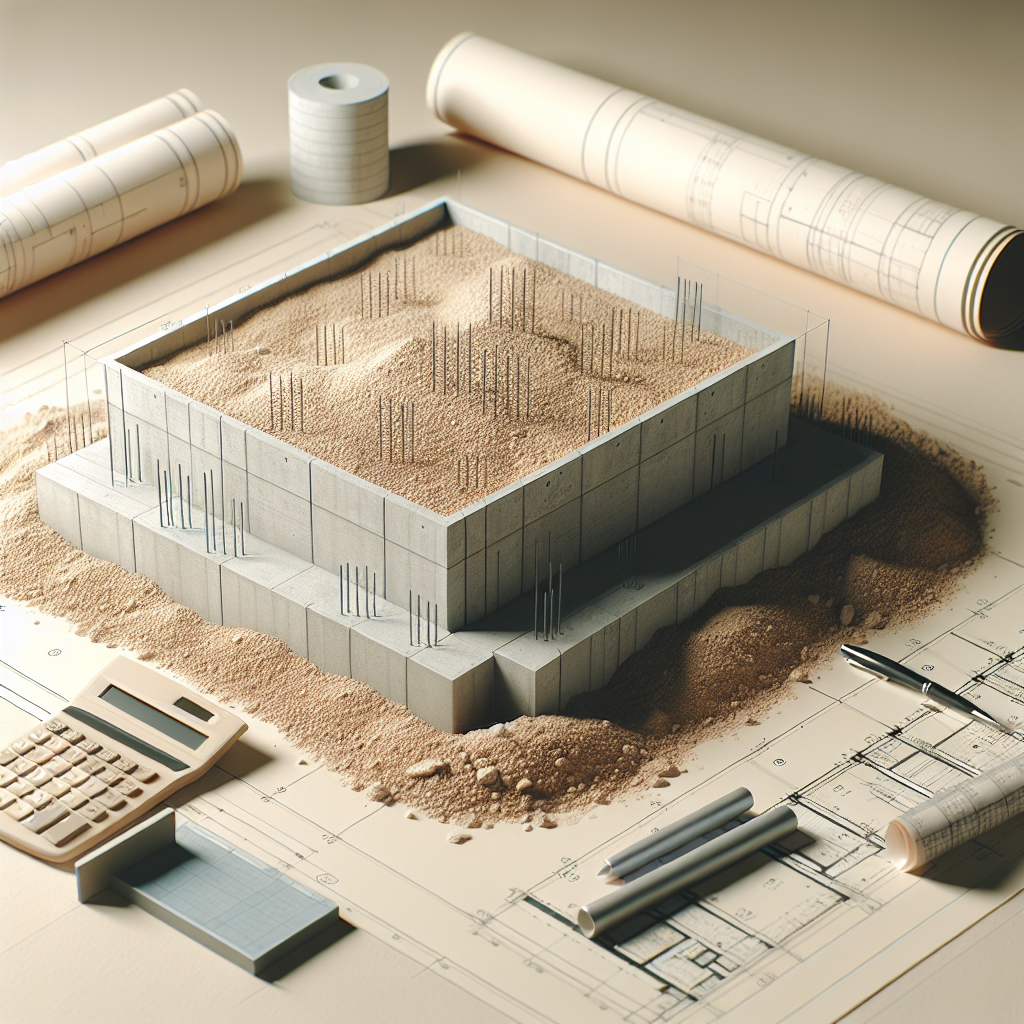
Sizing a foundation footing is one of the first practical tasks when preparing a small structure. The goal is simple: spread the building load to the ground safely without causing excessive settlement or bearing failure.
This article explains how to approach footing dimensioning in plain terms, with the math you can follow and common issues to watch for on site.
Key factors that set footing dimensions
Several variables determine how large a footing must be. Each affects the area you need to transfer loads to the soil.
Load from the structure
Start with the total vertical load the footing must carry. That includes dead loads (weight of structure and finishes) and live loads (occupancy, furniture, snow). If there are columns that transfer eccentric loads, they change how the pressure spreads under the footing.
Soil bearing capacity
The allowable bearing pressure is the soil’s capacity to carry load without excessive settlement or shear failure. Cohesive soils, sands, and rock have very different values. A conservative number often comes from local codes or a soil test report.
Safety and code factors
Design must include factors of safety and follow local rules on minimum footing depth, frost protection, and reinforcement. These rules affect size, depth, and detailing.
Step-by-step method to find footing area
Use a clear sequence: calculate loads, pick an allowable soil pressure, then derive the required area and convert that into footing dimensions.
Determine the design loads
List all loads on the footing. For a single column footing, add the column axial load and a portion of the superstructure load if applicable. Include self-weight of the footing if it is significant.
- Dead load (structure): sum of permanent weights.
- Live load (use code values): transient loads from use.
- Superimposed loads: equipment, finishes, point loads.
Choose allowable soil pressure
Use a conservative allowable bearing pressure from a geotechnical report when available. If not, consult local tables: dense sand and gravel might allow 200-300 kN/m2, soft clay much less.
Always reduce laboratory numbers to an allowable value with safety factors. Codes often include recommended values.
Basic area formula and example
The required area A is simply the total design load P divided by the allowable bearing pressure q_allow:
A = P / q_allow
Example: a column load P = 250 kN, allowable soil pressure q_allow = 150 kN/m2.
Then A = 250 / 150 = 1.667 m2. A square footing would have side length L = sqrt(A) = 1.29 m. Round dimensions up to practical sizes and check edge distances and reinforcement clearances.
Common footing types and when to use each
Choose a footing type based on load pattern, column spacing, and soil uniformity. Each type affects detailing and construction steps.
Isolated pad footing
Used under single columns carrying concentrated loads. It is simple to design using the area formula and is common in low-rise construction.
Strip footing
Used under load-bearing walls. The design considers line load per meter and width required to spread pressure to the allowable value.
Combined footing
When two columns are close to a property line or when loads are unequal, a combined footing (rectangular or trapezoidal) shares pressure more evenly.
Raft or mat foundation
When soils are weak or loads are closely spaced, a raft spreads the load across the whole area. Analysis may require plate or finite element methods for accurate pressure distribution.
Practical calculation tips and common pitfalls
Small mistakes in assumptions often lead to oversize or risky footings. These practical notes help avoid common errors.
Overestimating soil strength
Avoid optimistic soil values. If only a visual inspection is available, choose lower allowable pressures and increase footing size rather than the opposite.
Ignoring eccentricity and moments
If loads are not centered, pressure distribution under the footing becomes non-uniform. Check that maximum pressure anywhere under the footing remains below allowable values and that the uplift or tilting risk is addressed.
Settlement checks
Even if bearing capacity is safe, settlement can cause serviceability issues. For compressible soils, estimate settlement using modulus values or refer to geotechnical guidance.
Reinforcement and thickness
Footings need adequate depth to resist bending and punching shear. Minimum thickness often depends on span and cover requirements. Reinforcement should be placed to handle calculated moments and shear, not just to satisfy a rule of thumb.
Simple worked example with steps
This example walks through a basic isolated footing calculation for clarity. Numbers are rounded for demonstration.
Step 1: Gather loads
Column axial load P = 300 kN (total dead + live). No significant eccentricity assumed.
Step 2: Select soil pressure
Site has dense sand. Allowable bearing pressure q_allow = 175 kN/m2 from local tables.
Step 3: Compute area
A = P / q_allow = 300 / 175 = 1.714 m2. Choose a square footing, side = sqrt(1.714) = 1.31 m. Use practical size 1.4 m x 1.4 m to allow for reinforcement and tolerances.
Step 4: Depth and reinforcement
Estimate thickness to resist bending. For a 1.4 m span under uniform soil pressure, an initial thickness around 300 mm may be reasonable, but final depth should come from bending moment checks and punching shear checks at the column face.
Step 5: Verify edge and embedment
Ensure footing bottom is below frost depth and top maintains required cover. Check distances to property lines and adjacent footings.
Conclusion
Sizing a footing relies on a clear chain: know the loads, know what the soil can safely carry, then compute area and set practical dimensions. Small projects often use simple formulas, but conservative assumptions keep things safe.
When soil conditions are uncertain or loads are large, seek a geotechnical assessment to refine allowable pressures and settlement predictions.
Frequently Asked Questions
These common questions address practical concerns that often come up during design and site work.
How do I convert area to footing dimensions?
Compute the required area, then choose a shape. For a square footing take the square root of the area to find side length. For rectangular shapes pick a practical length and derive width as A/length.
What if the soil test shows layers with different strengths?
Use the bearing capacity of the weakest competent layer that will carry the footing load. If the weak layer is shallow, consider deeper foundations or soil improvement instead of increasing spread footing size excessively.
How much safety factor should be used on soil capacity?
Local codes typically supply factors. If no code is available, apply conservative reductions to laboratory shear values and use an allowable pressure that includes a safety margin—commonly in the range of 2 to 3 on raw strength parameters depending on soil type.
Can I just double the area if I am unsure?
Doubling area adds safety but is inefficient and may not prevent settlement in soft soils. It is better to use a reasonable allowable pressure and, where settlement is a concern, address soil improvement or deeper foundations.
When should a raft be chosen instead of isolated footings?
Choose a raft when columns are closely spaced or the soil is weak and differential settlement between isolated footings would be a problem. A raft spreads loads across the whole building footprint.
How important is checking punching shear around the column?
Punching shear can govern when footings are shallow and columns are heavily loaded. Always perform basic checks on critical sections around the column; increase thickness or provide shear reinforcement if needed.