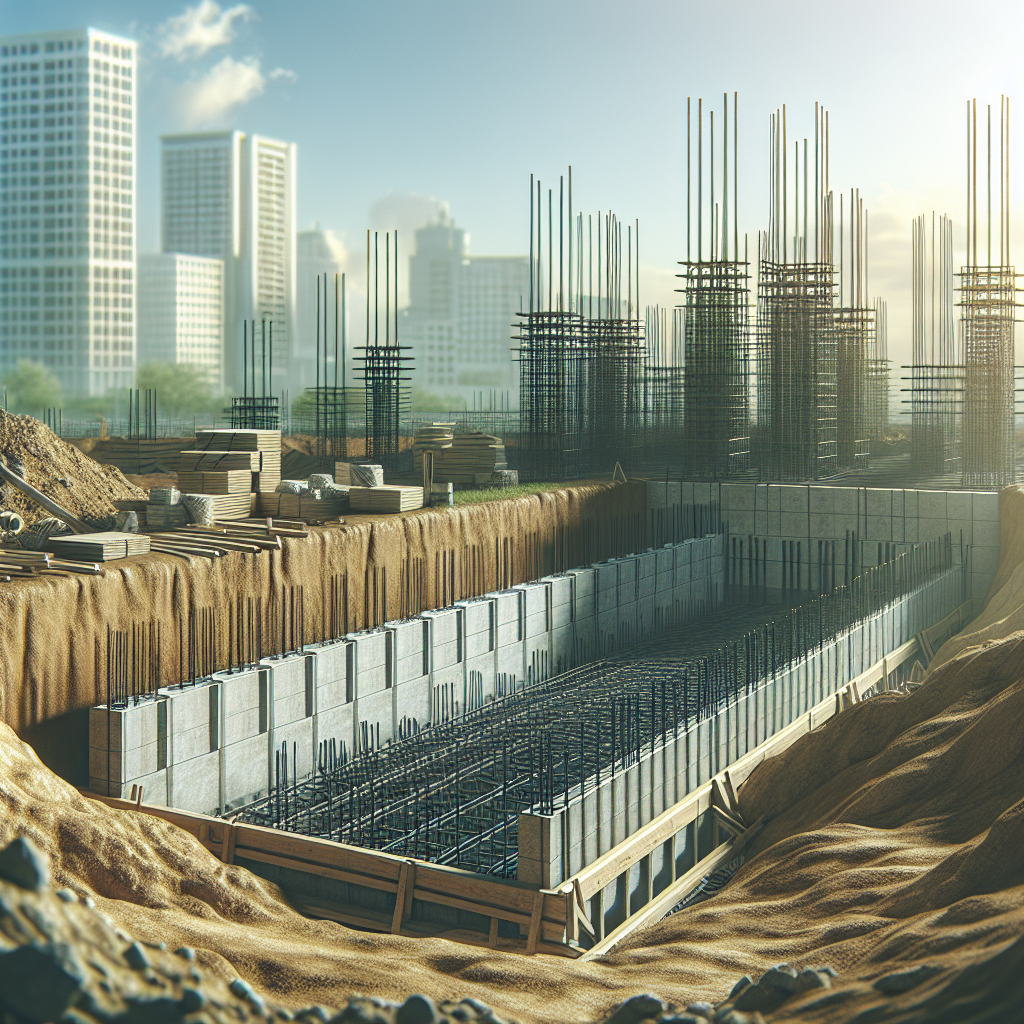
Shallow continuous footings are a common choice for low to medium load buildings where soil conditions are suitable. They distribute loads along a continuous trench below load-bearing walls and can be economical when designed and built correctly.
This article looks at the technical aspects that matter on site and in design. It breaks down soil checks, geometry, reinforcement, concrete, and common construction issues in clear, practical terms.
Basic concepts and when this solution works
Continuous footings support linear loads from walls and rows of columns. They are most effective where the bearing soil has uniform strength and the loads are modest compared with deep foundation needs.
Key advantages include simpler excavation, straightforward formwork, and easier integration with slab systems. Drawbacks appear when soils are weak, highly variable, or when differential settlement risk is high.
Load paths and bearing behavior
Load from the wall spreads through the footing into the ground. A well-designed cross section prevents local shear failure and limits settlement.
Understanding load paths helps set footing width and depth, and indicates where reinforcement must resist bending and shear.
When not to use continuous footings
They are not suitable when shallow soils are compressible, when high water tables make trench excavation unstable, or when heavy point loads demand concentrated footings or piles.
In those cases a different foundation type will be more reliable and cost effective over the long term.
Site investigation and soil considerations
Soil evaluation determines allowable bearing pressure, potential settlement, and whether trenches will stay stable during construction. A simple site study can save large costs later.
Even on small projects, basic tests such as hand auger borings, standard penetration readings, or lab grain size and Atterberg limits give useful data to size the footing.
Identifying suitable soil layers
Firm, dense sand and competent clay near the surface are preferred. Soft organic soils, peat, and loose fills need remediation before continuous footings are considered.
- Where weak layers exist, consider excavation and replacement or use a wider footing with geotextile reinforcement.
- Where groundwater is present, dewatering or deeper excavation may be necessary to reach acceptable strata.
Settlement assessment
Calculate expected settlement based on compressibility tests or published tables for common soil types. Allowable settlement limits are driven by structure tolerance.
Control differential settlement by ensuring even load distribution and consistent construction quality along the run of the footing.
Design dimensions and structural details
Dimensioning a continuous footing balances load, soil bearing capacity, and practical construction limits. Common variables are footing width, depth, reinforcement layout, and concrete cover.
Design must meet bending, shear and serviceability requirements. Simplified checks use allowable stress methods, while more rigorous cases use limit state design.
Width and depth rules of thumb
Footing width is typically set so that soil pressure under the base stays within allowable limits. For many small buildings this means a width of 600 to 900 mm, but actual values depend on load and soil.
Depth should reach below the frost line where applicable and be sufficient to develop bearing without punching or shear failure. Minimum depth also helps keep reinforcement to required cover against corrosion.
Reinforcement layout and detailing
Continuous footings need longitudinal bars to resist bending and distribution bars to control cracking. Stirrups or shear links are used where shear is critical, especially near concentrated loads like columns.
- Provide adequate lap lengths and anchorage at joints and changes in section.
- Keep bar spacing consistent and maintain minimum concrete cover per exposure class to avoid corrosion.
Materials and concrete considerations
Material choice influences durability and long-term performance. Select concrete grade, aggregate quality, and reinforcement type that match exposure conditions and structural needs.
Mix design should deliver workable concrete at the site with enough strength and durability for the footing exposure class.
Concrete strength and mix
Common strengths for footings vary but 20 to 30 MPa is typical in many regions. Where sulfate attack or aggressive ground conditions exist, use appropriate cement types and additives.
Ensure water content is controlled to reduce shrinkage and increase long term strength. Admixtures can improve workability without excess water.
Reinforcement specifications
Deformed bars are standard for bending resistance. Use corrosion-resistant reinforcement or increased cover if the site is in a coastal or chemically aggressive area.
Wire mesh can help control shrinkage cracks in the base of the footing, but it does not replace the need for main longitudinal bars.
Construction sequence and quality checks
Proper execution is as important as design. A clear sequence reduces mistakes: mark out, set levels, excavate, compact base, place blinding concrete if needed, install formwork, lay reinforcement, pour concrete, and cure.
At each stage, perform simple checks to catch deviations early. Small corrective actions at the time of construction prevent major repairs later.
Excavation and trench stability
Excavate to the planned depth and check levels frequently. Maintain stable side slopes or use temporary shoring where trenches are deep or soils unstable.
Remove any soft material at the base and replace with compacted granular fill or blinding concrete to provide a uniform support surface.
Placing and curing concrete
Place concrete in continuous runs where practical to avoid cold joints. Use vibration to consolidate and prevent honeycombing around reinforcement.
Curing is critical; keep concrete moist for at least seven days in most cases. Rapid drying increases shrinkage and cracking risk.
Inspection checkpoints
- Confirm bearing level and confirm undisturbed soil or compacted replacement before placing reinforcement.
- Verify reinforcement size, spacing, laps and cover against drawings.
- Check concrete slump, strength test cylinders, and curing regime.
Common problems and practical fixes
Issues that arise often include uneven settlement, cracking, water damage, and corrosion of steel. Early detection and simple remedies can preserve structural performance.
Address root causes such as poor compaction, inadequate depth, or wrong material selection rather than only repairing symptoms.
Settlement and uneven support
Where settlement appears uneven, first identify if it is from weak pockets of soil or from overloaded zones. Small settlements may be stabilized by grouting or underpinning in severe cases.
Preventive measures include adequate compaction and, where needed, wider footings or soil improvement before construction.
Cracking and structural distress
Hairline cracks from shrinkage are common and often non-structural. Wider cracks, step cracks, or cracks accompanied by wall movement indicate structural concern.
Repair techniques vary from epoxy injection and stitch repair to partial underpinning for more serious cases.
Moisture and corrosion control
Water ingress reduces soil strength and accelerates reinforcement corrosion. Ensure proper site drainage and consider damp proof membranes or waterproof coatings where needed.
Maintaining sufficient concrete cover and using coated or stainless steel bars in aggressive environments extends life span greatly.
Conclusion
Successful shallow continuous footings depend on matching design to site conditions and executing construction with care. Soil checks, correct sizing, proper reinforcement, and good concrete practice are the core elements.
Many common failures are avoidable with attention to compaction, drainage, curing, and protection of steel. Thoughtful planning pays off in stability and longevity of the foundation system.
Frequently Asked Questions
What minimum depth is usually required?
Minimum depth is controlled by frost protection and soil conditions. In temperate climates footings are often placed below frost depth; locally this might be 450 mm to 1 m. Also allow sufficient depth for cover to reinforcement.
How wide should a footing be for a typical load-bearing wall?
Width depends on wall load and soil bearing capacity. A simple calculation divides the wall load by allowable soil pressure to get base area. Practically, many domestic walls use widths between 600 and 900 mm but always confirm with site data.
Can continuous footings be used with basements?
Yes, but design needs to consider retained earth pressures, waterproofing, and integration with basement walls. In many cases a combined wall and footing system or separate retaining structures are used.
What inspections are most important on site?
Key checks are verification of bearing level and soil condition, correct placement of reinforcement including laps and cover, and confirming concrete quality and curing. Documenting these checks reduces later disputes.
When should soil improvement be chosen over a deeper foundation?
If weak layers are local and shallow, replacement or compaction may be economical. Where weak soils are widespread or very compressible, deeper foundations such as piles might be the safer long-term choice.