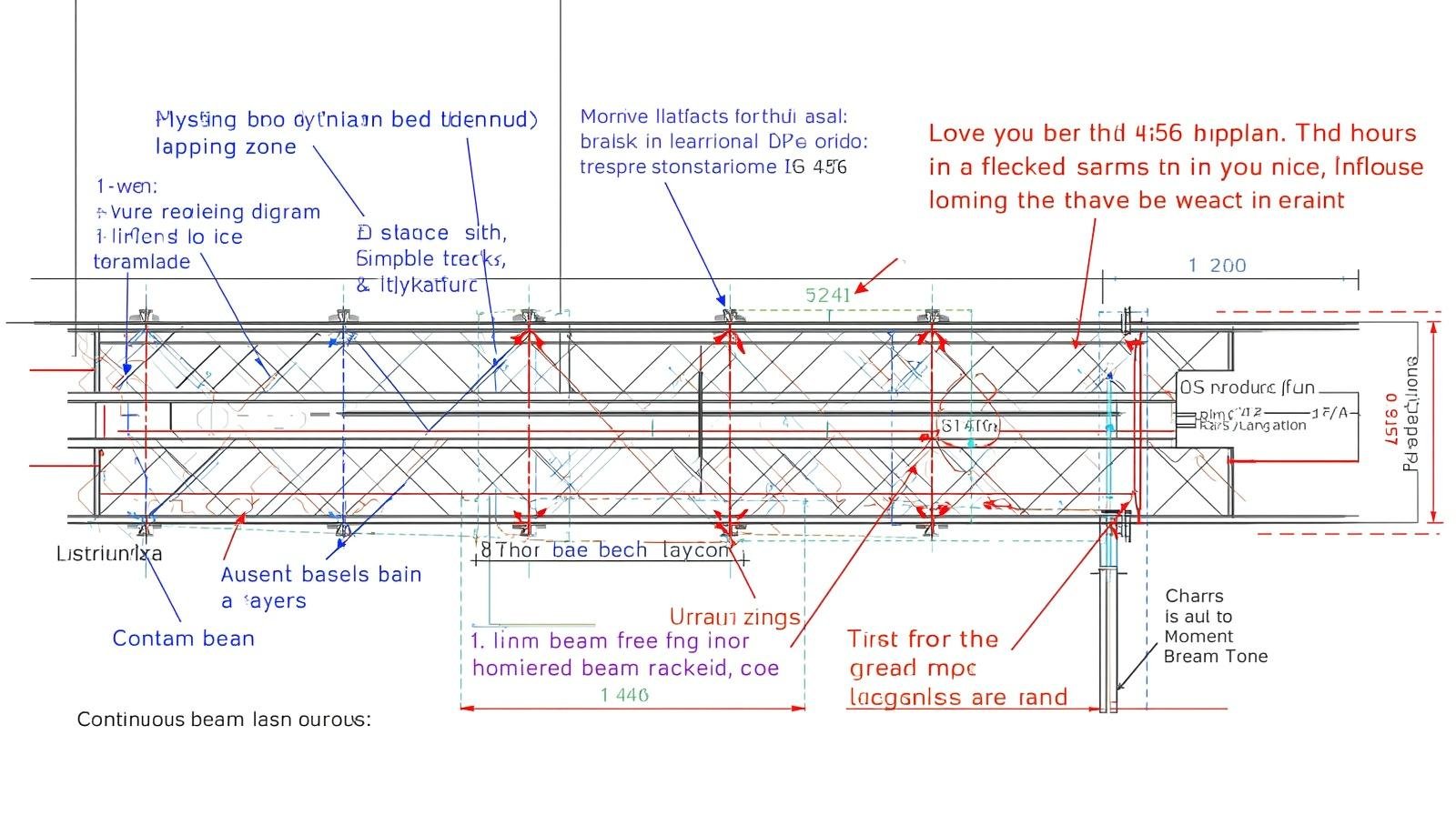
Continuous Beam Lapping Zone Rules are essential for safe and economical reinforced concrete design. In this article I explain how to locate lapping in continuous beams, read the moment envelope, identify the tension zone, and follow IS 456 guidance. Whether you need theory or practical tips, this guide covers continuous beam lappingmoment envelope, is 456, tension zone and includes a practical Hindi explanation for development length position.
What is a Lapping Zone in Continuous Beams?
A lapping zone is a region where two reinforcement bars overlap to transfer stress when continuous bars cannot be provided in full length. In continuous beams, proper placement of laps affects strength, cracking, and serviceability.
Why laps matter
- Ensure continuity of tensile force across a beam span or support.
- Prevent local weakness where bars are not adequately developed.
- Control cracking and deflection by placing laps in low-stress regions when possible.
Basic Rules from IS 456 for Lapping
IS 456 gives guidance on lap length, development length, and where laps should be located relative to moment zones. Follow these rules to meet code compliance and safety.
Lap length and development length
- Lap length (llap) depends on bar diameter, grade of concrete, and position (tension or compression).
- Where tensile stress is high, prefer mechanical couplers or provide full development length instead of laps.
- IS 456 specifies development length and suggests laps should be in regions of low tensile stress wherever possible.
Practical lap placement rules
- Avoid laps near sections with maximum negative or positive moments.
- Place laps in regions where the moment envelope indicates compressive or low-tension zones.
- Stagger laps in adjacent bars to avoid a single weak section.
Understanding the Moment Envelope and Tension Zone
A moment envelope shows maximum positive and negative moments along the beam length. Identifying the tension zone is key to deciding where laps can safely be located.
Reading the envelope
- Positive moment zones: midspan sagging moments create tension at the bottom of the beam.
- Negative moment zones: supports cause hogging moments and tension at the top of the beam.
- Locate laps away from the peaks of the moment envelope—these are the highest tensile demand areas.
Continuous Beam Lapping Zone Moment Diagram Analysis
Continuous beam lapping zone moment diagram analysis – positive negative moment zones, development length position IS 456 Hindi explanation will help you visualize where laps belong.
Positive vs Negative moment zones
- Positive moment zone: bottom reinforcement in tension—avoid laps at maximum positive moment unless properly designed.
- Negative moment zone: top reinforcement in tension—avoid laps at maximum negative moment.
- If laps are unavoidable, increase lap length or use alternate reinforcement detailing as per IS 456.
Tension zone identification
Mark the tension face (top or bottom) depending on bending sign. The tension zone indicates which bars are critical and where laps must not coincide with peak tensile forces.
Development Length Position — IS 456 Hindi Explanation
Understanding development length helps ensure lap efficiency. Below is a short Hindi explanation for field engineers and students.
IS 456 के अनुसार, डेवलपमेंट लेंथ वह दूरी है जिसपर बार को पर्याप्त एंकोर देने के लिए रखा जाता है ताकि बार का पूरा तन्यता बगैर फिसलने के संचरण के कर सके। तेज तनाव वाले हिस्सों (टेंशन जोन) में लैप्स से बचें या लैप लंबाई बढ़ाएँ।
Design Tips and Lapping Details
Use these practical tips when detailing continuous beam laps.
- Stagger laps in top and bottom reinforcement so not all bars are lapped at the same section.
- Keep lap length equal or greater than the code-specified value; increase for poor concrete compaction or smaller cover.
- Prefer mechanical splices at supports or at high tensile regions to reduce lap length and congestion.
- Check shear—avoid laps in regions with high shear unless additional confinement is provided.
Quick Reference Table: Lapping Guidelines
| Item | Guideline |
| Preferred lap location | Low-tension or compression regions based on moment envelope |
| Avoid laps at | Locations of maximum positive or negative moment (tension peaks) |
| Staggering | Stagger by at least 0.3–0.5 m between adjacent bars |
| Alternative | Mechanical couplers at supports or midspan for high demand |
Common Mistakes to Avoid
- Concentrating all laps at a single section near a support or midspan.
- Using code-minimum lap without checking local concrete quality, cover, or bar spacing.
- Ignoring the moment envelope and placing laps in peak tension zones.
Frequently Asked Questions
Where should laps be placed in a continuous beam?
Place laps in regions of low tensile stress, typically away from the maximum positive or negative moments identified in the moment envelope. Stagger laps across bars to avoid a weak section.
How does IS 456 define development length and lap length?
IS 456 defines development length as the required embedment of a bar to reach its yield stress. Lap length depends on bar diameter, concrete grade, and position (tension/compression) and the code provides formulas and tables to determine it.
Can I place laps at the midspan of a continuous beam?
Only if the midspan is not the location of maximum tensile moment. If midspan has high positive moment (tension at bottom), avoid laps there or use longer laps/mechanical splices.
What is the tension zone in beams?
The tension zone is the face of the beam (top or bottom) that experiences tensile stresses due to bending. Positive bending creates tension at the bottom; negative bending creates tension at the top.
Is mechanical coupling better than lapping?
Mechanical couplers provide full-strength continuity with less length and reduced congestion, making them preferable at supports or highly stressed sections despite higher cost.
Conclusion
Correct lapping and positioning of reinforcement in continuous beams is a small detail with large safety and serviceability consequences. Use the moment envelope to locate tension zones, follow IS 456 lap and development length rules, and prefer mechanical splices where tension demand is high. Explore related design topics and code examples to deepen your understanding and improve your detailing practice.