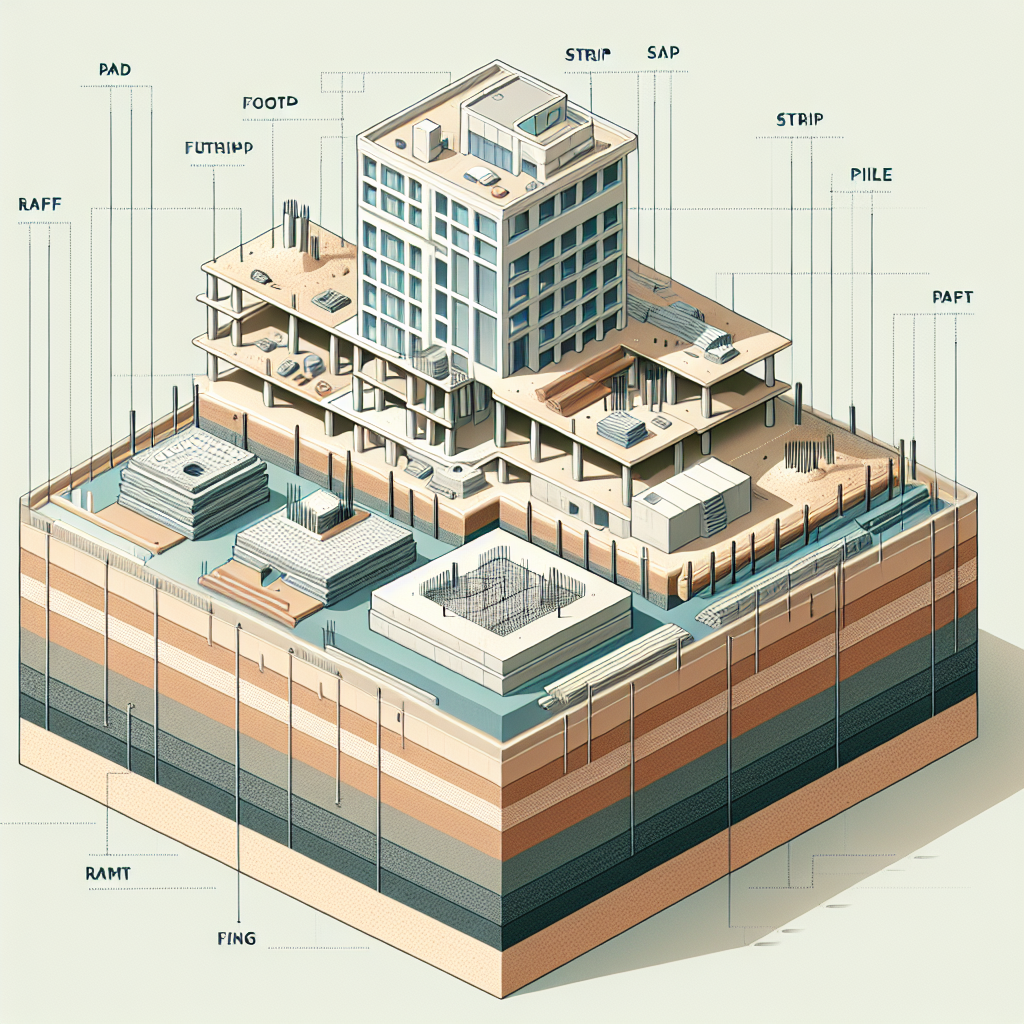
Strong foundations begin below ground, where the right footing keeps a structure safe and long-lasting. This article walks through common footing styles, why each is chosen, and the practical factors that shape those choices.
The aim is to clarify how footings work with soil, loads, and site conditions so you can understand what type makes sense for a given project. Short explanations and clear comparisons help make complex choices easier.
Why footings matter
Footings spread structural loads to the ground, preventing excessive settlement and ensuring stability. They are the link between a building and the soil beneath it.
Choosing the right type affects cost, construction time, and long-term performance. The wrong choice can lead to costly repairs, uneven floors, or structural distress.
Load distribution essentials
Footings distribute weight from columns, walls, or entire structures across a larger soil area. The goal is to keep soil stresses below its safe bearing capacity.
Different footings handle loads differently. Point loads call for pad footings or piles, while linear loads often use strip footings.
Soil and site interaction
Soil type, depth to firm strata, and groundwater all influence footing choice. Sandy soils behave differently from clays, and bearing capacity varies with moisture.
On sloping sites or where soft layers exist near the surface, deeper solutions like piles or caissons may be necessary.
Common types of footing
Several footing types are widely used in building work. Each has strengths, typical uses, and construction considerations.
Below are short descriptions and the main pros and cons to help compare them quickly.
Isolated (pad) footing
Isolated footings support single columns and are square, rectangular, or circular pads of reinforced concrete. They are often used in low-rise buildings with regular column grids.
- Pros: Simple to design and construct, cost-effective for moderate loads.
- Cons: Not suitable when columns are closely spaced or when soil bearing capacity is low.
Combined footing
Combined footings serve two or more columns when they are close together or when an edge column needs support that a single pad cannot provide. They are typically rectangular or trapezoidal.
- Pros: Balances load to prevent differential settlement between columns.
- Cons: Requires more concrete and reinforcement, design is slightly more complex.
Strip footing
Strip footings run continuously under load-bearing walls. They are shallow and distribute linear loads from walls to the ground.
- Pros: Economical for continuous walls in uniform soil conditions.
- Cons: Not ideal where wall loads concentrate or soil is weak near the surface.
Raft (mat) footing
A raft or mat footing is a large concrete slab covering the whole building footprint. It spreads loads across a wide area and reduces differential settlement risks.
- Pros: Effective where individual footings would overlap or in poor soils; reduces excavation depth variability.
- Cons: Higher material and formwork costs; requires careful reinforcement layout.
Pile footing
Piles transfer loads through weak near-surface soils down to firmer layers or bedrock. They come in driven, bored, or screw forms, using concrete, steel, or timber.
- Pros: Suitable for high loads and problematic soils; can reach great depths.
- Cons: Higher cost, needs specialized equipment and testing.
Caisson (drilled shaft) footing
Caissons are deep cylindrical shafts cast in place to support heavy loads when shallow footings are inadequate. They behave similarly to piles but are larger in diameter.
- Pros: Handle very heavy loads and are ideal where lateral resistance matters.
- Cons: Construction can be complex and time-consuming; suitable equipment required.
Design considerations and selection criteria
Choosing the right footing involves many factors beyond just building weight. Designers weigh soil, load, cost, and site constraints together.
Understanding these criteria helps explain why one footing type is selected over another in specific situations.
Soil bearing capacity and investigation
A thorough soil investigation is the starting point. Standard penetration tests, bore logs, and lab tests define bearing capacity and potential settlement.
Low bearing capacity often pushes designs toward larger shallow footings or deep foundations like piles.
Type and magnitude of loads
Vertical loads, eccentricity, uplift, and lateral forces all shape footing geometry and reinforcement. Heavy columns may need isolated footings with thickened pads or piles.
Dynamic loads from machinery or seismic forces also influence detailing and connection to the superstructure.
Water table and drainage
High groundwater raises construction challenges and can reduce effective soil strength. It may require dewatering, waterproofing, or switching to deeper foundations.
Drainage around the foundation and proper surface grading reduce long-term moisture-related issues.
Settlement limits and neighboring structures
When neighboring buildings exist, limiting differential settlement becomes critical. Stiffer foundation systems, like rafts or piles, help control movement.
Monitoring and staged construction can prevent damage to adjacent properties.
Constructability and site access
Site constraints, available equipment, and labor skills can limit the viable options. Remote or tight sites might rule out large piling rigs, steering the design toward shallower solutions.
Local availability of materials and the contractor’s experience also affect both cost and schedule.
Materials and common construction methods
Concrete and steel are the most common materials in foundation work. Proper mix, reinforcement, and workmanship are essential for durability.
Construction methods vary by type and site, and each method has practical considerations to ensure quality.
Concrete mix and reinforcement
Footings typically use concrete with specified strength, often between 20–40 MPa depending on design demands. Reinforcement controls cracking and distributes tensile forces.
Proper placement, consolidation, and curing of concrete are crucial. Poor curing can reduce strength and increase long-term shrinkage issues.
Excavation and formwork
Shallow footings require correct excavation depth and compacted bedding. Formwork must be stable to hold concrete shape until it gains strength.
Temporary shoring and safe access need attention on deeper excavations to protect workers and adjacent structures.
Pile installation methods
Piles can be driven, bored, or helical. Driven piles offer immediate capacity through skin and end bearing, while bored piles are formed in place and can be larger in diameter.
Choice depends on noise, vibration limits, site access, and the presence of obstructions underground.
Quality control and testing
Field tests like pile load tests, plate bearing tests, and inspections of reinforcement and concrete help confirm design assumptions.
Monitoring during construction catches issues early, reducing the risk of costly fixes later on.
Conclusion
Footing selection combines technical data, site realities, and practical experience. From simple pad footings to deep piles, each type serves a clear purpose based on soil, load, and access.
Careful investigation, sensible design choices, and good construction practices make foundations reliable and long-lasting, protecting the structure above for decades.
Frequently Asked Questions
Common queries often focus on when to use each footing type and what risks to watch for during construction.
What determines whether shallow or deep footings are needed?
The key factors are soil bearing capacity and the depth of competent strata. If near-surface soils are weak or compressible, deep footings like piles or caissons transfer loads to stronger layers below.
How does groundwater affect foundation choice?
High groundwater can decrease soil strength and complicate excavation. It may require dewatering, waterproofing measures, or switching to deeper foundations that bypass saturated layers.
When is a raft slab a better option than isolated footings?
A raft is preferred when loads are spread across many columns, when columns are close, or when soil is weak but uniform. It reduces differential settlement compared to many isolated pads.
Can damaged footings be repaired without rebuilding?
Minor damage from settlement or cracking can sometimes be repaired with underpinning, grouting, or localized strengthening. Severe failure often requires more extensive measures and careful assessment.
Are driven piles noisy and disruptive?
Driven piles create vibration and noise, which can be significant in urban areas. Alternatives like bored piles or screw piles reduce vibration but may increase cost or require different equipment.