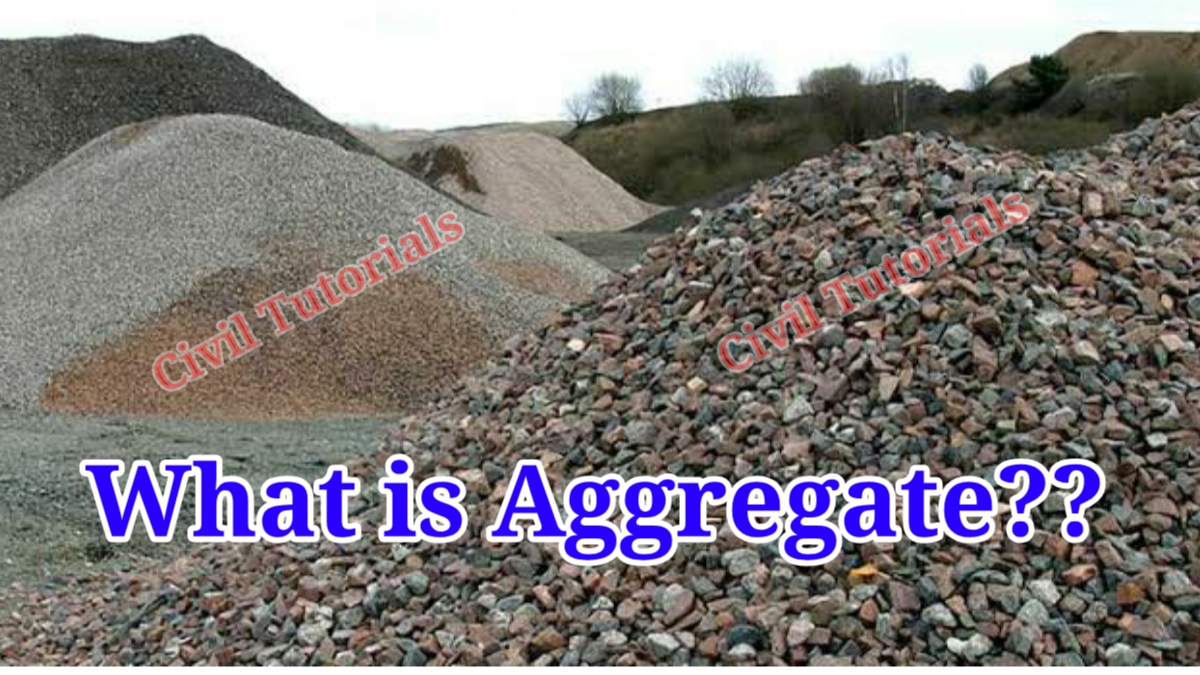
Aggregates are granular materials used in concrete, road construction, railway works and other civil engineering applications. They may be obtained from natural sources, manufactured by crushing rock, or produced from approved recycled materials. Their properties—including particle size, shape, grading, strength, durability and cleanliness—affect the performance of the construction material in which they are used. This article explains the main types and uses of aggregate.
Aggregates form the bulk of many concrete and pavement mixtures. In concrete, they provide dimensional stability and contribute to strength, stiffness, abrasion resistance and durability, while also helping control cost. Their proportion varies with the mix design and aggregate characteristics; there is no single percentage that applies to every concrete mix.
Types of aggregate
There are two types of Aggregate.
Coarse Aggregate
Coarse aggregate is the fraction predominantly retained on the 4.75 mm IS sieve. Common nominal maximum sizes used in concrete include 10 mm, 20 mm and 40 mm, but the selected size depends on the member dimensions, reinforcement spacing, placing method and mix design. Aggregate is classified by sieve analysis; it is not defined only by whether the material is crushed stone.

Fine Aggregate
Fine aggregate is the fraction predominantly passing the 4.75 mm IS sieve, such as natural sand or manufactured sand. Its grading is determined by sieve analysis, and the amount of material finer than the 75-micron sieve is controlled by the applicable specification. Fine aggregate is therefore not defined as material that must be entirely retained on the 75-micron sieve.
Grade of aggregate
Aggregate grading describes the distribution of particle sizes determined by sieve analysis. Common descriptive terms include well-graded, uniformly or narrowly graded, and gap-graded; terminology and acceptance limits depend on the relevant standard and application.
- Well-graded: Contains a suitable range of particle sizes, with smaller particles filling spaces between larger particles.
- Uniformly graded: Contains particles within a relatively narrow size range.
- Gap-graded: Has one or more particle-size ranges missing or present in very small proportions.
Sieve Size for Grading of Aggregates
Coarse aggregates: Sieve analysis may use a suitable set of IS sieves such as 80 mm, 40 mm, 20 mm, 10 mm, 4.75 mm and intermediate sizes, depending on the nominal size and grading being tested. Use the sieve series and grading limits specified by the applicable standard and project documents.
Fine aggregates: Common sieve sizes used for fine-aggregate grading include 4.75 mm, 2.36 mm, 1.18 mm, 600 microns, 300 microns and 150 microns. The required sieve series and grading limits should be taken from the applicable standard and project specification.
Uses of aggregate
- In concrete, coarse and fine aggregates form the granular skeleton. Fine aggregate helps fill spaces between coarser particles and contributes to workability and finish, while both fractions influence strength, dimensional stability and durability when properly graded and proportioned.
- Aggregate is use in road construction for provide stability and mass. In this type construction mostly use of coarse and fine both aggregate.
- Its also use for railway projects.
1 thought on “What is aggregate, Types of aggregate and uses”