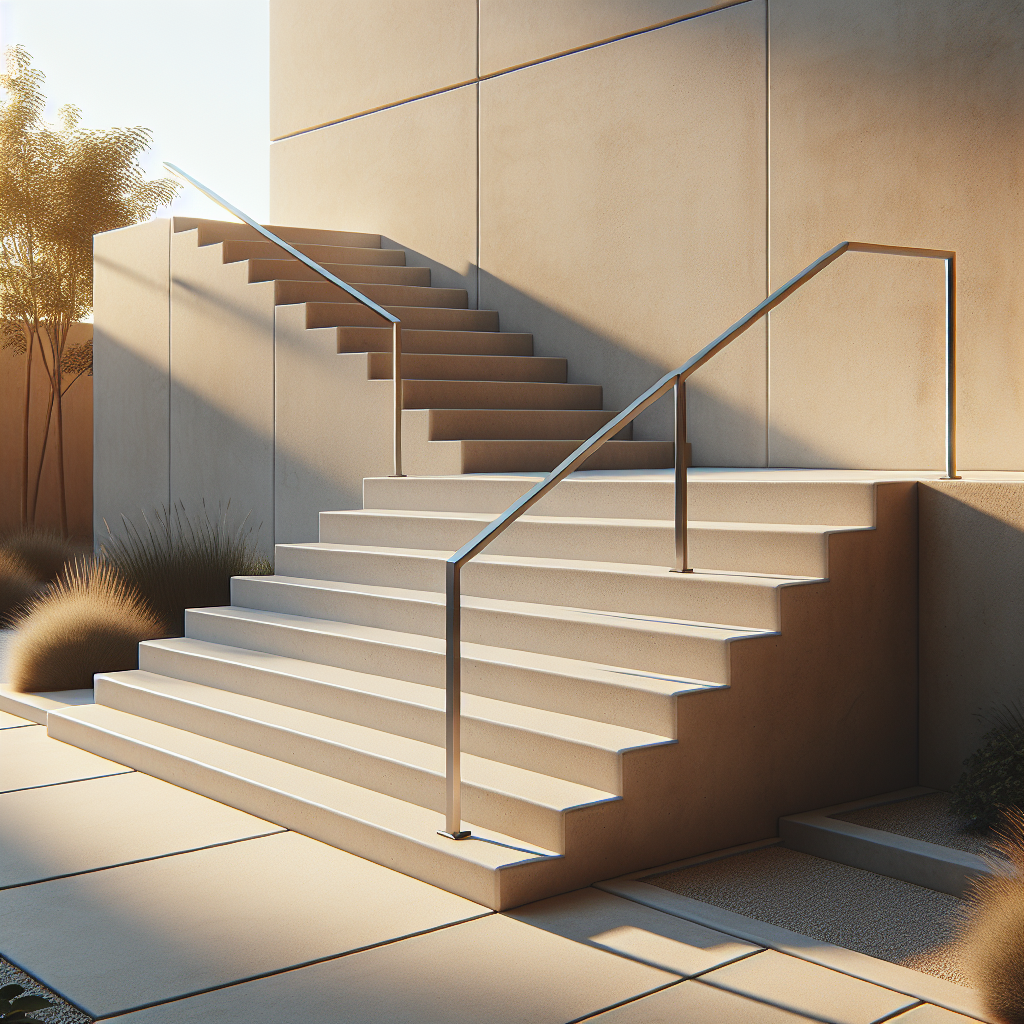
Concrete steps are a long-lasting way to connect levels, accent an entrance, or stabilize a slope. They can be shaped, textured, and finished to suit nearly any outdoor setting while resisting wear and weather.
This article explains common types, proven construction sequences, measurement norms, and maintenance approaches that help steps perform well for years. Read on for clear, practical explanations that you can use when planning or assessing a stair project.
Materials and common types
Choosing the right type starts with the site, expected use, and speed of installation. Two widely used approaches are precast units and cast-in-place steps. Each has tradeoffs in cost, customization, and installation time.
Precast concrete steps
Precast steps arrive ready-made from a factory or yard. They are ideal where consistent quality and fast installation matter. A crane or lift is used to set each unit into place on a prepared base.
- Advantages: predictable finish, quick installation, factory curing for strength.
- Limitations: less flexible in shape, transport and lifting logistics, need solid foundation and accurate layout.
Cast-in-place steps
Cast-in-place means building formwork on site and pouring concrete where the steps will remain. This method gives more freedom to match the slope and unique geometry of a site.
- Advantages: custom fits, on-site adjustments, continuous structure that ties into surrounding slabs.
- Limitations: longer cure time, more on-site labor, weather sensitivity during placement.
Materials and mix choices
Concrete mix strength of 3000–4000 psi is common for exterior steps. Additives like air-entrainment improve freeze-thaw resistance in cold climates.
Reinforcement is usually welded wire mesh or rebar to control cracking and add tensile capacity. Stainless steel or epoxy-coated bars help where deicing salts are used.
Construction methods and sequence
Building concrete steps follows a logical sequence: site prep, setting forms or units, placing reinforcement, pouring or setting, finishing, and curing. Attention at each stage reduces later problems.
Site preparation and base
Start with solid ground and proper drainage. Remove loose soil, compact the subgrade, and place a granular base if needed. A stable base prevents settlement and keeps steps level over time.
Formwork and alignment
For cast-in-place work, formwork must be rigid and accurately set to the planned rise and tread dimensions. Well-built forms produce clean edges and consistent riser heights.
- Check lines and levels repeatedly before pouring.
- Include temporary supports to resist the weight of wet concrete.
Reinforcement and embedded items
Place mesh or rebar so it sits near the middle or upper third of the slab thickness to resist tension. Anchor any embedded items such as handrail posts or light fixtures before pouring.
Overlap bars per standard practice and use chairs or spacers to keep reinforcement from touching the subgrade.
Pouring, finishing, and curing
Pour in a controlled way to avoid cold joints and segregated mix. Consolidate the concrete with vibration or rodding as appropriate for the element size.
Finish the treads with a non-slip texture. Common approaches include broom finish, exposed aggregate, or integral slip-resistant additives. Proper curing—keeping the concrete moist for several days—boosts durability and strength.
Design, measurements and safety considerations
Comfort and safety depend on consistent riser height, adequate tread depth, and good drainage. Small variations in riser height can cause trips, so consistency is essential.
Rise and run best practices
Typical riser heights range around 6 to 7.5 inches, with tread depths often between 10 and 12 inches for outdoor steps. A widely used comfort target is to keep 2R + T near 24 to 25 inches, where R is riser height and T is tread depth.
Uniformity is key: keep each riser within small tolerances of the others to avoid missteps.
Nosing, tread finish and slip resistance
Nosing should be visible and offer a small overhang to improve footing. Avoid sharp overhangs that can trip users or chip prematurely.
For finishes, choose textures that shed water and provide grip. Broomed finishes, anti-slip coatings, or coarse aggregates exposed on treads reduce slip risk when wet.
Drainage, joints and freeze-thaw details
Prevent standing water by providing a slight pitch on treads or ensuring lateral drainage. Water pooling accelerates surface wear and freeze-thaw damage.
Include control joints to direct cracking where it can be managed. Use expansion joints where steps abut rigid structures to accommodate movement without stress transfer.
Handrails, lighting and accessibility
Handrails add safety, especially on longer runs or where elevation change is steep. Anchors should be integrated into the concrete or into dedicated sleeves placed during forming.
Lighting along the run and on landings helps visibility at night and reduces trip risk. Position lights to avoid glare while clearly illuminating each tread.
Conclusion
Concrete steps offer durability and design flexibility when materials, measurements, and construction steps are aligned with the site conditions. Choosing the right type and paying attention to reinforcement, drainage, and surface finish keeps steps safe and long-lived.
Whether using precast units or casting in place, accuracy in layout, proper curing, and routine care are the easiest ways to prevent common problems like cracking, settlement, or slippery surfaces.
Frequently Asked Questions
What are the main advantages of precast steps?
Precast units provide consistent finish and strength from factory curing, and they speed installation. They reduce on-site finishing time but require accurate foundations and lifting equipment.
How deep should each tread be for comfortable outdoor use?
Many outdoor treads fall in the 10–12 inch range. This width balances a comfortable stride with space constraints. Combine tread depth and riser height so that 2R + T is near 24–25 inches for good ergonomics.
How can I reduce cracking in cast-in-place steps?
Good subgrade preparation, proper mix design, correct reinforcement placement, and timely control joints lower crack risk. Adequate curing prevents rapid moisture loss that often leads to shrinkage cracks.
What finishes work best in wet or icy climates?
Textured finishes such as broomed surfaces, exposed aggregate, or slip-resistant coatings perform well. Air-entrained concrete mixes and stainless or coated reinforcement also help resist freeze-thaw damage.
How often should outdoor concrete steps be maintained?
Inspect steps annually. Look for hairline cracks, spalling, or drainage issues. Clean debris, reseal surfaces as needed, and address small repairs early to avoid larger problems down the line.
1 thought on “Design, Build, and Maintain Safe Concrete Steps Outdoors”
Comments are closed.