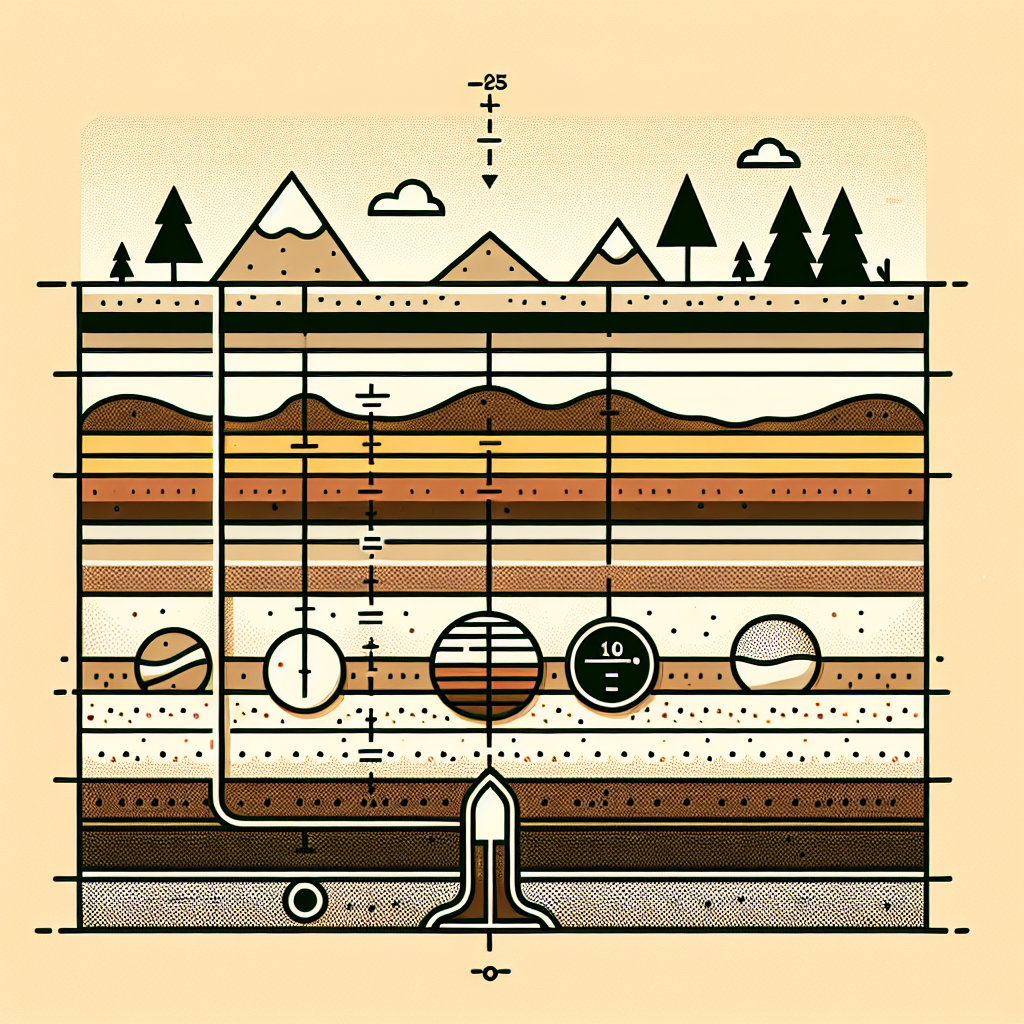
Knowing how much load the ground under a foundation can safely carry is a core step in planning any structure. A clear understanding of soil capacity cuts risk, helps size footings, and avoids costly repairs later.
This article explains what controls load capacity, summarizes common calculation approaches, and walks through a worked example. The aim is simple, practical clarity so readers can assess shallow foundation sizing with confidence.
Understanding soil load capacity
Soil load capacity is a measure of the maximum pressure a ground layer can carry before it fails or settles excessively. It is not a single number but depends on the soil type, depth, moisture, and the shape and size of the foundation.
Two related terms are often used: ultimate capacity, which is the soil pressure at failure, and allowable capacity, which reduces the ultimate value by a safety factor to limit risk and settlement.
Types of failure to consider
There are three common failure modes under shallow foundations: shear failure (soil yields and collapses), excessive settlement (deformation causes serviceability problems), and tilt or rotation (uneven support causes instability). Each mode can control the design depending on soil and loading conditions.
Ultimate vs allowable values
Ultimate capacity refers to the theoretical limit when soil strength is fully mobilized. Allowable capacity is what designers use and is the ultimate value divided by a factor of safety. Typical safety factors range from 2 to 3 for bearing calculations, often higher where uncertainties are large.
Key factors that control capacity
Several site variables strongly influence how much load a patch of ground can support. Identifying these early helps choose the right calculation method or decide if deeper investigation is needed.
Below are the most important factors to check before running numbers.
Soil type and strength
Granular soils (sands and gravels) derive strength from internal friction. Cohesive soils (clays) hold together through cohesion and effective stress. Strength parameters commonly used are cohesion (c) and friction angle (phi).
Depth and groundwater
Deeper foundations often sit on denser or stiffer material, increasing capacity. A high groundwater level reduces effective stress and lowers capacity, so adjust calculations when water is present near the foundation level.
Footing size and shape
Wide footings spread load and usually gain more capacity than narrow ones. Rectangular, circular, and strip footings each have different shape factors that change the bearing result. Edge effects matter when footings are close to the ground surface.
Load type and eccentricity
Concentric vertical loads are simplest to analyze. Eccentric or inclined loads create nonuniform pressure under the footing and reduce usable capacity. Always check the pressure distribution and adjust allowable values if loads are offset.
Common calculation approaches and an example
Over time, several analytical methods have been developed. They use soil parameters and footing geometry to estimate ultimate capacity. Below are widely used approaches with notes on where each works best.
After the method summaries, a step-by-step example shows how to apply a classic formula to get both ultimate and allowable values.
Terzaghi’s classical approach
Terzaghi’s formula is simple and widely used for shallow strip footings on homogeneous soils. It combines cohesion, effective overburden pressure, and friction effects through bearing capacity factors.
The method applies well to small, shallow footings on relatively uniform material. Corrections exist for depth, shape, and inclination, but the base form helps check orders of magnitude quickly.
Meyerhof’s method
Meyerhof expanded Terzaghi’s work to include shape and depth factors more explicitly and to handle different footing shapes. It often predicts slightly higher capacities because of added correction terms.
This approach is useful when dealing with square or circular footings or when the footing depth is not negligible compared to its width.
Skempton’s approach for clays
Skempton focused on cohesive soils and provided simplified estimates for undrained strength conditions. For soft clays where shear strength does not depend on confining pressure, Skempton’s method gives practical results with fewer parameters.
It is especially handy when only undrained shear strength is available from lab tests like the vane shear or UU triaxial.
Worked calculation: a simple strip footing
Problem data: consider a strip footing 1.0 m wide on a sandy layer. Soil friction angle phi = 30 degrees, cohesion c = 0 kPa (clean sand), unit weight gamma = 18 kN/m3, footing depth D = 0.5 m. Water table is well below foundation.
Using a common formula for ultimate bearing capacity q_ult = c*Nc + q*Nq + 0.5*gamma*B*Ngamma, where q is the effective overburden at footing base and Nc, Nq, Ngamma are bearing factors that depend on phi.
Step 1 — compute overburden pressure q: q = gamma * D = 18 * 0.5 = 9 kPa.
Step 2 — select bearing factors for phi = 30 deg. Typical values are Nq ≈ 18.4, Nc ≈ 30.1, Ngamma ≈ 22.4.
Step 3 — insert values: q_ult = 0*30.1 + 9*18.4 + 0.5*18*1.0*22.4 = 165.6 + 201.6 = 367.2 kPa (approx).
Step 4 — allow a safety factor. If a factor of safety of 3.0 is chosen, allowable bearing capacity q_allow = q_ult / FS = 367.2 / 3 = 122.4 kPa.
Interpretation: a 1.0 m wide strip footing can safely carry about 122 kPa vertical pressure without expecting shear failure under the assumptions used.
Checking settlement risk
Even if shear strength is adequate, settlement may still limit allowable load. Settlement estimates require stiffness parameters like Young’s modulus or an empirical relationship based on soil type and density.
A quick check compares expected settlement under service load to allowable limits (often <25 mm for many structures). For conservative designs, if settlement is uncertain then use a lower allowable pressure or increase footing size.
Conclusion
Estimating load capacity at a foundation level combines soil properties, geometry, and judgment. Analytical formulas offer quick estimates, while lab and field tests refine results where uncertainty is high.
Always check both strength and settlement, adjust for groundwater and eccentric loads, and select a safety factor that reflects site conditions and acceptable risk.
Frequently Asked Questions
Below are short answers to common queries related to foundation pressure and soil behavior.
What information is needed to calculate soil bearing strength?
Basic inputs are soil type, cohesion and friction parameters (or undrained strength), unit weight, footing size and depth, and groundwater location. Site investigation data improves accuracy.
When should field testing be done?
Field testing is necessary when soil conditions are variable or when large or critical structures are planned. Common tests include standard penetration tests (SPT), cone penetration tests (CPT), and plate load tests.
How does a high water table change results?
A high water table reduces effective stress and can lower bearing capacity significantly. Buoyancy reduces soil weight, and pore water pressures can weaken the soil during loading.
Is a higher safety factor always better?
Higher safety factors reduce risk but can lead to larger, more expensive foundations. Balance safety against cost, uncertainty, and the consequences of failure. Use higher factors when data is limited or consequences are severe.
Can the same method be used for all soils?
No. Methods vary by soil behavior. Terzaghi and Meyerhof work well for many granular soils and mixed conditions, while Skempton’s approach is often better for soft clays under undrained conditions. Choose a method that matches the dominant soil behavior and available data.