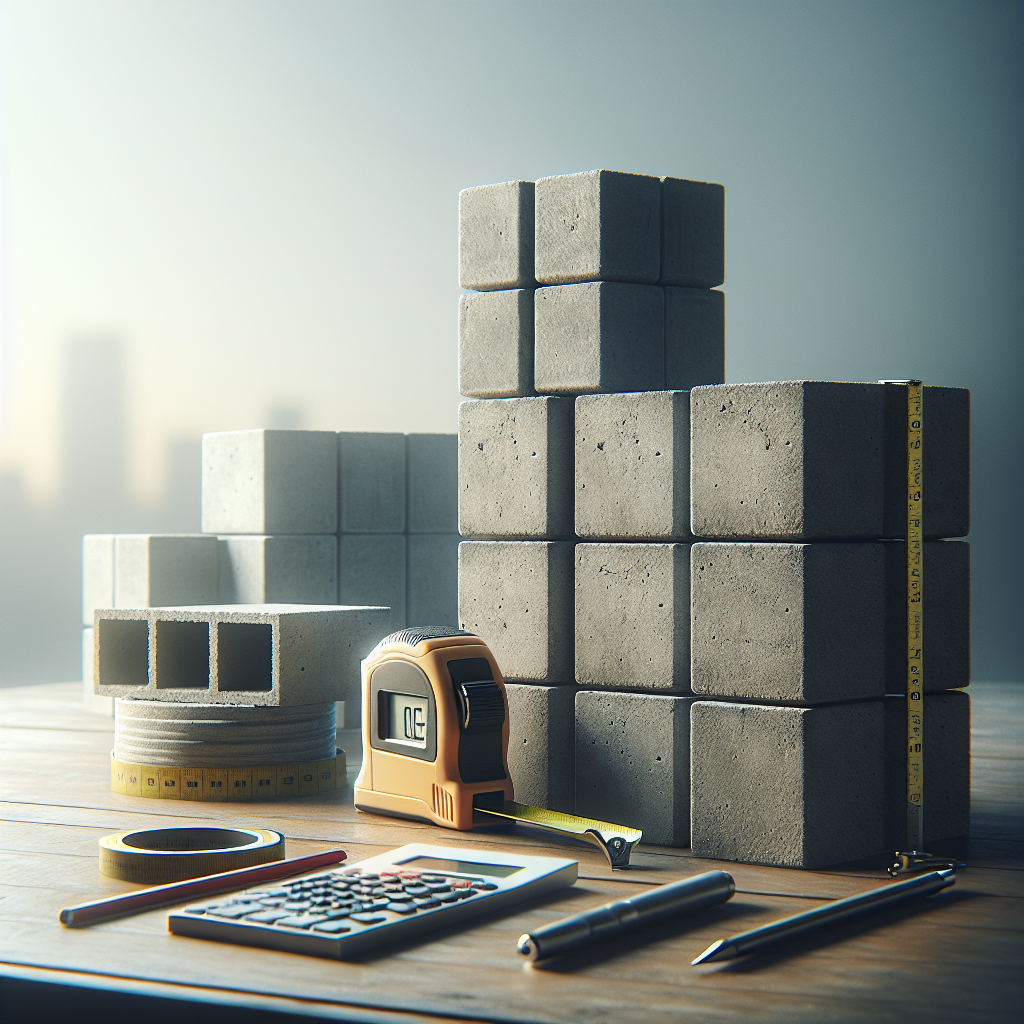
Estimating how many concrete blocks a wall or structure needs can feel tricky at first, but a few straightforward methods make it predictable. This article breaks down the math and practical adjustments you should use when planning materials.
You’ll find clear steps to convert measurements into block counts, how mortar joints and cuts change totals, plus common block sizes and useful checks to reduce errors and waste.
Why precise block estimates matter
Running out of blocks mid-project delays work and often increases cost because small orders are pricier and cause downtime. Over-ordering ties up money and storage space while raising the risk of damage.
Accurate estimates help set realistic budgets, order the right quantities, and reduce unnecessary handling. A consistent method saves time when comparing suppliers or planning multiple walls.
Cost and material control
Knowing the exact block count lets you compare prices per unit and spot outliers in supplier quotes. It also clarifies how much mortar and reinforcement you’ll need.
Time and waste reduction
Estimating with a small margin for cuts and breakage prevents last-minute trips. It also reduces leftover stock that must be moved or disposed of later.
Simple math methods to estimate blocks
There are two common approaches: the area method and the volume method. Each works well in different situations and both are quick once you know the block size and wall dimensions.
Pick the one that matches your data: if you know wall length and height, use area. If you must account for thickness and openings precisely, volume is safer.
Area method (quick count)
This method is ideal for standard single-layer walls without complex cavities. It treats the wall as a flat area and divides by the face area of one block.
- Measure wall length and height in metres or feet.
- Multiply to get wall area.
- Divide by the face area of a block (block length x block height).
- Add a wastage percentage (commonly 5–10%).
Example: a 10 m long, 2.4 m high wall has 24 m2 area. If a block face is 0.39 m x 0.19 m (0.0741 m2), divide 24 by 0.0741 = ~324 blocks. Add 7% = ~347 blocks.
Volume method (wall thickness included)
Use this when walls have varying thickness, cavities, or heavy reinforcement. Work in cubic metres or cubic feet so mortar and block volume are both accounted for.
- Calculate wall volume: length x height x thickness.
- Find the net volume of one block (length x height x width) excluding cores if needed.
- Divide wall volume by block volume and add allowance for mortar and cutting.
This method is more accurate for double-skin walls or when block cores reduce actual material volume.
Layout and openings adjustment
Always subtract areas of doors, windows, and large openings before dividing by block face area. Small openings under 0.5 m2 often get included in a general wastage percentage instead of subtracted individually.
For repetitive openings, tally the exact number of blocks removed and subtract from the total.
Block sizes, mortar joints and wastage
Blocks come in several standard sizes. Mortar joint thickness and the need to cut around openings make a difference, so use realistic joint widths and account for cut pieces.
Wastage depends on skill, block type, and cutting complexity. Use lower percentages for simple straight walls and higher for decorative patterns or lots of small openings.
Common block sizes
Typical concrete block dimensions (length x height x width):
- Standard: 390 x 190 x 190 mm (face area 0.0741 m2)
- Half-size: 190 x 190 x 190 mm
- Longer formats: 440 x 215 x 100 mm (used in some regions)
Always confirm actual block dimensions with the supplier because nominal and finished sizes can differ by region.
Mortar joints and how they affect counts
Mortar joints typically range from 8 to 12 mm. When you include joints, the effective face area of a block increases, reducing block count slightly compared to raw block dimensions without mortar.
For accurate results measure a small portion of built wall to verify how joint thickness affects the average course height and block spacing.
Allowing for cuts, breakage and off-cuts
Include an allowance for cutting and breakage that suits the job complexity. Common practice is 5–10%:
- 5% for long straight runs with few corners.
- 7–10% for walls with many openings, curved sections, or decorative work.
Keeps leftover cut pieces usable by planning where to place them in the layout instead of discarding immediately.
How to use a concrete block calculator effectively
A calculator is only as good as the inputs you provide. Gather accurate wall dimensions, block size including mortar, and a clear list of openings before you start.
Use the calculator results as a baseline, then apply practical checks and rounding rules to create a workable order quantity.
Essential inputs to collect
Before using a calculator, note:
- Wall lengths and heights, to nearest 10 mm or 1/8 inch.
- Block nominal size and actual finished size.
- Planned mortar joint thickness.
- List of openings with their dimensions and positions.
- Desired wastage percentage based on complexity.
Interpreting results and rounding rules
Calculators usually return decimals. Round up to whole blocks, then add your wastage percentage. If the result is close to a batch size offered by a supplier, consider ordering in that batch size to lower unit cost.
Also check truck or pallet limits; some suppliers sell blocks by the pallet, so ordering exact pallets can be efficient.
Validating numbers on-site
Always cross-check calculated counts with a quick manual check on a short wall section. Lay out a single course physically or mark it on the wall to confirm the number of blocks per metre or foot.
That sample confirms mortar joint behavior, reveals measurement errors, and helps adjust the total before placing an order.
Practical tips to avoid common estimation mistakes
Small measurement errors multiply across long walls. Use consistent units and double-check conversions. Treat mixed units (feet and metres) with caution and convert before calculating.
Account for corners and bond patterns early. Stretcher and header placements may change the number of blocks in each course, especially near openings.
Measure twice, calculate once
Take two independent measurements of the same wall. If they differ, resolve the discrepancy before calculating. Small rounding in multiple places adds up fast.
Plan for the entire build sequence
Consider masonry accessories that affect ordering: lintels, reinforcement, ties, and flashings aren’t blocks but influence the net block area.
Mark where these items sit and subtract their footprint to avoid overestimating block needs.
Store and protect ordered blocks
Blocks should be kept off the ground, on flat pallets, and covered if rain is expected. Damaged stock should be accounted for in wastage once delivered.
Conclusion
Estimating block quantities becomes routine with clear measurements and one reliable method. Whether using area or volume calculations, include mortar joints, openings, and a sensible wastage allowance.
Double-check figures on-site and coordinate orders with supplier packaging to save time and money. Small preparations reduce surprises during the build.
Frequently Asked Questions
Below are concise answers to common questions about block estimation and practical calculation issues.
How do I calculate block count for a wall with windows?
Measure the full wall area, subtract the combined area of windows and doors, then divide by block face area. For many small openings, subtracting individually is best; for a few small vents, include them in the wastage allowance.
What percentage should I add for wastage?
Use 5% for straight runs and experienced workers, 7–10% for complex layouts with many cuts, and increase slightly if handling or storage risks are high.
Should mortar thickness be included in block size?
Yes. Use the finished size including mortar when applying the area method. Mortar makes courses taller and slightly changes the effective face area of the block.
Is it better to estimate by area or volume?
Use area for single-layer walls with consistent thickness. Use volume when thickness varies, cores matter, or when calculating mortar and reinforcement precisely.
How do I adjust for pallet or delivery sizes?
Check the supplier’s pallet quantity and round orders to full pallets when possible. This often reduces cost and avoids partial pallet handling fees.