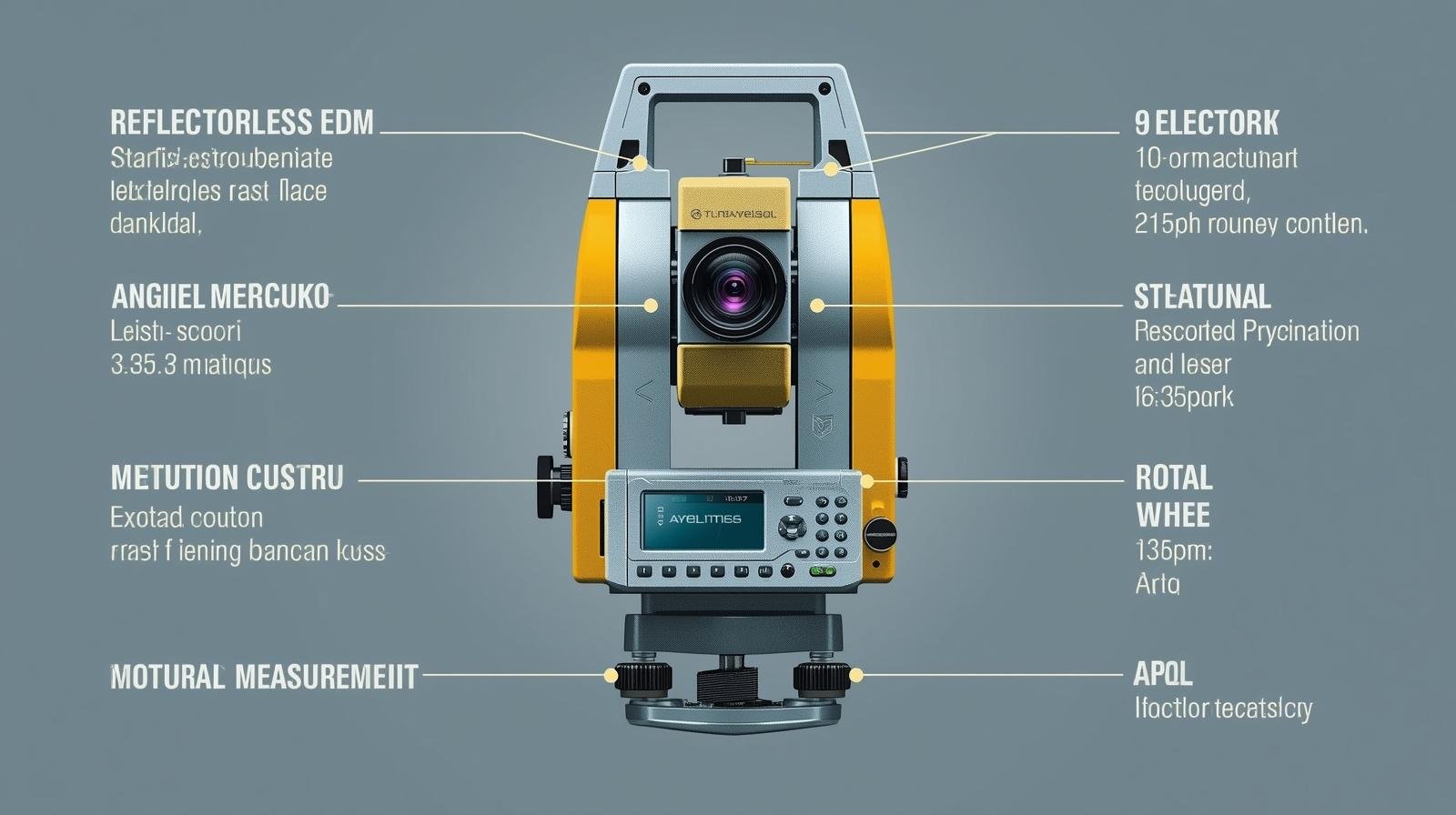
Understanding the Total Station Least Count Specification is essential for surveyors and engineers. In this guide you’ll learn what total station least count means, how angular and reflectorless EDM accuracy specs affect real-world work, and practical tips—including a short Hindi guide. This article covers Total Station Least Count Specification, total station least count, least countedm angular, reflectorless, accuracy specs, and the wider topic: Total station least count and accuracy specification – reflectorless EDM angular measurement details, practical applications
What is Least Count and Why It Matters
Least count is the smallest increment a total station can measure. It defines resolution for angles and distances. A better (smaller) least count gives finer measurements. But resolution alone doesn’t guarantee overall accuracy.
- Angular least count: often in seconds (e.g., 1″, 5″, 10″).
- Distance least count: often in millimeters or centimeters (e.g., 1 mm, 5 mm).
Always pair least count with accuracy specs to judge instrument performance.
Angular Measurement: Details and Practical Notes
How angular least count works
Angular least count is about how finely the instrument reads horizontal and vertical angles. Common settings include 1 second (high precision), 5 seconds, or 10 seconds. Smaller numbers mean higher angular resolution.
Factors that affect angular accuracy
- Instrument quality and optics
- Collimation and calibration
- Environmental conditions (wind, temperature, refraction)
- User handling and prism/target stability
Reflectorless EDM and Accuracy Specs
Reflectorless EDM (Electronic Distance Measurement) lets you measure to surfaces without a prism. This is valuable for hard-to-reach spots. Reflectorless measurements often have slightly lower accuracy than prism measurements.
Typical accuracy specs
Manufacturers express accuracy in formats such as ±(2 mm + 2 ppm) for prism mode and ±(3 mm + 3 ppm) for reflectorless mode. These combine a fixed term and a distance-proportional term (ppm = parts per million).
| Parameter | Typical Value |
| Angular least count | 1″ to 10″ |
| Angular accuracy | 1″ to 10″ (manufacturer dependent) |
| Distance accuracy (prism) | ±(1–3 mm + 1–2 ppm) |
| Distance accuracy (reflectorless) | ±(3–5 mm + 2–5 ppm) |
Note: These are representative ranges. Always consult the specific instrument’s specification sheet for exact figures.
Interpreting Specs: Least Count vs Accuracy
Least count is resolution. Accuracy combines instrument precision, systematic errors, and environmental effects. A small least count helps read fine changes, but true measurement quality depends on calibrated accuracy.
- High resolution (small least count) improves readability of small differences.
- High accuracy (small error terms) gives reliable absolute measurements.
- Good surveying practice balances both: choose an instrument whose specs suit your job.
Practical Applications and Field Tips
When to prioritize reflectorless mode
- Measuring facades, rooftops, or hazards where placing a prism is unsafe.
- Quick checks and asset surveys where speed matters.
When to use prism mode
- High-accuracy control surveys.
- Long distances where reflectorless noise increases with range.
Field best practices
- Calibrate and level the instrument before each job.
- Use multiple backsights or redundant measurements for control.
- Record environmental conditions and apply refraction or temperature corrections if required.
- Keep the instrument clean and optics free from dust.
Practical Examples
Example 1: For topographic mapping near buildings, use reflectorless EDM with a good reflectorless accuracy spec. Expect slightly higher scatter than prism readings but gain speed and safety.
Example 2: For geodetic control, use prism measurements and high angular precision (1″ or better). Combine repeated observations to average out random errors.
Calibration, Maintenance, and Verification
Regular calibration keeps angular and distance measurements reliable. Simple station checks include:
- Two-face measurements to detect collimation errors.
- Comparing known baseline distances to instrument readings.
- Checking vertical circle index and compensator.
Manufacturer service intervals vary. Keep a log of calibration and repairs.
Short Hindi Guide (संक्षिप्त हिंदी मार्गदर्शिका)
Total station least count का मतलब है सबसे छोटा माप जिसे उपकरण नाप सकता है। छोटे least count सेละเอียด नाप संभव होती है।
- Angular measurement: कोणों के लिए छोटे सेकण्ड (1″, 5″) बेहतर होते हैं।
- Reflectorless EDM: बिना प्रिज़्म के दूरी नापने की सुविधा; पर सटीकता थोड़ी कम हो सकती है।
प्रैक्टिकल काम के लिए, जहाँ सुरक्षा या पहुँच समस्या हो, वहाँ reflectorless उपयोगी है; जहाँ उच्च सटीकता चाहिए, वहाँ prism मोड चुनें।
Frequently Asked Questions
What exactly is “least count” on a total station?
Least count is the smallest unit the instrument can display for angle or distance. It tells you the resolution, not the absolute accuracy.
How does reflectorless accuracy compare to prism mode?
Reflectorless mode is convenient and fast but usually has slightly poorer accuracy and more noise than prism measurements. For best precision, use prism mode where possible.
Can I rely on the least count alone to choose an instrument?
No. Least count indicates resolution but you must check full accuracy specs and environmental tolerances. Calibration and field procedures also matter.
How often should I calibrate a total station?
Calibration frequency depends on use and manufacturer guidance. For heavy professional use, annual calibration and periodic in-field checks are common.
Does atmospheric condition affect EDM readings?
Yes. Temperature, pressure, and humidity can change the speed of light in air and cause small distance errors. Apply corrections for high-precision work.
Conclusion
Understanding Total Station Least Count Specification and accuracy specs—especially for reflectorless EDM and angular measurement—helps you choose the right tool and method for each job. Balance least count and accuracy to match field requirements. Keep equipment calibrated, follow good surveying practices, and consult manufacturer data for precise specs. Explore related topics like calibration procedures, instrument comparison, and field error corrections to deepen your practical skills.