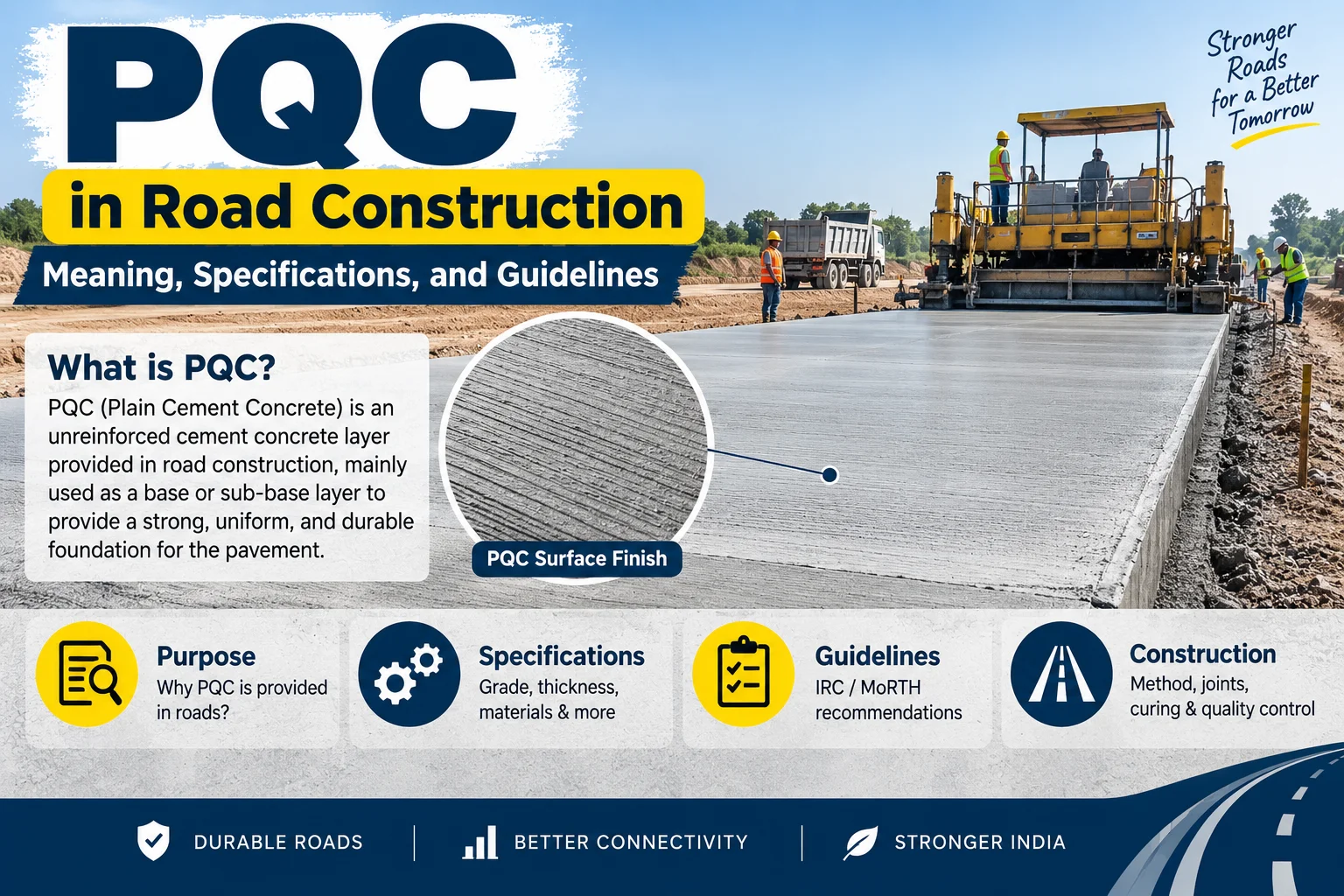
If you are searching for pqc full form in road construction, the answer is simple: PQC means Pavement Quality Concrete. It is the cement concrete layer used in rigid pavement roads, especially in high-traffic highways, expressways, airport pavements, and other projects where high strength and long service life are required.
PQC is not just ordinary concrete. It is a specially designed pavement layer placed over a prepared base or sub-base. Its job is to carry wheel loads, resist abrasion, and provide a durable riding surface. For civil engineering students, site engineers, and contractors, understanding the meaning, specifications, layer arrangement, and construction requirements of PQC is essential for correct highway execution.
What is PQC in Road Construction?
PQC stands for Pavement Quality Concrete. It is a concrete slab used as the main wearing and structural layer in rigid pavement construction. Unlike flexible pavement, where bituminous layers carry traffic loads through layered distribution, PQC acts as a stiff slab that directly resists bending and tensile stresses.
The term pqc full form in road construction meaning is therefore linked to a high-quality concrete pavement layer designed for road serviceability, load transfer efficiency, and long-term performance. It is commonly used where durability, low maintenance, and heavy-load resistance are important.
Where PQC is Used
PQC is widely used in:
- National highways and expressways
- Industrial corridors and logistics roads
- Container terminal and port roads
- Airport aprons and taxiways
- Industrial yards and heavy-duty pavements
It is particularly useful where traffic loading is heavy and continuous, and where frequent resurfacing is undesirable.
Typical Road Construction Layers in Rigid Pavement
To understand PQC properly, it helps to know the arrangement of road construction layers. In a rigid pavement system, the layers are generally provided in the following order:
The exact pavement composition may vary depending on the project design, drainage needs, soil condition, and the applicable standards.
PQC Full Form in Road Construction Specification
The pqc full form in road construction specification refers to the technical requirements for the concrete used in pavement work. These specifications are generally governed by the project drawings, MoRTH provisions, IRC guidelines, and the approved design mix.
Although exact values depend on the project, PQC is usually required to have:
- Good flexural strength and compressive strength
- Low permeability for durability
- Proper workability for paving and compaction
- Controlled shrinkage and cracking
- Resistance to abrasion from traffic
PQC is typically produced using design mix concrete with quality-controlled batching, mixing, laying, compaction, finishing, and curing. The mix design is project-specific and should follow the approved contract requirements and relevant codes.
Common Materials Used in PQC
- Ordinary Portland Cement or other approved cementitious material
- Well-graded coarse and fine aggregates
- Clean water
- Admixtures, if approved for workability, setting control, or durability
The aggregate quality is especially important because pavement concrete must resist repeated wheel loading and surface wear.
Layer Thickness in Highway PQC Works
The actual layer thickness in highway projects depends on pavement design, traffic loading, subgrade strength, and drainage conditions. There is no universal single thickness for all roads.
In practice, PQC thickness is determined by structural design rather than guesswork. For major highways, the slab thickness is selected based on wheel load repetitions, concrete strength, joint spacing, and support conditions. Since this is project-specific, the approved drawings and design report should always be followed.
Similarly, the thickness of the underlying base or sub-base layer also varies depending on the pavement system. A well-prepared support layer is important because PQC performance depends heavily on uniform support.
How PQC Roads Are Constructed
The construction of PQC requires strict control at every stage. A rigid pavement slab may look simple, but its long-term performance depends on execution quality.
- Subgrade preparation: The foundation soil is compacted and brought to the required level and density.
- Base layer construction: A stable base or sub-base is laid to provide even support.
- Formwork or slipform setup: Depending on the method, forms are fixed or a slipform paver is used.
- Concrete batching and transportation: The approved design mix is produced and delivered without segregation or excessive delay.
- Laying and compaction: Concrete is placed, leveled, and compacted to remove voids and ensure proper density.
- Finishing: Surface finishing is done to achieve the required profile and texture.
- Joint cutting and sealing: Joints are formed as per design to control cracking and movement.
- Curing: Proper curing is carried out to develop strength and reduce surface defects.
Quality Control Points for PQC
For highway engineers, quality control is one of the most important parts of PQC work. A good mix alone is not enough if site execution is poor.
- Check the approved mix design before execution
- Monitor slump or workability as specified in the project
- Ensure proper alignment, level, and thickness
- Control concrete temperature, especially in hot weather
- Verify compaction and surface finish
- Ensure timely curing and joint cutting
- Take test specimens as required by the project quality plan
Common problems in PQC work include honeycombing, edge cracking, poor curing, insufficient joint timing, and uneven slab thickness. These defects can reduce pavement life and increase maintenance needs.
Advantages of PQC in Road Construction
- High load-carrying capacity
- Long service life compared with many flexible pavement systems
- Better resistance to rutting and permanent deformation
- Suitable for heavy truck traffic
- Lower routine maintenance in many applications
Limitations of PQC
- Higher initial construction cost
- Requires skilled workmanship and strict quality control
- Jointing and curing are critical
- Repairs may be more difficult than flexible pavement patches
So, while PQC is durable, it demands better planning and execution than many other pavement types.
PQC vs Bituminous Pavement: Quick Comparison
Consider a high-traffic four-lane highway project where long-term performance and low maintenance are priorities. The designer may choose a rigid pavement system with a prepared subgrade, a supporting base layer, and a PQC slab as the top structural layer. The slab thickness, joint spacing, and concrete grade are then finalized based on traffic and design requirements.
In such a project, the contractor must ensure correct batching, consistent paving, timely joint cutting, and proper curing. If these steps are not controlled, even a well-designed PQC pavement can develop cracks or premature distress.
Important Note on IRC and MoRTH Guidelines
For pqc full form in road construction specification and execution, engineers should follow the applicable MoRTH, IRC, and project documents. However, specific numerical requirements such as thickness, strength grade, joint spacing, and acceptance criteria may vary with the contract, traffic category, and pavement design.
That is why PQC should never be treated as a one-size-fits-all layer. It must always be confirmed against the approved design, drawings, and current specifications for the project.
FAQs on PQC in Road Construction
1. What is the full form of PQC in road construction?
PQC stands for Pavement Quality Concrete. It is the concrete slab used in rigid pavement roads.
2. Is PQC used in flexible pavement?
No. PQC is mainly used in rigid pavement systems. Flexible pavements use bituminous layers instead.
3. Why is PQC preferred for highways?
PQC is preferred for highways because it can handle heavy traffic, has good durability, and generally needs less routine maintenance.
4. Does PQC thickness remain the same for all roads?
No. Thickness depends on traffic loading, design life, subgrade strength, base layer, and project specifications.
5. What is the main quality issue in PQC construction?
Common issues include poor curing, improper joint cutting, uneven slab thickness, and weak surface finish. These can affect pavement performance.
Conclusion
To sum up, pqc full form in road construction is Pavement Quality Concrete, the rigid concrete slab used in durable highway and heavy-duty pavement systems. Its performance depends on correct layer arrangement, approved mix design, proper thickness, joint detailing, and strict site quality control. For practical highway work, always follow the project-specific MoRTH, IRC, and design requirements rather than assuming a universal standard.