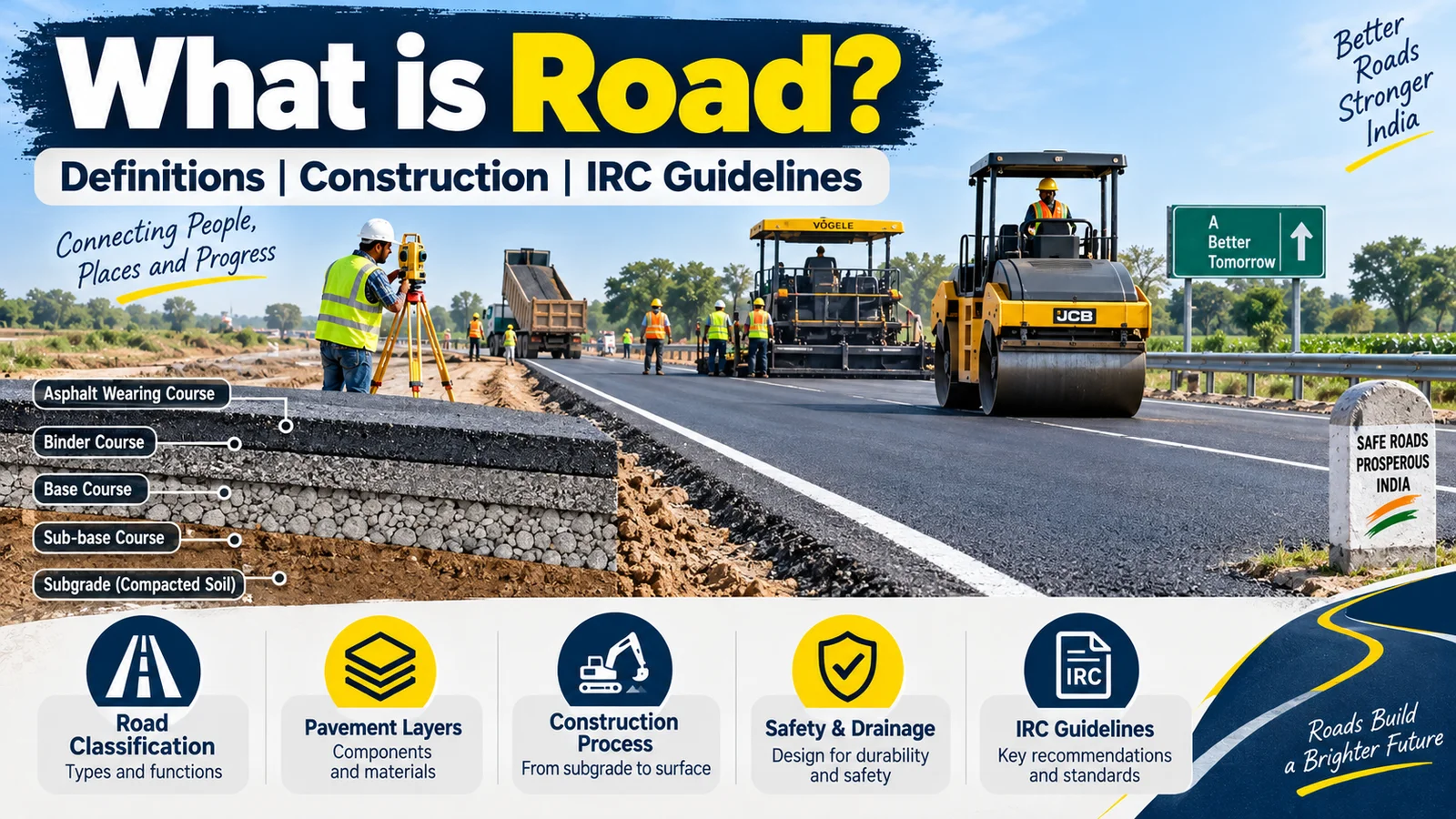
If you are asking what is road in civil engineering, the simple answer is this: a road is a prepared transport corridor built to allow safe and efficient movement of vehicles, pedestrians, and sometimes cyclists. In road construction, the term covers much more than the visible surface. It includes the subgrade, pavement layers, shoulders, drainage, and other elements that make the road durable and serviceable.
For civil engineers, a road is both a structural system and a transportation facility. Its performance depends on soil conditions, traffic loading, material quality, drainage, construction method, and compliance with the relevant highway engineering standards. That is why understanding the definition, layer composition, and field procedure is essential for design as well as execution.
Meaning of Road in Civil Engineering
In simple terms, a road is a man-made strip of land improved for travel. In what is road civil engineering discussions, the road is treated as a layered structure designed to distribute wheel loads to the ground without excessive deformation or failure.
A road is not only an alignment between two points. It must also satisfy requirements such as ride quality, safety, drainage, strength, visibility, and maintenance access. Depending on its function, a road may be a village road, urban street, collector road, arterial highway, or expressway.
Main functions of a road
- Provide a smooth and safe travel path
- Carry traffic loads from vehicles to the subgrade
- Support drainage and control water damage
- Connect settlements, markets, industries, and transport hubs
- Improve accessibility and regional development
Basic Components of a Road
A typical road section contains several parts, each serving a specific purpose. The exact configuration may vary depending on whether the road is flexible or rigid pavement, the traffic category, and the project specification.
Types of Roads Used in Construction
Roads are commonly classified by surface type or structural system. This helps engineers select the right materials and construction method for the expected traffic and site conditions.
Flexible pavement roads
Flexible pavements typically use bituminous layers over granular layers and subgrade. The load is distributed through the layers gradually. These roads are common because they are easier to construct and repair, but they depend strongly on good drainage and timely maintenance.
Rigid pavement roads
Rigid pavements are usually cement concrete roads. The slab itself carries a large part of the load by slab action, so the structure behaves differently from a flexible road. Construction quality, joints, and curing are very important in this type.
Earthen and gravel roads
These are low-cost roads used in rural or temporary access situations. They are simpler to build but require more maintenance and are more sensitive to rainfall and traffic wear.
What Is Road Field Procedure in Construction
The phrase what is road field procedure refers to the sequence of on-site activities needed to build the road according to drawings, specifications, and quality standards. Although details vary across projects, the general construction flow is similar.
- Survey and setting out: Establish centerline, levels, cross-sections, and right-of-way limits.
- Clearing and grubbing: Remove vegetation, topsoil, obstructions, and unsuitable material.
- Subgrade preparation: Shape, moisture-condition, and compact the soil to the required density.
- Construction of sub-base and base: Place granular or treated layers in controlled thickness and compact properly.
- Pavement layer construction: Lay bituminous or concrete surface layers depending on the road type.
- Shoulder and drainage works: Complete side support and ensure effective water disposal.
- Finishing and opening: Markings, signage, inspection, and final acceptance.
In actual site work, compaction, moisture control, and layer thickness control are critical. Poor preparation at the lower layers often leads to settlement, rutting, cracking, or premature failure of the road surface.
Engineering Specs and Design Considerations
When engineers discuss road specifications, they usually focus on the pavement design, geometric design, materials, and construction tolerances. These are not universal fixed numbers for every project. They depend on traffic volume, design life, soil strength, climate, and applicable standards.
Key design factors
- Traffic loading and axle repetitions
- Subgrade strength and soil classification
- Rainfall and drainage conditions
- Availability and quality of aggregates, bitumen, or cement
- Expected service life and maintenance strategy
- Geometry such as curve radius, gradient, and sight distance
For pavement design, engineers often refer to irc pavement design guidance, along with project-specific contract documents. IRC methods help determine layer thicknesses and material suitability based on traffic and soil support conditions. However, the final design must always match the applicable code edition and project requirements.
Materials commonly used
- Compacted soil and selected fill for subgrade improvement
- Granular sub-base materials
- Crushed aggregate for base course
- Bitumen and mineral aggregates for flexible pavement
- Cement concrete, reinforcement where required, and joint materials for rigid pavement
Highway Engineering Standards and Their Role
Road construction does not rely on guesswork. Highway engineering standards guide the design, materials, workmanship, testing, and acceptance of road works. In India, engineers commonly follow IRC recommendations for pavement and geometric design, and MoRTH specifications for construction and quality control requirements, where applicable to the project.
These standards help ensure that the road has an acceptable level of safety, durability, and performance. They also define how materials should be tested, how layers should be measured, and what tolerances are acceptable during execution. Because standards may be updated, the latest approved project documents should always be checked before construction starts.
Tests and Quality Control on Site
Good road construction depends on quality control at every layer. If the lower layers are weak, the road surface will not perform well even if the top layer looks good.
Common site tests
- Soil compaction and field density checks
- Moisture content determination
- Gradation tests for aggregates
- Bitumen quality and mix control tests
- Concrete slump, strength, and curing checks for rigid pavements
- Level, camber, and thickness verification
Mraining? Actually, drainage is often one of the most overlooked parts of road quality. Even a well-constructed pavement can fail early if water enters the layers and weakens the subgrade. That is why side drains, cross-fall, and proper shoulder finishing are essential.
Flexible Road vs Rigid Road
Consider a new two-lane approach road to a residential development. The engineer first checks soil strength and drainage conditions, then decides whether the pavement will be flexible or rigid based on traffic and budget. The subgrade is compacted, the granular layers are placed in controlled lifts, and each layer is tested before the next one begins.
If the project uses a bituminous pavement, the team must also control mixing temperature, laying temperature, rolling pattern, and surface evenness. If the road is a concrete pavement, curing and joint construction become equally important. In both cases, proper site control is as important as the design itself.
Common Construction Mistakes to Avoid
- Poor subgrade preparation before placing upper layers
- Inadequate compaction of granular layers
- Ignoring drainage and allowing water to remain near the pavement
- Incorrect thickness placement during laying
- Using materials that do not meet project specifications
- Poor curing in concrete roads
- Opening the road to traffic before the layer gains proper strength
FAQ: What Is Road in Road Construction?
What is road in civil engineering?
A road in civil engineering is a prepared transport corridor built with layers and supporting elements to carry traffic safely and efficiently.
What is road field procedure?
It is the step-by-step on-site method of constructing the road, including setting out, subgrade preparation, layer placement, compaction, testing, and finishing.
Which standards are commonly used for road construction?
In many projects, IRC recommendations and MoRTH specifications are used, along with the relevant project drawings and contract documents.
What is the most important part of road construction?
Subgrade preparation, drainage, and proper compaction are among the most important parts because they directly affect long-term pavement performance.
Why is pavement design important?
Pavement design ensures that the road thickness and materials are adequate for expected traffic, soil conditions, and service life.
What is the difference between flexible and rigid roads?
Flexible roads use bituminous and granular layers, while rigid roads use a concrete slab that carries load differently. Their construction and maintenance needs are also different.
Conclusion
So, what is road in road construction? It is a structured engineering system built to carry traffic safely over prepared layers, with careful attention to materials, drainage, compaction, and design standards. For civil engineering students and site engineers, understanding the road as both a transport facility and a structural system is the key to better construction quality.
Whether you are studying what is road civil engineering concepts or managing site execution, always connect field practice with approved specifications, IRC pavement design guidance, and applicable highway engineering standards. That is the practical path to building roads that last.