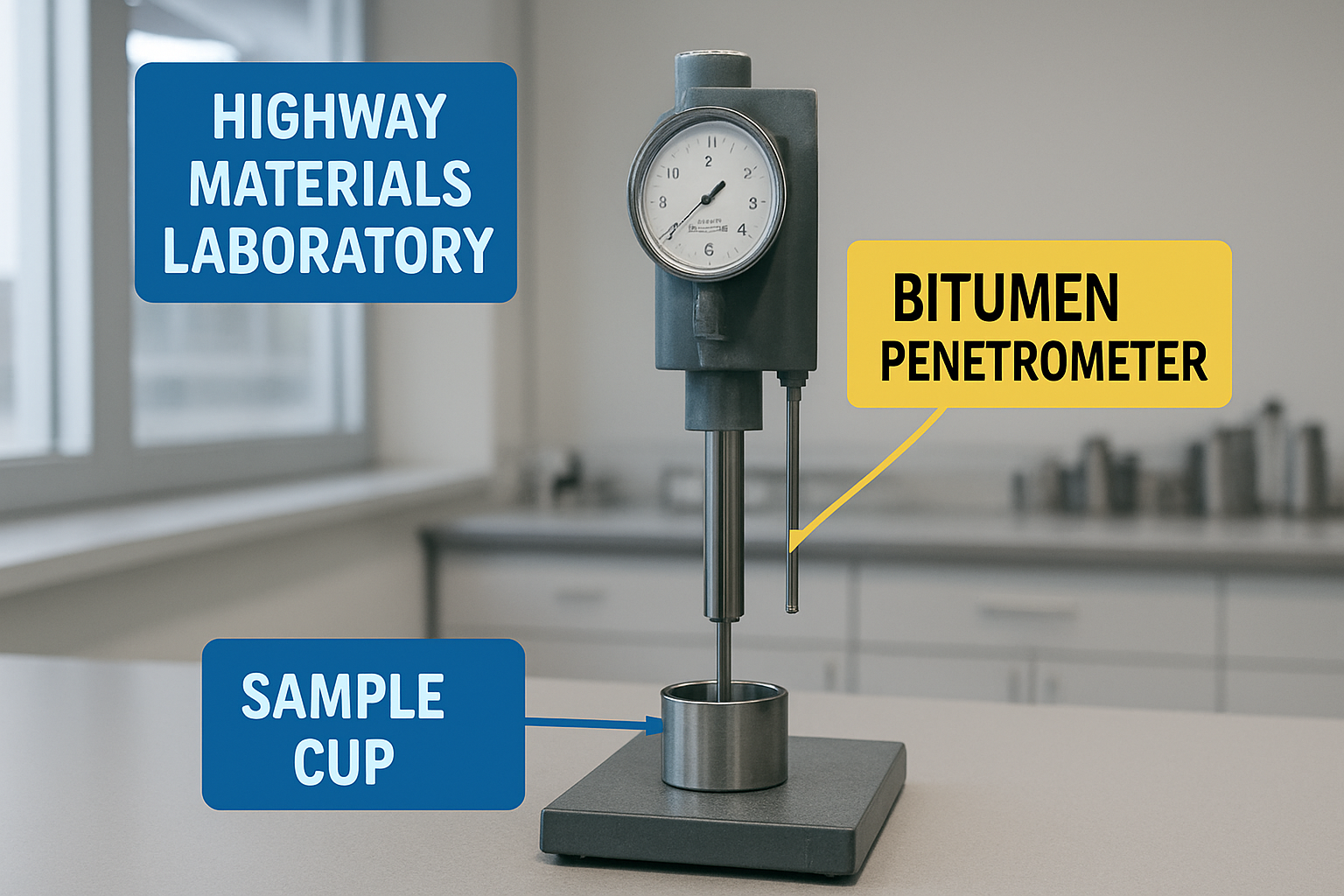
The Bitumen Penetration Test is a crucial procedure used to assess the consistency and quality of bitumen, which plays a vital role in road construction and pavement engineering. This test evaluates how far a standard needle penetrates the bitumen sample under specific conditions, providing key insights into its suitability for various applications. Understanding the penetration value of bitumen is essential for engineers and construction professionals to ensure the longevity and performance of asphalt mixtures. For the current method and revision, check the relevant entry in the BIS standards portal.
This article delves into the apparatus required, the step-by-step bitumen test procedure, and how to interpret the results effectively. Whether you are a civil engineering student, site engineer, or contractor, mastering this test will enhance your understanding of asphalt binder performance and its implications on construction projects.
Apparatus Required for the Bitumen Penetration Test
The apparatus for conducting the Bitumen Penetration Test includes the following essential components:
- Penetration Needle: A standard needle with a specific weight, typically 100 grams, and a defined diameter for consistency in measurement.
- Penetration Test Equipment: This includes the device that holds the bitumen sample at a constant temperature and applies the weight to the needle.
- Water Bath: A facility to maintain the bitumen at the specified temperature, usually 25°C, for accurate results.
- Bitumen Sample: A representative specimen of the asphalt binder to be tested.
- Penetrometer Dial or Digital Display: Used to read penetration in tenths of a millimetre (0.1 mm), commonly reported as dmm.
- Thermometer: To monitor the temperature of the water bath accurately.
Sample Conditioning for the Test
Before conducting the test, it is essential to condition the bitumen properly. The sample should be heated gently until it is in a fluid state, avoiding overheating. Once melted, the bitumen should be poured into the test container and allowed to cool to a uniform consistency. This typically involves cooling the sample to the testing temperature of 25°C before initiating the penetration test.
Bitumen Test Procedure
The steps involved in the Bitumen Penetration Test are as follows:
- Prepare the Sample: Heat the bitumen to a liquid state and pour it into a metal container. Allow it to cool to room temperature, and then stabilize it in a water bath at 25°C.
- Insert the Needle: Place the needle on the surface of the cooled bitumen, ensuring it is at the correct starting point according to the equipment design.
- Apply Weight: Gradually apply a load of 100 grams on the needle and allow it to penetrate for exactly 5 seconds.
- Measure Penetration: Carefully remove the needle without disturbing the bitumen and measure the depth of penetration to the nearest millimeter using the graduated scale.
Interpreting the Results
The penetration value is reported in tenths of a millimetre (dmm). Higher values generally indicate a softer binder and lower values a harder binder. Do not use a generic hard/soft classification table as a grading specification: penetration grade limits and permitted ranges depend on the applicable binder specification (such as the relevant IS or ASTM/AASHTO specification) and product grade. Compare the measured result with the exact grade requirements stated in the project specification.
The penetration value of bitumen is directly related to its application in asphalt mixtures. It helps in selecting the right binder for specific environmental conditions and traffic loads, ensuring the pavement’s integrity over its lifespan.
Common Mistakes to Avoid
When performing the Bitumen Penetration Test, a few common pitfalls can affect the accuracy of results:
- Temperature Control: Failing to maintain the sample at the specified 25°C can lead to inaccurate penetration readings.
- Incorrect Timing: Not allowing the needle to penetrate for the exact 5 seconds can skew results; timing is critical.
- Contaminated Samples: Using samples that are not representative of the material in use can mislead testing outcomes.
Applications of the Test
The Bitumen Penetration Test is widely used to:
- Determine the grade of bitumen suitable for a particular project.
- Evaluate the consistency of bitumen during quality control processes.
- Assist in research and development of new binder materials.
FAQs
What is the importance of the Bitumen Penetration Test?
The test is critical for determining bitumen’s consistency, affecting its performance in paving materials and ensuring the suitability for the intended application.
How often should the test be performed?
It should be performed regularly for quality control, especially when sourcing new batches of bitumen or adjusting formulations for specific projects.
Can the test results vary with temperature?
Yes, temperature can significantly affect the penetration results, hence maintaining the specified test temperature is crucial for accuracy.
Are there alternative tests for bitumen?
Yes, other tests, such as the Absolute Viscosity Test or Softening Point Test, also provide valuable insights into the performance characteristics of bitumen.
What types of projects typically require this test?
The test is essential for road construction, airport pavements, and any project involving asphalt pavements that must withstand various traffic and weather conditions.
In conclusion, the Bitumen Penetration Test is a fundamental assessment tool for civil engineers and construction professionals. By mastering this procedure, one can ensure the effective use of bitumen in asphalt bindings, contributing to durable and safe road infrastructures. Understanding the relationship between the penetration value of bitumen and its practical applications will elevate the quality of work in any pavement-related project.