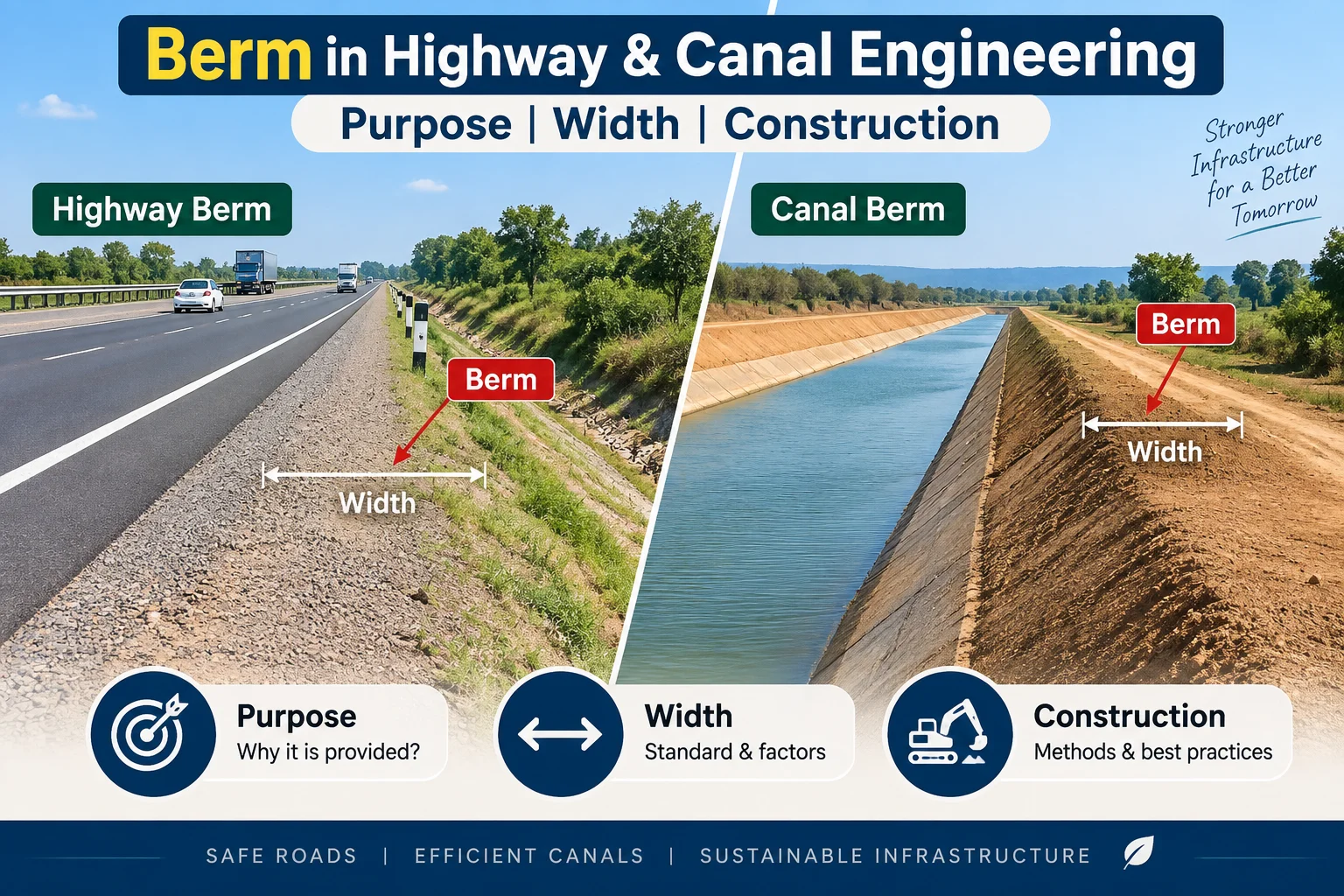
Berm in Highway & Canal Engineering: Purpose, Width & Construction
A berm is a strip of land left between a slope and a ditch, between two slopes, or along the side of an embankment, roadway, or canal. In highway and canal engineering, the berm is not just an extra piece of soil. It plays an important role in stability, drainage, maintenance access, and safety.
If you are asking about the purpose of berm in road works, the short answer is that it helps protect the embankment slope, improves serviceability, and provides space for inspection or maintenance. In canal works, a berm may also help control seepage, improve slope stability, and provide room for upkeep.
Although the concept is simple, the actual berm width and construction details depend on the project geometry, soil conditions, water level, traffic needs, and applicable design standards.
What Is a Berm?
A berm is a horizontal or nearly horizontal ledge provided on an earth slope. It may be formed on the side of a road embankment, along a canal bank, or at intermediate levels on a high slope. In many civil engineering texts, it is also called a bench or shelf, depending on the context.
In road engineering, a berm is often provided on the outside of an embankment or between slope breaks. In canal engineering, it is commonly left between the canal edge and the toe of the bank slope, or between the canal and a service road. The exact function changes based on the structure it supports.
Purpose of Berm in Road Engineering
The main purpose of berm in road construction is to improve the behavior of the road embankment and its side slopes. It offers a practical transition zone between the roadway and the natural ground or lower slope.
Common functions include:
- Reducing the effective height of a steep slope by breaking it into smaller segments
- Improving embankment slope protection by reducing surface erosion and runoff velocity
- Providing access for inspection, maintenance, and slope repair
- Helping intercept rainwater and direct it safely toward drainage features
- Improving overall slope stability in high embankments
In some road projects, a berm also serves as a safeguard against minor slope failures, debris movement, or loose material falling onto the carriageway below.
Berm Width Calculation: What Engineers Consider
berm width calculation is not a one-size-fits-all exercise. The required width depends on the purpose of the berm, slope height, soil type, drainage needs, maintenance access, and the project design standard.
There is no universal width that applies to every highway or canal project. Instead, engineers generally evaluate the following before finalizing the berm width:
- Height and steepness of the embankment or bank
- Need for maintenance vehicle access
- Drainage path and surface runoff control
- Space needed for slope stability and erosion protection measures
- Available right of way and site constraints
A practical approach is to select a berm wide enough to perform its function without becoming too narrow to maintain or too wide to waste valuable land. In road projects, the berm may need to support periodic inspection and slope maintenance. In canal projects, it may need to allow inspection of the bank, lining, or drainage features.
General Design Logic
If the berm is meant mainly for maintenance, it should be wide enough for safe movement and working space. If it is meant to improve stability, the width should also help interrupt the slope and reduce the length of exposed face. If it is meant for drainage, the surface should be graded so that water does not pond.
Because the width depends on functional and site-specific requirements, it should always be checked against the project drawings and design criteria rather than assumed from a rule of thumb.
Typical Components of a Berm
A berm may look simple, but its performance depends on several construction details.
| Component | Function |
|---|---|
| Surface layer | Provides a workable top surface and may include compacted soil, granular material, or protective treatment |
| Side slope tie-ins | Connects the berm smoothly to adjacent embankment or canal slope |
| Drainage fall | Helps move runoff away from the berm surface |
| Protection layer | May include turfing, stone pitching, geotextile, or other erosion control measures |
Berm Construction in Highway Works
Construction of a road berm usually begins with earthwork. The area is prepared, shaped, and compacted to the required line and level. The finished berm surface should be stable, even, and properly connected to the embankment slope.
A typical construction sequence is:
- Set out the berm location as per drawings.
- Prepare the foundation and remove soft or unsuitable material.
- Place selected fill in layers and compact each layer adequately.
- Shape the berm to the required width, level, and crossfall.
- Finish the side slopes smoothly to avoid weak junctions.
- Provide erosion protection, drainage, or surfacing if specified.
Good compaction is essential. A poorly compacted berm may settle differently from the adjoining embankment and create cracks or depressions. These defects can allow water ingress and reduce slope performance.
Berm Construction in Canal Engineering
In canal projects, the berm works together with the canal bank and side slope. It helps improve bank stability, especially where the canal runs along soft ground or where the bank height is significant.
Canal berms may also support access for inspection and maintenance. In lined canals, the berm can help protect the lining edge and provide a buffer zone between water movement and adjacent ground. In unlined canals, it may help reduce erosion and manage seepage-related issues.
Canal Berm vs Road Berm
The two are related, but they are not used for exactly the same purpose. The following comparison is useful for students and site engineers.
| Aspect | Road Berm | Canal Berm |
|---|---|---|
| Main purpose | Embankment stability, slope protection, maintenance access | Bank stability, seepage control, inspection, maintenance access |
| Drainage role | Reduces runoff and protects road slope | Helps manage water near the canal bank |
| Traffic use | May support maintenance access, not regular traffic unless designed for it | Usually for inspection or service access, not general traffic |
| Context | Highway embankments, cut slopes, fills | Canal banks, lined or unlined waterways |
So, when comparing canal berm vs road berm, the geometric form may be similar, but the functional requirement is different. A road berm is more closely tied to embankment safety and slope maintenance. A canal berm is more focused on waterway bank protection and operational access.
Embankment Slope Protection and Berm Stability
One of the most valuable functions of a berm is embankment slope protection. By interrupting a long slope, it reduces the length of face exposed to rainwater runoff and surface erosion. This can be especially important on high embankments or where the soil is erodible.
However, a berm alone does not solve every stability issue. It must be combined with proper slope design, drainage control, compaction, and, where needed, protective measures such as turfing, stone pitching, toe protection, or geosynthetics. Without proper drainage, water can accumulate on the berm and create new problems.
Common Site Considerations
- Provide a gentle crossfall so water does not collect on the berm
- Avoid loose soil or uneven settlement at the berm edge
- Ensure continuity of drainage paths across slope breaks
- Use erosion protection where rainfall or surface flow is high
- Check that the berm width is usable for maintenance, not just shown on paper
A common mistake is to treat the berm as unused extra width. In reality, it is a functional part of the earthwork system. Poor shaping, inadequate compaction, or improper drainage can make the berm ineffective.
Practical Example
Consider a highway embankment built across a hilly section. If the slope is long and exposed to heavy rainfall, the engineer may provide a berm partway down the embankment. This reduces the slope length, gives workers access for inspection, and helps collect runoff before it gains enough speed to cause erosion.
In a canal alignment passing through soft soil, a berm may be added to improve bank stability and give access for canal inspection. The design intent is different, but in both cases the berm supports long-term performance of the earth structure.
FAQs
What is the main purpose of a berm in road construction?
The main purpose is to improve embankment stability, protect slopes from erosion, and provide access for inspection and maintenance.
How is berm width decided?
Berm width is decided based on function, slope height, drainage needs, maintenance access, soil conditions, and project design requirements. It is not a fixed universal value.
Is a berm always required in highway embankments?
No. A berm is provided where it is useful for stability, drainage, access, or safety. Many embankments do not need one if the slope is short and stable.
Can a berm carry traffic?
Only if it is specifically designed for that purpose. In most cases, a berm is meant for maintenance access, not regular traffic loading.
What is the difference between canal berm and road berm?
A canal berm mainly supports bank stability, seepage management, and inspection access, while a road berm mainly supports embankment slope protection, drainage, and maintenance of road earthworks.
What protection is commonly used on berms?
Common protection methods include turfing, stone pitching, geotextile layers, and proper drainage shaping, depending on site conditions.
Conclusion
A berm is a small but important part of highway and canal engineering. It improves stability, supports drainage, protects slopes, and provides useful access for maintenance. The exact width and construction details depend on the project conditions, so proper design judgment is essential.
For civil engineering students and site professionals, understanding the berm means understanding how earth structures stay safe and serviceable over time. Whether it is a road embankment or a canal bank, the berm is an effective feature when it is planned, built, and maintained correctly.
the information receive is very important especially to present application and concept of geotechnical to detremine structural stability of road construction and building construction.