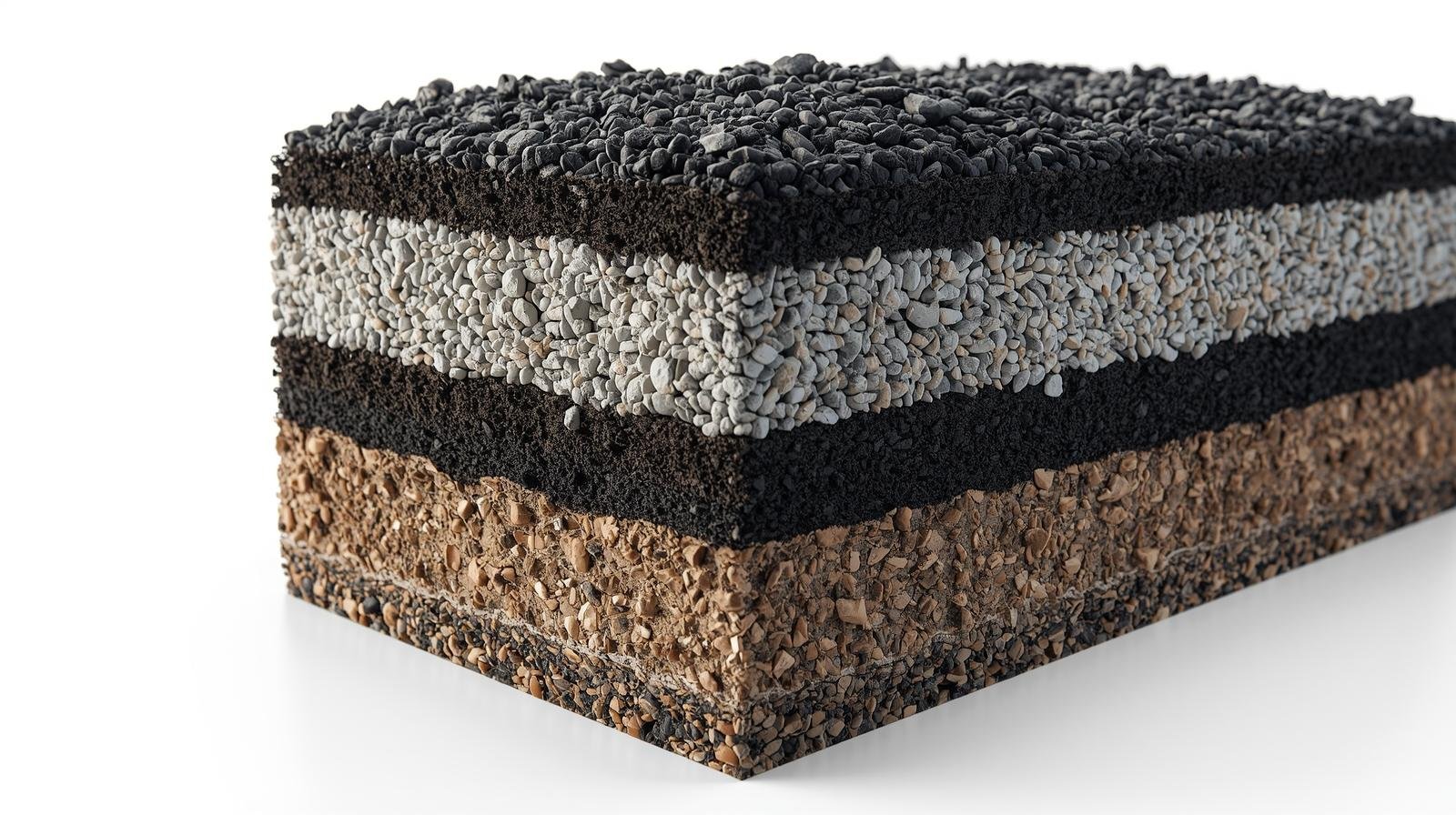
The GSB layer in road construction is the granular sub-base placed above the prepared subgrade and below the base or other upper pavement layers shown in the approved design. It provides a working platform and helps distribute stresses; it can also assist drainage when the selected grading, permeability and outlets are designed for that purpose. The exact pavement layer sequence depends on the pavement type and project specification, so GSB should not be described as compulsory in every road structure.
This article focuses on the position and function of GSB within the highway cross-section. For the full form and basic meaning, see our GSB full form article. For gradings and material tests, see the main GSB engineering guide.
What is GSB in Road Layers?
GSB or Granular Sub-Base is a granular pavement layer placed above the prepared subgrade and below the base or upper pavement layers specified in the design. Its function is to provide uniform support and help distribute stresses. It may also serve a drainage role when the grading, permeability, outlets and overall pavement drainage are designed for that purpose.
Importance of GSB in Highway Construction
GSB provides a transition layer between the prepared subgrade and upper pavement layers. Depending on the selected grading and pavement drainage arrangement, it can help distribute stresses, provide a stable construction platform, reduce the risk of fine-soil intrusion and assist water movement toward designed drainage outlets. Its contribution depends on the pavement design, material properties, compaction and drainage detailing; it does not guarantee a fixed road service life.
Properties of GSB Material
GSB materials are carefully selected to meet engineering requirements. Important properties include:
- Grading: Must match the grading envelope specified for the project and verified by sieve analysis.
- Material strength and durability: Check aggregate impact, abrasion, soundness or other tests required for the approved source.
- Plasticity and fines: Test the fine fraction and deleterious materials against the limits in the governing specification.
- CBR: Use the specified test condition, density and acceptance value from the pavement design and contract; do not apply a single universal CBR range by road class.
- Water absorption and moisture: Determine these properties by the specified test method and use them in source approval and moisture correction where required.
- Cleanliness: Material should be free from unsuitable organic matter and contamination.
Types of GSB in Road Construction
Granular Sub-Base (GSB) represents the invisible foundation beneath every road surface that ensures decades of reliable performance under heavy traffic loads. As the critical intermediate layer positioned between natural subgrade soil and upper pavement layers, GSB transforms unpredictable ground conditions into a stable, engineered platform.

Understanding the different types of GSB materials available helps engineers and contractors select the most appropriate solution for specific project requirements, balancing performance specifications with economic considerations and local material availability to achieve optimal long-term road infrastructure durability.
GSB Grading Categories
MoRTH Table 400-1 lists six GSB grading envelopes, designated I to VI, based on the percentage passing specified IS sieves. These are particle-size distributions, not premium, standard or basic quality classes. The grading to be used is specified in the contract and selected as part of the pavement design. Material quality is assessed separately through the physical-property tests and acceptance limits in the governing specification.
For the complete sieve-wise grading limits, see our GSB grading guide. For the layer’s role, material requirements and construction controls, see the main granular sub-base guide.
Common GSB Material Sources
GSB can be produced from different granular sources, but the source name alone does not establish suitability. The processed material must meet the grading and physical-property requirements specified in the project contract and receive the required approval.
Crushed Rock Aggregates
Crushed aggregates from approved hard-rock quarries are commonly used. Crushing and screening produce the particle sizes needed to meet the selected grading envelope. Aggregate strength, abrasion resistance, shape, water absorption and cleanliness must be confirmed by the specified tests.
Natural Gravel and Alluvial Materials
Natural gravel and alluvial deposits may be used when they can be screened, blended or processed to meet the specified grading and material-quality requirements. Rounded particles, clay coatings, silt, organic matter and variable source quality should be checked during approval and production.
Recycled Aggregates
Recycled concrete or masonry aggregates may be considered only where the governing specification and project contract permit them. The source requires processing and testing for grading, contamination, strength, absorption and other specified properties. Recycled material is not automatically acceptable for GSB merely because it has been crushed and screened.
Industrial by-products, reclaimed asphalt and stabilized mixtures also require explicit specification provisions and approval; they should not be treated as interchangeable with conventional unbound GSB.
Selection should be based on test results, source consistency, transport distance, environmental controls and cost, while meeting the same acceptance requirements that apply to the project.
Technical Specifications of GSB (As per IRC & MoRTH)
MoRTH Table 400-1 contains six separate grading envelopes (I to VI), each with its own sieve-wise percentage-passing limits. There is no single generic GSB gradation table that can be applied to all projects. Check the full grading column selected in the contract, and compare it with the laboratory sieve-analysis report for the proposed material. A quick reference is available in our GSB grading guide.
Grading and material quality are separate checks. Verify the applicable physical requirements—including aggregate strength or abrasion, plasticity, CBR and other deleterious-material limits—against the specification edition and amendments named in the project contract. Do not combine different acceptance values into a universal “GSB grade” range.
Construction Process of GSB in Road Layers
The construction of GSB involves several steps:
Subgrade Preparation
- Remove debris and vegetation
- Compact the subgrade to required density
- Provide slope for drainage
Material Placement
- Transport aggregates without segregation
- Spread material uniformly using graders
- Place each layer within the loose and compacted thickness limits permitted by the project specification and the approved method statement; the roller and material must be able to achieve uniform compaction through the full layer depth.
Compaction and Quality Control
- Compact with vibratory rollers
- Maintain optimum moisture content
- Conduct field density tests regularly
- Perform proof rolling to detect weak spots
GSB Layer Thickness
GSB thickness is determined by pavement design, subgrade strength, traffic loading, drainage requirements and the governing project specification. It should not be assigned from a simple highway, urban-road or rural-road lookup range. The approved drawings state the compacted thickness and whether the layer is to be constructed in more than one lift.
Difference Between GSB and WMM Layer
| Factor | GSB | WMM |
|---|---|---|
| Full form | Granular Sub-Base | Wet Mix Macadam |
| Typical position | Sub-base over prepared subgrade | Base course, commonly above GSB where specified |
| Material | Selected granular material meeting specified grading and quality requirements | Aggregates mixed with water to the specified grading and moisture condition |
| Role | Support, stress distribution and possible drainage support | Structural base layer supporting upper pavement layers |
| Acceptance | Project-specified grading and material tests | Project-specified WMM grading, compaction and quality checks |
Role of GSB in Pavement Performance
The success of any highway project depends on the proper construction of the GSB layer. Its role includes:
- Preventing rutting and deformation of the pavement
- Reducing maintenance costs
- Improving ride quality
- Supporting heavy traffic efficiently
Cost and Sustainability Aspects of GSB
- Cost estimate: Measure the specified material quantity and layer thickness, then apply current local rates for supply, transport, spreading, watering, compaction and testing. Cost shares vary by source, lead distance and project location.
- Sustainability: Use of recycled aggregates and local materials helps reduce costs and environmental impact
- Long-Term Value: Good quality GSB extends road life and reduces repair frequency
FAQs on GSB in Road Construction
Q1. What is the full form of GSB in road layers? Granular Sub-Base.
Q2. What is the required thickness of GSB? There is no universal minimum or maximum for every road. The compacted thickness is determined by the pavement design, subgrade strength, traffic, drainage requirements and project specification, and is shown in the approved drawings.
Q3. Can recycled materials be used in GSB? Yes, if they meet IRC and MoRTH specifications.
Q4. Why is GSB important in highways? It distributes load, prevents waterlogging, and ensures pavement stability.
Conclusion
The full form of GSB in road layers is Granular Sub-Base, and it is the backbone of flexible pavements. By providing structural strength, drainage, and durability, GSB ensures highways last longer and perform better. Proper construction and adherence to specifications are critical for maximizing its benefits in road engineering.