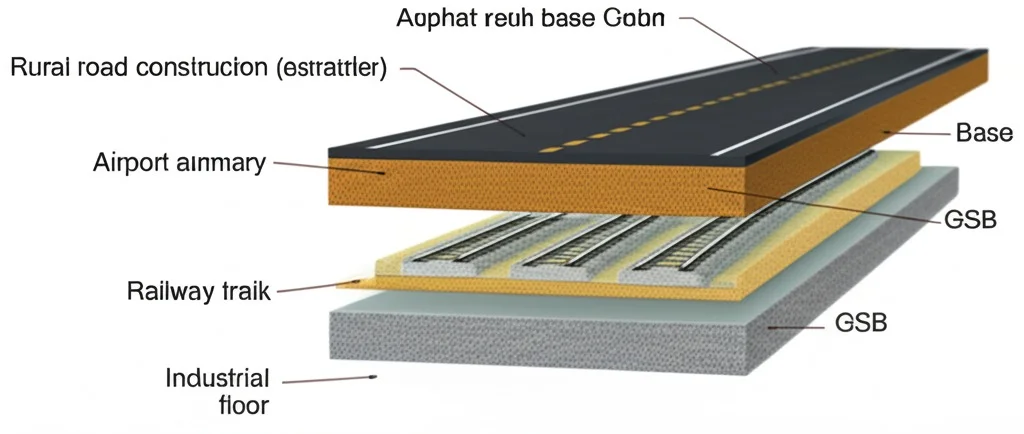
Granular Sub Base (GSB) is an important layer in road construction, placed over the prepared subgrade and below the base course or other pavement layers. It provides a stable working platform, helps distribute traffic loads and can support drainage when the selected grading and pavement drainage arrangement are suitable. The quality of granular sub base depends on material selection, grading, moisture control, compaction and field testing—not simply on the size of the stones used. For a rigid pavement application, see our explanation of PQC in road construction.
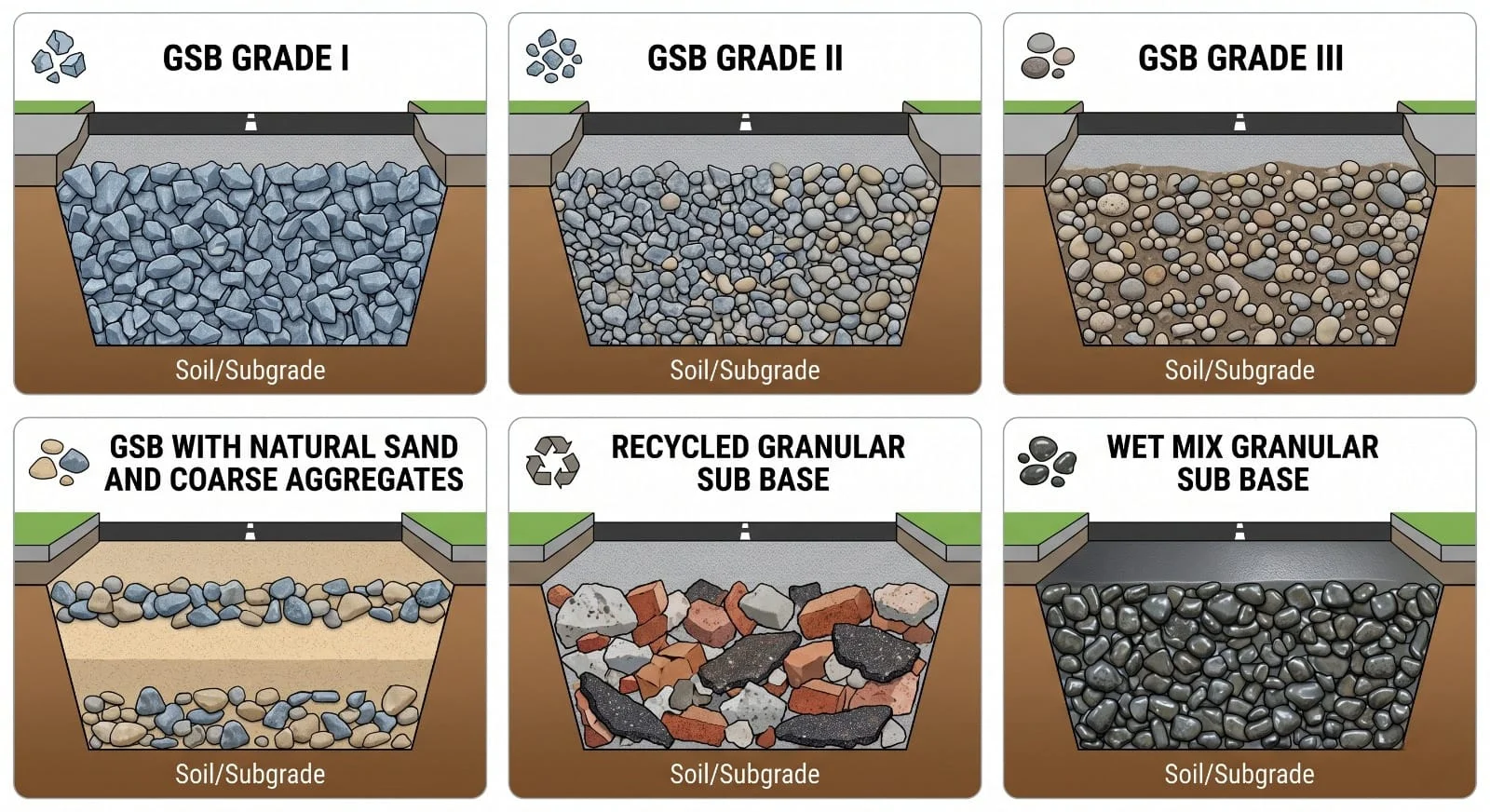
What Is Granular Sub Base in Road Construction?
Granular Sub Base, commonly known as GSB, is a pavement layer made from selected granular materials such as natural sand, crushed gravel, crushed stone, crushed slag or approved combinations. It is laid and compacted over a prepared subgrade to provide support to the pavement layers above. GSB is not the wearing course. Its exact material, grading, thickness and acceptance criteria must follow the approved pavement design and project specification.
Functions of GSB in Road Construction
- Load distribution: Helps spread stresses from upper pavement layers over a wider area of the subgrade.
- Working platform: Provides a stable surface for construction traffic and subsequent pavement operations.
- Subgrade protection: Helps reduce disturbance and limits intrusion of fine soil when properly designed.
- Drainage support: Selected gradings can convey water when suitable drainage paths and outlets are provided.
- Uniform support: Creates a consistent foundation for the base course and surface layers.
GSB does not automatically solve waterlogging. Drainage also depends on grading, fines content, crossfall, side drains, outlets and the overall pavement design.
Materials Used for Granular Sub Base
For a closer look at the source material and site checks, see our separate GSB material testing and field standards article.
MoRTH Clause 401.2.1 (Fifth Revision, 2013) identifies natural sand, crushed gravel, crushed stone, crushed slag or combinations of these materials, depending on the required grading. Brick metal, kankar and crushed concrete are permitted in the lower sub-base under the cited clause. Material must be free from organic and other deleterious constituents and meet the specified grading and physical requirements.
GSB Grading Table as per MoRTH
MoRTH Specifications for Road and Bridge Works, Fifth Revision (2013), Clause 401 refers to six gradings in Table 400-1. Values below represent percentage by weight passing each IS sieve. A dash means no range is specified at that sieve for that grading.
| IS Sieve | I | II | III | IV | V | VI |
|---|---|---|---|---|---|---|
| 75.0 mm | 100 | – | – | – | 100 | – |
| 53.0 mm | 80–100 | 100 | 100 | 100 | 80–100 | 100 |
| 26.5 mm | 55–90 | 70–100 | 55–75 | 50–80 | 55–90 | 75–100 |
| 9.50 mm | 35–65 | 50–80 | – | – | 35–65 | 55–75 |
| 4.75 mm | 25–55 | 40–65 | 10–30 | 15–35 | 25–50 | 30–55 |
| 2.36 mm | 20–40 | 30–50 | – | – | 10–20 | 10–25 |
| 0.85 mm | – | – | – | – | 2–10 | – |
| 0.425 mm | 10–15 | 10–15 | – | – | 0–5 | 0–8 |
| 0.075 mm | <5 | <5 | <5 | <5 | – | 0–3 |
MoRTH states that Gradings III and IV should preferably be used in lower sub-base, while Gradings V and VI are used as a sub-base-cum-drainage layer. The grading for a project is the one specified in its contract. For a focused discussion of GSB grading categories, see grade of GSB and MoRTH grading selection. Where the sub-base is laid in two layers as upper and lower sub-base, the cited clause states that each layer should not be less than 150 mm thick.
Physical Requirements of GSB Material
| Property | Test Reference | Requirement in MoRTH Table 400-2 (2013) |
|---|---|---|
| Aggregate Impact Value | IS 2386 (Part 4) or IS 5640 | Maximum 40 |
| Liquid Limit | IS 2720 (Part 5) | Maximum 25 |
| Plasticity Index | IS 2720 (Part 5) | Maximum 6 |
| CBR at 98% dry density | IS 2720 (Part 16) | Minimum 30, unless otherwise specified in contract |
Where aggregate water absorption exceeds 2%, or soft aggregates such as kankar, brick ballast and laterite are used, the cited clause requires Wet Aggregate Impact Value testing as applicable. Confirm the governing edition, amendments and project-specific requirements before accepting a material source.
GSB Construction Process: Step by Step
1. Prepare the Subgrade
Complete the subgrade to the required line, level, crossfall and profile. Remove vegetation and other extraneous matter. Correct soft or unsuitable areas and obtain the required inspection before placing GSB.
2. Test and Approve the Material
Check the source and laboratory results for grading, plasticity, aggregate quality and CBR. Confirm that the proposed material matches the grading stated in the contract.
3. Determine Moisture Content
Carry out the specified compaction test to establish Optimum Moisture Content (OMC) and Maximum Dry Density (MDD). Use the contract’s specified method and acceptance criteria for field control.
4. Mix and Spread the Material
Mix the material mechanically with controlled water addition to obtain a uniform blend. Spread it evenly using suitable equipment such as a motor grader. Avoid segregation, dry pockets and local accumulation of fines.
5. Compact the GSB Layer
Compact with suitable rollers using an approved rolling pattern. Maintain the moisture condition required by the specification. A fixed number of roller passes alone does not prove adequate compaction; field density checks are necessary.
6. Inspect the Finished Layer
Check line, level, crossfall, thickness, uniformity and loose or segregated areas. Complete the specified field density and quality-control tests before placing the next pavement layer.
Important Tests for GSB Quality Control
- Sieve analysis: Checks compliance with the specified grading.
- Liquid Limit and Plasticity Index: Assess the plasticity of the fine fraction.
- Aggregate Impact Value: Assesses aggregate resistance to impact.
- CBR test: Evaluates bearing strength under defined laboratory conditions. Read our California Bearing Ratio (CBR) test explanation.
- Proctor compaction test: Determines OMC and MDD for compaction control.
- Field density test: Checks the density achieved at site.
- Thickness and level checks: Confirm compliance with approved drawings and specifications.
Common GSB Construction Mistakes
- Using material without confirming source, grading and test results.
- Allowing segregation during transport, mixing or spreading.
- Adding excessive or insufficient water before compaction.
- Placing GSB over a soft or unapproved subgrade.
- Assuming a fixed number of roller passes guarantees density.
- Ignoring thickness, crossfall and finished-level checks.
- Allowing water to collect because drainage paths or outlets are incomplete.
- Placing the next layer before required inspection and acceptance.
Difference Between GSB and WMM
| Point | GSB | WMM |
|---|---|---|
| Full form | Granular Sub-Base | Wet Mix Macadam |
| Typical position | Sub-base above subgrade | Generally base course above sub-base |
| Main role | Sub-base support and working platform | Stronger base support for upper layers |
| Specification | MoRTH Clause 401, where adopted | MoRTH Clause 406, where adopted |
For a detailed comparison, read the difference between WBM and WMM roads.
Where Is GSB Used?
GSB is commonly used in flexible pavement structures and may also be included in rigid pavement foundations when the design specifies it. Its grading and thickness depend on traffic, subgrade conditions, drainage needs and the approved pavement composition. In concrete pavement projects, the supporting arrangement may also include a Dry Lean Concrete (DLC) layer. Read our article on Dry Lean Concrete in road construction. GSB should not be assumed to replace another specified pavement layer.
Frequently Asked Questions About Granular Sub Base
What is the full form of GSB?
GSB stands for Granular Sub-Base. It is a granular pavement layer placed over the prepared subgrade.
How many gradings are specified for GSB in MoRTH Table 400-1?
The MoRTH Fifth Revision (2013) Table 400-1 lists six gradings, identified as Grading I to Grading VI. The project contract specifies which grading is to be used.
What is the minimum CBR requirement for GSB?
Table 400-2 of the MoRTH Fifth Revision (2013) specifies a minimum CBR of 30% at 98% dry density unless otherwise specified in the contract. Confirm the applicable project specification and test method.
Which test is used to check GSB compaction?
Field density testing checks the density achieved at site. The reference MDD, required compaction percentage and accepted field test method must follow the project specification.
Is GSB used in concrete road construction?
GSB may be included in a rigid pavement foundation when specified by the pavement design. The complete layer arrangement must follow approved drawings and project requirements.
What is the difference between GSB and WMM?
GSB is generally the sub-base layer, while WMM is generally used as a base course above it. Their grading, material requirements and construction specifications are different.
Conclusion
Granular Sub Base is an important part of road pavement construction because it provides support to the layers above and helps protect the prepared subgrade. Its performance depends on selecting the correct MoRTH grading, checking material properties, controlling moisture, achieving specified compaction and completing field quality checks. Engineers and site supervisors should follow approved drawings, applicable standards and the project contract rather than relying on general thickness or density assumptions.