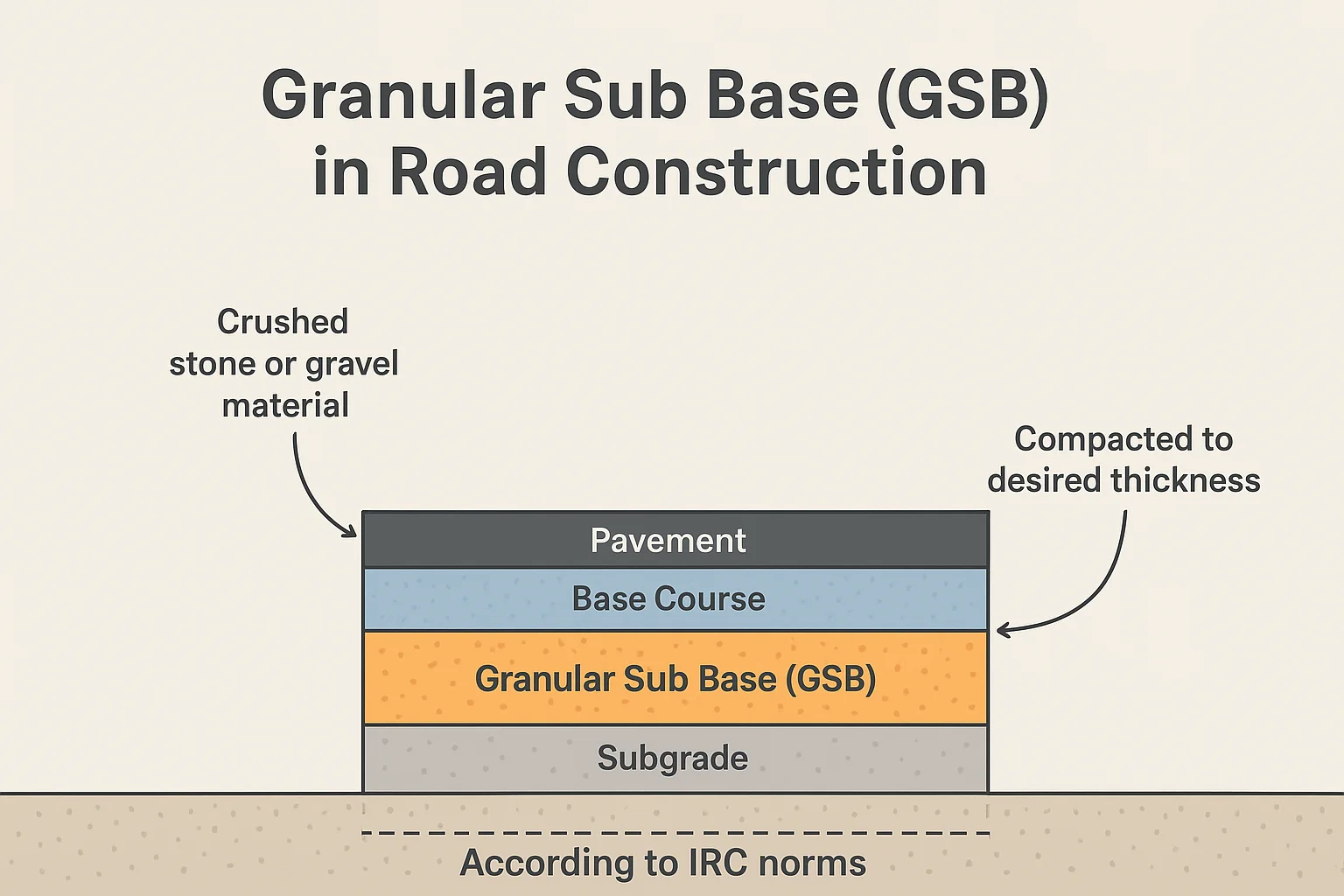
When people search for gsb full form in road construction, they are usually looking for the meaning, role, and specifications of this important pavement layer. GSB stands for Granular Sub-Base. It is one of the key layers in flexible pavement and serves as the foundation between the natural subgrade and the upper pavement layers.
In simple terms, GSB helps distribute wheel loads, improve drainage, reduce stress on the soil below, and provide a stable working platform for further road layers. For civil engineering students, site engineers, and contractors, understanding the gsb full form in road construction meaning is essential because this layer strongly affects road performance and durability.
This article explains what GSB is, its materials, construction method, typical thickness, testing, and the way it fits into the overall road construction layers system used in highways.
What is GSB in Road Construction?
GSB, or Granular Sub-Base, is a granular layer placed above the prepared subgrade and below the base course in a flexible pavement system. It is made from selected aggregates or natural materials that satisfy the required grading and quality parameters set by project specifications and applicable highway standards.
The main purpose of GSB is not to carry the full traffic load like the upper pavement layers, but to support them by improving stability and drainage. It also helps prevent contamination of the base layer by fine soil from below.
Why GSB is Important in Road Construction
GSB plays a major role in pavement performance. A good sub-base layer helps the road remain stable under repeated traffic loading and wet weather conditions. Without a proper GSB layer, the pavement may develop settlement, cracking, rutting, or loss of strength over time.
Its key functions include:
- Providing a firm and uniform support layer
- Improving drainage below the pavement structure
- Reducing stress transmitted to the subgrade
- Preventing mixing of subgrade soil with upper layers
- Helping in construction traffic movement on site
GSB Full Form in Road Construction Specification
The gsb full form in road construction specification depends on project documents and the relevant highway code or schedule of construction. In general, specifications describe the grading of the material, quality of aggregates, plasticity limits of fines, compaction requirements, and layer thickness limits.
Although exact values vary with the design and standards used, GSB material is generally required to be:
- Well-graded and durable
- Free from organic matter and harmful impurities
- Capable of being compacted to a stable layer
- Suitable for drainage, where required
In highway works, GSB requirements are commonly guided by MoRTH specifications and IRC-based design practices, but the exact clause, grading, and thickness must always be checked from the project specification and drawings.
Materials Used in GSB
GSB can be made from different types of granular materials depending on availability and design needs. Common materials include crushed stone, gravel, moorum, natural sand-gravel mix, or recycled granular materials where permitted by the specification.
The selected material should have adequate strength, proper grading, and low plasticity. If the fines content is too high or the material contains excess clay, drainage and compaction performance may be affected.
Common Material Properties Considered
- Gradation or particle size distribution
- Strength and durability of aggregates
- Plasticity of fines
- Moisture sensitivity
- Field compaction behavior
Layer Thickness in Highway Construction
The layer thickness in highway for GSB is not a fixed universal number. It depends on pavement design, traffic loading, material quality, drainage requirement, and the thickness specified in the contract documents.
In practice, GSB is often provided in one or more layers to allow better compaction and workmanship. If the design thickness is large, it is usually laid in separate compacted lifts rather than in a single thick layer.
For accurate construction, engineers should verify the following from the approved drawings and specifications:
- Total designed GSB thickness
- Maximum compacted thickness per lift
- Required density and moisture control
- Cross fall and drainage details
Road Construction Layers and the Position of GSB
To understand GSB properly, it helps to see where it fits in the full pavement structure. In a typical flexible pavement system, the layers are arranged from bottom to top as follows:
| Layer | Function |
|---|---|
| Subgrade | Natural soil foundation that supports the pavement structure |
| GSB | Improves support, drainage, and separation |
| WMM or other base layer | Provides stronger load distribution |
| Bituminous layers | Provide riding quality and protect lower layers from traffic and water |
In this sequence, GSB is the first prepared granular layer above the subgrade. It is especially important when the subgrade soil is weak or susceptible to moisture-related damage.
GSB vs WMM: Key Difference
Many new engineers confuse GSB with WMM. Both are granular layers, but they serve different structural roles.
| Aspect | GSB | WMM |
|---|---|---|
| Main role | Sub-base support and drainage | Stronger base layer for load distribution |
| Position | Above subgrade, below base | Above GSB, below bituminous layers |
| Material quality | Granular and well-graded | Generally higher strength and stricter quality control |
| Primary focus | Stability and drainage | Structural support |
In short, GSB is more of a supportive and protective layer, while WMM works as a stronger structural base.
Construction Procedure for GSB
Proper construction is critical because even good material can perform poorly if placed incorrectly. A typical GSB construction sequence includes the following steps:
- Prepare and level the subgrade or previous layer.
- Check line, level, camber, and cross fall.
- Spread the approved GSB material uniformly.
- Adjust moisture content as required for compaction.
- Compact the layer with suitable rolling equipment.
- Check finished thickness, density, and surface regularity.
Site control is important during spreading and compaction. Material segregation, uneven moisture, and loose areas should be corrected immediately before the next layer is placed.
Tests and Quality Control for GSB
Quality control tests help ensure the layer meets the specified performance. The actual test schedule depends on the project specification, but commonly checked parameters include:
- Gradation test
- Plasticity test for fines
- Moisture content test
- Field density or compaction test
- Thickness and surface level checks
Engineers should also inspect the material for segregation, contamination, and proper drainage slope. Poor compaction or excessive fines can reduce the effectiveness of the layer.
Practical Example of GSB Use
On a highway project passing through a clayey subgrade area, GSB is often used to create a stable working surface before placing the base course. If the subgrade is wet and weak, the granular layer helps reduce pumping of fines and improves accessibility for construction equipment.
In such situations, the drainage function of GSB becomes as important as its load distribution role. That is why engineers pay close attention to material selection, thickness control, and compaction quality.
Advantages and Limitations of GSB
GSB offers several practical benefits in pavement construction, but it also has some limitations.
Advantages
- Improves pavement support
- Provides drainage and moisture control
- Enhances construction ease
- Reduces contamination between layers
- Helps increase pavement durability
Limitations
- Needs proper compaction and moisture control
- Performance depends strongly on material quality
- Thickness and grading must match the design requirement
- Poor workmanship can reduce its effectiveness
Frequently Asked Questions
What is the full form of GSB in road construction?
GSB stands for Granular Sub-Base.
What is the main purpose of GSB?
Its main purpose is to provide support, drainage, and separation between the subgrade and upper pavement layers.
Is GSB and sub-base the same thing?
GSB is a type of sub-base layer made from granular material. In highway construction, the term is commonly used for this specific layer.
What is the difference between GSB and WMM?
GSB is mainly a sub-base layer for support and drainage, while WMM is a stronger base layer that carries more structural load.
Does GSB thickness remain the same for every road?
No. Thickness depends on pavement design, traffic loading, subgrade strength, and the applicable project specification.
Which standards control GSB construction?
GSB work is generally guided by MoRTH and IRC-based highway specifications, but the exact requirements should always be verified from the project documents.
Conclusion
The gsb full form in road construction is Granular Sub-Base, and it is one of the most important layers in flexible pavement. It supports the upper layers, improves drainage, protects the subgrade, and helps the road perform better over time.
For good results, engineers must focus on correct material selection, proper thickness, careful compaction, and compliance with the project’s MoRTH or IRC-based requirements. Understanding GSB clearly helps in better execution, quality control, and long-term pavement performance.