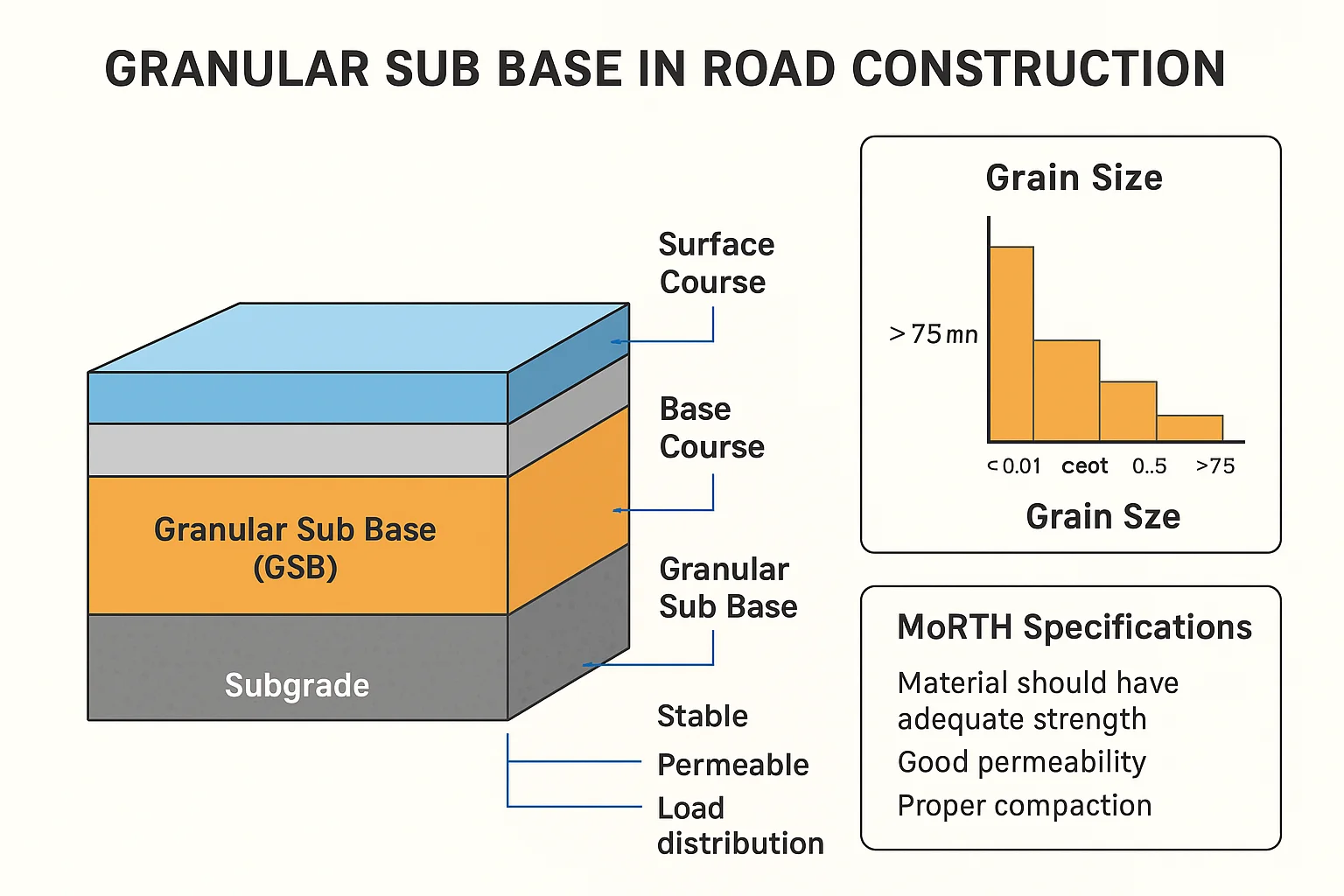
In road construction, granular sub base is one of the most important pavement layers because it provides a stable working platform, helps distribute load, and supports the layers above it. It is placed below the base course and above the prepared subgrade, so its quality has a direct effect on pavement performance.
For students, site engineers, and contractors, the practical questions are usually the same: What grading is allowed, what thickness should be provided, how is compaction checked, and what field CBR value can be expected? This article explains the role of granular sub base, the gsb grading table morth requirements in principle, typical construction practice, and key quality-control points in simple engineering language.
The exact method and acceptance criteria may vary with project specifications, traffic class, and the applicable contract documents. However, the core concepts below apply to most flexible pavement works.
What Is Granular Sub Base?
Granular sub base, commonly called GSB, is a layer made of well-graded granular material such as crushed stone, gravel, or a mixture of natural and processed aggregates. Its main purpose is to improve load transfer, prevent intrusion of fines from the subgrade, and provide drainage where needed.
In simple terms, GSB acts as a transition layer between weak soil and stronger pavement layers. It is not the wearing layer and it is not designed to resist traffic directly for long periods, but it plays a major support role in pavement stability.
Why Granular Sub Base Is Important in Roads
- Provides a firm and uniform platform for laying base and binder layers.
- Helps reduce stress on the subgrade soil.
- Improves drainage and reduces water-related damage.
- Minimizes pumping of fines from the subgrade into upper layers.
- Supports construction traffic during paving operations.
Without a properly compacted granular sub base, even a well-designed pavement may develop settlement, rutting, or early cracking due to poor support below.
GSB Grading Table MoRTH: What It Means
The gsb grading table morth refers to the grading requirements given in the MoRTH specifications for granular sub-base material. The intent of the grading table is to ensure that the material contains a proper distribution of particle sizes so that it can compact well, remain stable, and provide good drainage characteristics where required.
MoRTH provides different grading options for GSB. The exact grading selected depends on the source material, layer purpose, and project requirements. In practice, engineers verify that the aggregate passes and retains within the specified sieve limits before approving the material for use.
Because grading tables are specification-based, they should be checked directly from the applicable MoRTH edition and project contract. Do not assume one grading fits all projects. The key engineering idea is that the material must be neither too coarse nor too fine, otherwise compaction, stability, and drainage may suffer.
General Grading Requirements to Check on Site
- Well-graded aggregate with controlled fines content.
- Particles should be durable and free from harmful organic matter.
- Excessive clay lumps, soft particles, and deleterious materials should be avoided.
- The approved material should match the selected grading type consistently during supply.
Granular Sub Base Thickness
Granular sub base thickness is not a single universal value. It depends on pavement design, subgrade strength, traffic loading, drainage needs, and the layer configuration adopted in the project. In many road works, the GSB is provided in one or more layers rather than a single thick lift to allow proper compaction.
From a construction point of view, thickness must be practical to compact uniformly. If the layer is too thick in one pass, the lower portion may remain loose even if the surface appears dense. That is why engineers usually place and compact GSB in controlled layers.
Practical Thickness Considerations
- Use the project drawing or pavement design as the primary reference.
- Ensure each compacted lift can be adequately densified with available rollers.
- Maintain uniform thickness across the full lane width.
- Avoid local over-thickness at low spots without addressing subgrade level correction.
Materials Used in Granular Sub Base
GSB is typically made from natural gravel, crushed stone, broken rock, or a mixture of these materials. In some projects, processed materials from approved sources may also be used if they satisfy the specified quality and grading requirements.
The important performance characteristics are particle strength, cleanliness, gradation, and resistance to breakdown during compaction and service. The material should not contain excessive dust or plastic fines that can reduce drainage and stability.
Construction Procedure for Granular Sub Base
- Prepare the subgrade: The subgrade should be finished to line, level, and camber as specified. Soft spots must be corrected before GSB placement.
- Spread the material: Place the approved granular material over the prepared surface in a uniform layer.
- Control moisture: Add water or allow drying so that the material is near optimum moisture content for compaction.
- Compact the layer: Use suitable rollers and compact in the required passes until the specified density is achieved.
- Check level and thickness: Verify surface evenness, crossfall, and layer thickness before placing the next course.
A good construction sequence matters as much as the material quality. Even a correct material can fail to perform if the subgrade is unstable, moisture control is poor, or compaction is incomplete.
Optimum Moisture Content and Compaction
As with most granular layers, performance depends strongly on moisture during compaction. The material should be compacted close to its optimum moisture content, determined by laboratory compaction testing. If the material is too dry, it may not densify properly. If it is too wet, it may pump or become unstable under roller action.
The target density and method of compaction are specified by the project requirements, and field acceptance is usually based on the approved test procedure. For this reason, the gsb compaction test is a critical part of quality control.
Common Field Checks for Compaction
- Field density test to verify achieved compaction.
- Moisture check before and during rolling.
- Thickness verification after spreading and compaction.
- Surface level and crossfall check with survey instruments or straightedge.
CBR Value for GSB
The cbr value for gsb is often discussed because CBR indicates the material’s bearing behavior under load. However, the required field or design CBR depends on the specification and the role of the layer in the pavement system. It should not be treated as one fixed number for all road projects.
In practical terms, a higher CBR generally indicates better resistance to penetration and better support characteristics. But engineering acceptance must still follow the applicable standard or project specification, along with gradation, compaction, and strength requirements.
It is important to remember that GSB is not selected on CBR alone. Aggregate quality, grading, drainage behavior, and compaction response all matter. A material with acceptable CBR but poor gradation may still perform badly in the field.
GSB vs WMM
Granular sub base and Wet Mix Macadam are different layers in a pavement structure, although both use granular materials. GSB is usually the lower layer, designed mainly for support and drainage, while WMM is a stronger, more tightly controlled base layer that carries higher structural responsibility.
| Aspect | Granular Sub Base | Wet Mix Macadam |
|---|---|---|
| Position in pavement | Below the base course, above subgrade | Above GSB, below bituminous layers or surface course |
| Main function | Support, drainage, load distribution | Stronger base layer for structural support |
| Material nature | Well-graded granular material | Controlled graded aggregate with finer quality control |
| Construction emphasis | Uniform spreading and compaction | Close control on mixing, laying, and compaction |
Common Site Mistakes to Avoid
- Placing GSB over soft or disturbed subgrade without correction.
- Using material that does not match the approved grading.
- Adding water unevenly and compacting outside the moisture range.
- Compacting too thick a lift in one pass.
- Ignoring thickness and level checks after rolling.
- Allowing segregation during transport or spreading.
These errors often lead to weak spots, settlement, and poor pavement performance later. Quality control at the GSB stage is much more economical than repairing defects after the road is paved.
Practical Example
Consider a road section where the subgrade has moderate support but needs a stable platform before base work begins. The engineer approves a suitable GSB material based on the specified grading, ensures the moisture content is controlled close to the lab-determined optimum, and checks compaction by field tests. After the layer meets thickness and density requirements, the base course can be built on a more uniform and reliable foundation.
This simple sequence shows why granular sub base is not just a filler layer. It is an essential part of pavement performance and construction quality.
Frequently Asked Questions
What is the main function of granular sub base in road construction?
Its main function is to provide a stable support layer, distribute load, and improve drainage below the pavement layers.
How is GSB grading checked on site?
By sampling the material and comparing sieve analysis results with the approved grading requirements in the applicable specification.
What is the importance of compaction in GSB?
Proper compaction increases strength, reduces settlement, and improves the layer’s ability to support upper pavement courses.
Does granular sub base always have the same thickness?
No. Thickness depends on pavement design, traffic, subgrade condition, and project specifications.
Why is moisture control important during GSB laying?
Because compaction is effective only when the material is near its optimum moisture content. Too dry or too wet material will not compact properly.
Is CBR the only parameter used to approve GSB?
No. CBR is important, but grading, material quality, compaction, and drainage behavior are also essential.
Conclusion
A properly designed and compacted granular sub base is a critical support layer in flexible pavements. Its success depends on correct grading, suitable thickness, controlled moisture, effective compaction, and acceptance through field testing. For site engineers and contractors, careful attention to these details is the difference between a durable road and one that develops early distress.
When reviewing GSB work, always verify the approved material, the applicable specification, the construction sequence, and the required quality-control tests before proceeding to the next layer.