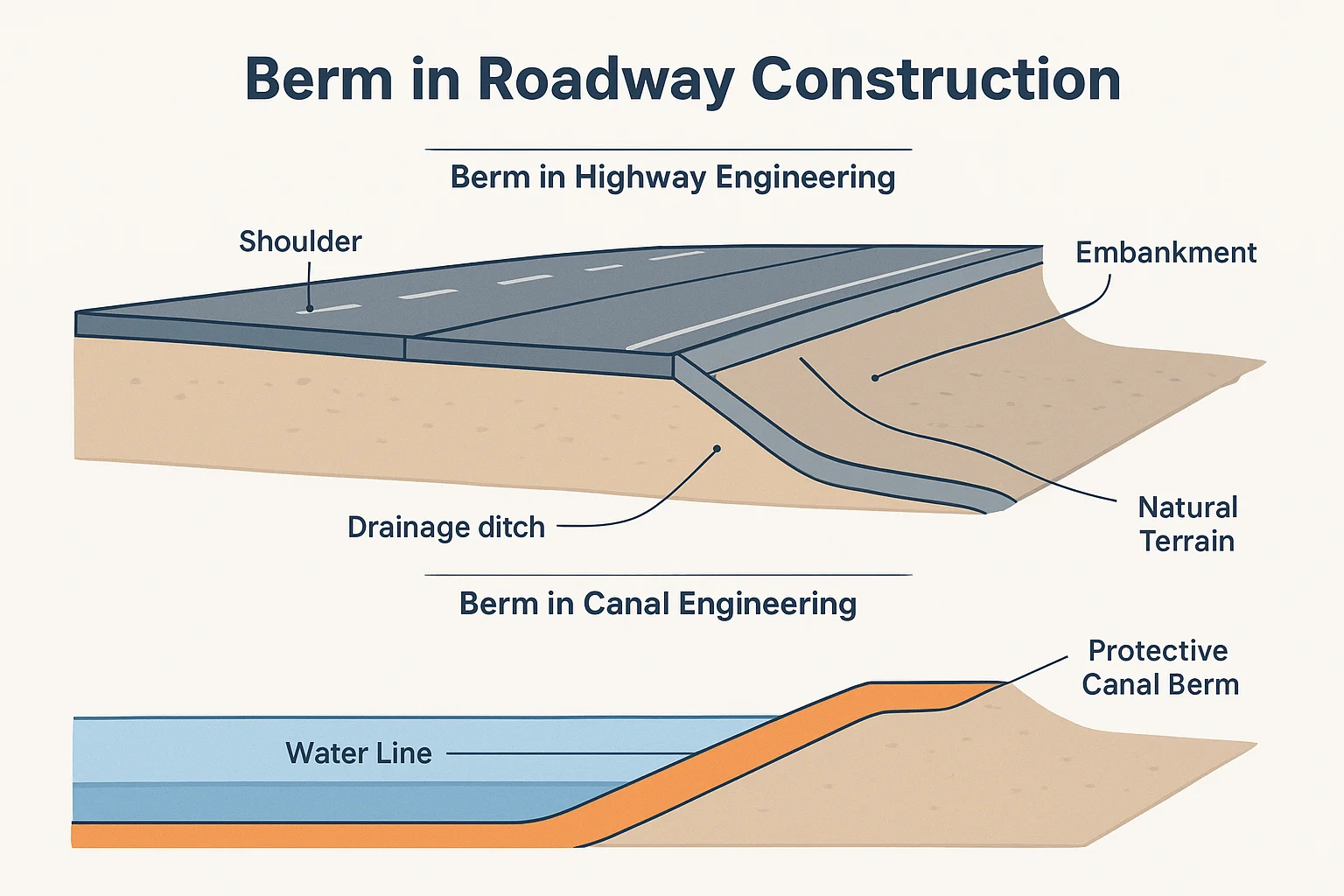
The berm in road is an important part of embankment design in highway engineering. It is the horizontal strip of land provided between the road formation and the side slope, or sometimes at intervals on a high embankment, to improve safety, drainage, and slope stability.
Although it may look like a simple extra strip of soil, a berm performs several technical functions. It helps protect the embankment slope, supports maintenance access, reduces erosion, and can improve the overall performance of the earthwork section.
In canal engineering, a berm is also used, but its function and location are different. Understanding the purpose of berm in road, its typical width, construction method, and the difference between canal berm vs road berm is useful for students, site engineers, and contractors alike.
What is a Berm in Road?
A berm in road is a nearly level strip provided on an embankment or along the edge of a road section. It acts as a buffer zone between the traffic carriageway and the adjacent slope or drainage feature. In many highway projects, berms are especially relevant where the road is built on a high fill or where slope protection is needed.
In simple terms, the berm gives the embankment a safer and more stable geometry. It is not the main travel lane, but it contributes to the long-term durability of the road structure.
Purpose of Berm in Road
The main purpose of berm in road is to improve stability and safety. It reduces the direct exposure of the embankment slope to runoff, surface erosion, and localized damage caused by maintenance activity or traffic-related impacts.
Key functions of a road berm include:
- Embankment slope protection by reducing erosion and runoff impact.
- Improved stability on high embankments by breaking a long slope into smaller segments.
- Maintenance access for inspection, repair, and vegetation control.
- Drainage control by helping guide surface water away from the slope face.
- Safety support by providing a recovery or buffer area in some road layouts.
In high fill sections, berms are particularly useful because a single long slope is more vulnerable to erosion and maintenance problems. A berm can also help reduce the apparent steepness of the embankment and make construction easier to control.
Berm Width Calculation: What Controls the Size?
The berm width calculation is not a universal fixed value. It depends on the road cross-section, embankment height, slope angle, drainage needs, maintenance access requirements, and the applicable project specifications or highway authority guidelines.
In practice, designers consider the following factors before finalizing berm width:
- Height of embankment — higher fills often need more careful slope protection and access.
- Slope gradient — steeper side slopes may require wider or additional berms.
- Drainage arrangement — space may be needed to intercept or carry runoff safely.
- Maintenance access — the berm should allow workers and equipment to inspect the embankment.
- Right of way constraints — available land may limit the berm size.
A practical way to think about berm width is that it must be wide enough for its intended function. If it is only meant as a narrow inspection strip, the width may be modest. If it must support drainage channels, slope protection works, or equipment movement, the width must be greater. Final dimensions should always come from the project design rather than from a generic rule.
Types of Berm Used in Road and Highway Works
1. Embankment berm
This is the most common type in road projects. It is provided on high embankments to interrupt the slope and improve stability.
2. Shoulder berm
In some layouts, a berm is provided near the shoulder zone to separate traffic from the side slope or drainage feature. This is more of a functional buffer in certain road sections.
3. Maintenance berm
This type is intended mainly for inspection and upkeep of drains, slope protection systems, or retaining features adjacent to the road.
Construction of Berm in Road
The construction of a berm in road is normally done as part of the embankment work. Good compaction and proper surface shaping are essential because a poorly built berm can collect water and cause local failure.
- Prepare the foundation by clearing and compacting the base where the embankment and berm will be formed.
- Place fill material in layers and compact each layer to the required density.
- Shape the berm to the specified width and level surface, maintaining proper cross-fall for drainage if required.
- Form the side slopes with the correct gradient to avoid erosion and slippage.
- Provide slope protection such as turfing, pitching, stone protection, geotextile systems, or other approved measures depending on site conditions.
- Inspect drainage paths to ensure water will not pond on the berm or run uncontrolled down the embankment face.
For embankment slope protection, the berm often works together with turfing, stone pitching, riprap, or lined drains. The exact protection method depends on rainfall, soil type, flow conditions, and design details.
Materials and Practical Considerations
Berm material is usually the same as the embankment fill, unless the design specifies a special layer. The fill should be suitable for compaction, stable under moisture changes, and free from harmful organic matter or oversized debris.
Important site considerations include:
- Avoiding loose fill at the edges of the berm.
- Maintaining proper camber or cross-slope so water does not stand on the surface.
- Ensuring the berm does not become a pathway for uncontrolled erosion.
- Protecting the berm edge from wheel loads if maintenance vehicles will use it.
Quality control should focus on layer thickness, moisture content during compaction, and the final geometry. Even a well-designed berm can fail if the surface is uneven or badly drained.
Road Berm vs Canal Berm
The terms may sound similar, but canal berm vs road berm refers to two different engineering functions.
| Feature | Road Berm | Canal Berm |
|---|---|---|
| Main purpose | Supports embankment stability, drainage, and maintenance access | Provides space between canal edge and adjacent slope, road, or service area |
| Location | Along or within a road embankment section | Along the canal banks or between canal features |
| Typical function | Slope protection and access in highway works | Canal maintenance, access, and bank stability |
| Design influence | Traffic, drainage, embankment height, safety | Waterway operation, bank stability, access, lining details |
In canal works, berms may be used to protect the canal bank or provide a service strip. In road works, the berm is more closely tied to embankment stability and roadside safety. The concept is similar, but the engineering objective is different.
Common Design and Execution Mistakes
- Providing a berm without proper drainage, which leads to water ponding.
- Using poorly compacted fill and creating settlement cracks.
- Ignoring the need for slope protection on exposed embankments.
- Reducing berm width below what is needed for inspection or maintenance access.
- Not matching the berm design with the actual embankment height and soil condition.
These mistakes can reduce the effectiveness of the berm and compromise the embankment over time. Good planning at the design stage is much easier than repairing erosion or slope damage later.
Practical Example
Consider a highway section built on a high earthen embankment in a rainfall-prone area. The design may include a berm so the long side slope is interrupted and surface runoff can be managed more safely. The berm may also be used for inspection and to support slope protection works such as turfing or stone pitching.
In this type of project, the berm is not just extra width. It becomes an active part of the embankment protection system and helps the roadway perform better during heavy rain and routine maintenance.
Advantages and Limitations
Advantages
- Improves embankment stability.
- Helps control erosion on side slopes.
- Supports maintenance and inspection access.
- Can improve drainage management.
Limitations
- Requires additional land width.
- Needs proper drainage to avoid water accumulation.
- Increases earthwork quantity and cost.
- Must be designed carefully for project-specific conditions.
FAQs
What is the main function of a berm in road?
The main function is to improve embankment stability, support drainage, and protect the side slope from erosion and damage.
Is berm width fixed for all roads?
No. Berm width depends on the project design, embankment height, drainage needs, and site constraints. It is not a universal fixed value.
Why is embankment slope protection important near a berm?
Because the berm alone does not stop erosion. The slope surface still needs protection, especially in rainfall-prone areas or on steep embankments.
Can a berm be used for vehicle movement?
Sometimes it can support maintenance vehicles if the design allows it, but it should not be assumed to be a traffic lane unless specified in the project design.
What is the difference between canal berm vs road berm?
A road berm mainly supports roadway embankment stability and drainage, while a canal berm is provided for canal bank stability, maintenance access, or separation within canal works.
What is the biggest construction issue with berms?
Poor drainage and weak compaction are common problems. If water collects on the berm or the fill is not compacted properly, settlement and erosion can develop.
Conclusion
A berm in road is a small but important feature in highway embankment design. It improves slope stability, helps with drainage, supports maintenance, and works as part of overall embankment protection. Its width and details are not fixed for every project, so the final design should always follow site conditions and applicable engineering requirements.
For civil engineering practice, the key takeaway is simple: a well-designed berm is not wasted space. It is a functional element that helps the road perform safely and durably over time.