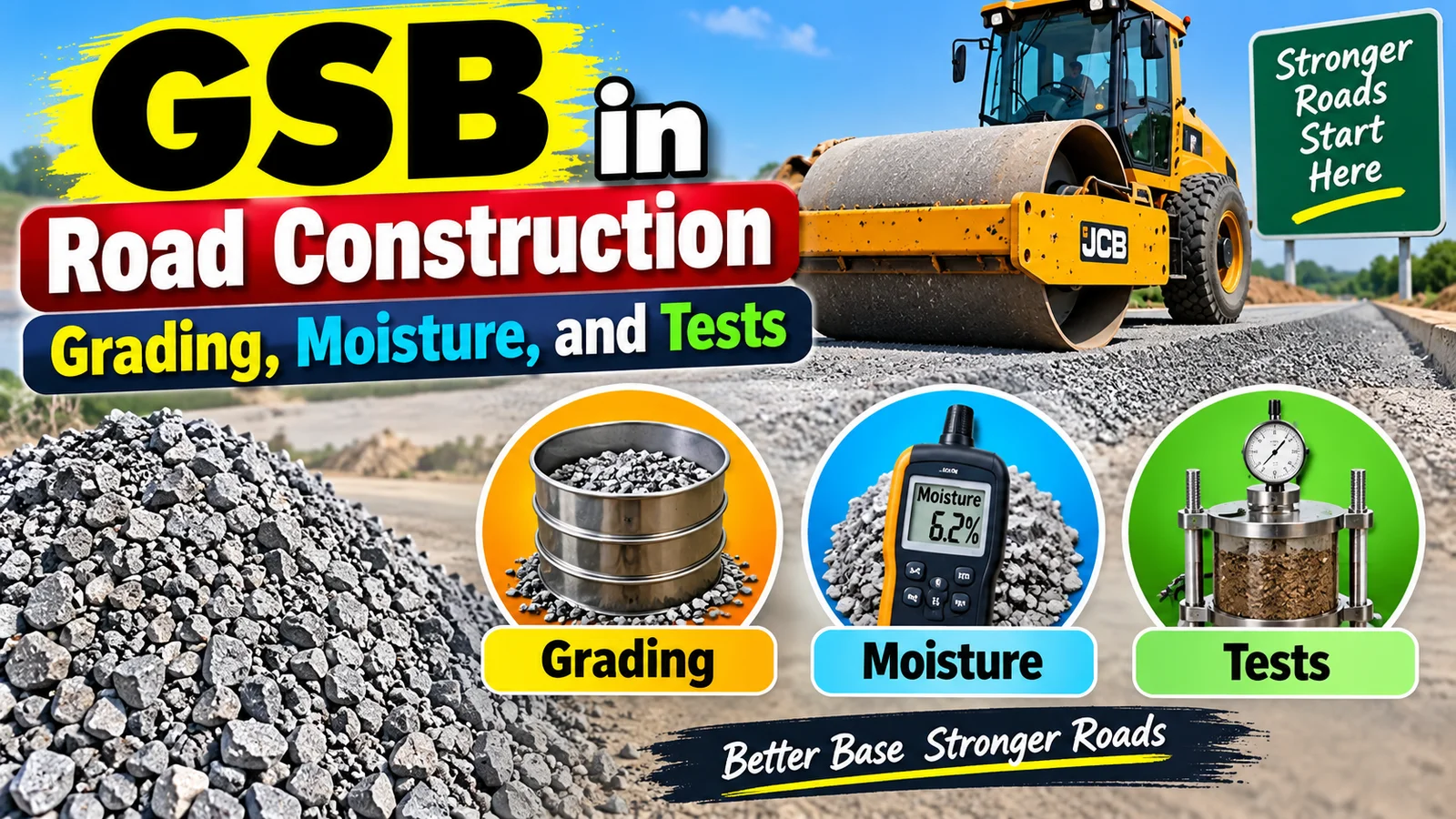
If you are asking what is gsb in road construction, the short answer is this: GSB stands for Granular Sub-Base, a prepared layer of granular material laid below the base course in a pavement structure. It acts as a load-spreading, drainage-supporting, and working platform layer before the next pavement layer is constructed.
GSB is one of the most important layers in flexible pavement construction because it helps transfer wheel loads safely to the subgrade while improving stability and reducing moisture-related damage. In simple terms, it is the foundation layer that prepares the road for the base and surface courses above it.
For civil engineering students, site engineers, contractors, and diploma engineers, understanding GSB grading, thickness, compaction, and field testing is essential for achieving proper road performance and meeting project requirements.
What Is GSB in Road Construction?
Granular Sub-Base is a layer made from crushed stone, natural gravel, quarried materials, or a mixture of suitable aggregates. It is placed above the prepared subgrade and below the base course in a pavement system. Its main role is not to resist traffic directly like the bituminous layers, but to provide a stable and uniform support layer.
GSB is especially useful where the subgrade is weak, moisture-sensitive, or likely to deform under repeated loading. It improves constructability by creating a firm surface for laying the next pavement layer and also helps in drainage if the material and compaction are properly controlled.
Functions of Granular Sub-Base
- Distributes wheel loads over a wider area of the subgrade.
- Provides a working platform for construction traffic and equipment.
- Improves drainage and reduces water retention in pavement layers.
- Reduces stress on the subgrade and helps control deformation.
- Supports the overlying base course with a uniform surface.
GSB Grading Table as per MoRTH
The gsb grading table morth is used to define the particle size distribution of materials permitted for granular sub-base construction. MoRTH specifies different gradings to suit different pavement needs. The exact grading selection may depend on the design, local material availability, and project specifications.
| GSB Grade | General Description | Typical Use |
|---|---|---|
| Grade I | Well-graded coarse granular material with larger nominal maximum size | Used where higher drainage and stronger sub-base support are needed |
| Grade II | Finer graded granular material compared with Grade I | Used in general road works where a finer gradation is suitable |
| Grade III | Even finer grading for specific applications | Used where project specifications require a finer sub-base layer |
It is important to note that the exact sieve limits and percentage passing requirements should always be checked from the applicable MoRTH specification and project document, because grading requirements may be updated or project-specific. The engineer should not assume one gradation fits all situations.
Material Requirements for GSB
The material used for GSB should be durable, clean, and free from harmful organic matter, clay lumps, and excessive fines. Excessive plastic fines can reduce drainage and stiffness, which affects performance. The material should also be strong enough to remain stable after compaction and under traffic loading.
Common material sources include crushed rock, gravel, broken stone, or a combination of suitable granular materials. In many projects, the selection depends on local availability, cost, and compliance with quality requirements.
Important material characteristics
- Proper particle size distribution
- Low plasticity fines, if any
- Good durability and hardness
- Minimal clay, silt, and organic contamination
- Ability to compact into a stable layer
Granular Sub Base Thickness
The required granular sub base thickness is not a single universal value. It depends on the pavement design, subgrade strength, traffic loading, drainage requirement, and the specific road project. In practice, GSB may be laid in one or more layers depending on the total thickness specified in the design.
For site execution, the thickness should be checked carefully using level markers, grids, or survey control points. If the layer is too thin, it may not provide adequate support; if it is too thick without proper compaction in lifts, uniform density becomes difficult to achieve.
A practical rule on site is to place the material in manageable layers and compact each layer properly rather than trying to compact a very thick loose layer at once. The final compacted thickness must match the approved design or specification.
Moisture Content and Compaction Requirements
Proper moisture control is essential for achieving the desired density. The material should be brought close to its optimum moisture content before compaction. If it is too dry, it will not compact properly; if it is too wet, it may rut, pump, or lose strength under rolling.
The target moisture range and compaction requirement are generally defined in the project specification and the applicable standard. In field practice, the engineer should verify moisture uniformity across the spread layer before rolling starts.
GSB compaction test
A gsb compaction test is carried out to confirm that the placed layer has achieved the required density. The field density may be checked using approved methods such as sand replacement or nuclear gauge methods, depending on project practice and acceptance criteria.
Compaction is usually approved based on the percentage of the laboratory maximum dry density specified for the layer. The exact value depends on the contract and standard requirements, so it should be verified from the project documentation rather than assumed.
Good compaction practice on site
- Prepare and trim the underlying surface properly.
- Spread the GSB material in the specified loose thickness.
- Adjust moisture content close to the required range.
- Compact with suitable rollers in overlapping passes.
- Check level, thickness, and field density.
- Repair any segregated, loose, or soft areas before moving ahead.
CBR Value for GSB
The cbr value for gsb is an important quality indicator because it reflects the strength of the compacted granular layer under soaking or controlled test conditions, depending on the specification. A higher CBR generally indicates better load-bearing capacity, but the required value may vary with the material classification and project standard.
In road construction, the CBR requirement is usually linked to design assumptions and the quality of the sub-base material. Therefore, the engineer should always confirm the specified minimum CBR from the contract documents or approved standards rather than using a single universal number.
For practical planning, CBR is not just a laboratory number. It should represent how the material will behave after proper compaction and moisture control in the field.
GSB vs WMM
Many beginners confuse GSB with Wet Mix Macadam (WMM), but they serve different functions in the pavement structure. GSB is the sub-base layer, while WMM is typically the base course above it.
| Aspect | GSB | WMM |
|---|---|---|
| Position in pavement | Below base course, above subgrade | Above sub-base, below bituminous layers |
| Main role | Load distribution and drainage | Stronger structural base support |
| Material character | Granular, well-graded sub-base material | Crushed aggregates mixed and laid with controlled moisture |
| Structural requirement | Generally lower than base course | Higher strength and stiffness |
This comparison helps in understanding why GSB is not meant to replace the base course. It prepares the pavement foundation, while WMM provides stronger support for the upper layers.
Construction Procedure for GSB Layer
- Inspect the subgrade and ensure it is trimmed, compacted, and approved.
- Mark out the required line, level, and thickness.
- Spread suitable GSB material uniformly without segregation.
- Add water if needed to reach proper moisture condition.
- Compact the layer using the approved rolling pattern.
- Check surface evenness, thickness, and density.
- Rectify low, loose, or segregated locations before placing the next layer.
Common Site Problems to Avoid
- Using material with too many fines or clay contamination
- Placing a thick loose layer and expecting full compaction in one pass
- Poor moisture control before rolling
- Segregation during transport or spreading
- Not checking field density after compaction
- Allowing traffic on an under-compacted layer
Practical Example in Road Work
Suppose a two-lane road is being built on a subgrade that is moderately weak and moisture-sensitive. The design may call for a granular sub-base layer to improve support and create a stable working platform before the base course is placed. In such a case, the engineer would verify the material grading, spread the material in controlled lifts, compact each lift properly, and then check the field density and layer thickness before allowing the next layer to proceed.
This kind of control is critical because a poorly compacted GSB layer can lead to settlement, unevenness, and premature pavement distress later in service.
FAQ on GSB in Road Construction
What is GSB in road construction used for?
GSB is used as a sub-base layer to distribute loads, support the pavement structure, and improve drainage below the base course.
Is GSB the same as subgrade?
No. Subgrade is the prepared natural soil or improved soil below the pavement, while GSB is a separate granular layer placed above the subgrade.
How is GSB compaction checked?
Compaction is checked by field density testing, and the acceptance is based on the project’s specified compaction requirement.
Why is grading important in GSB?
Proper grading ensures good interlocking, compaction, stability, and drainage performance in the sub-base layer.
Can GSB thickness be the same for every road?
No. Granular sub-base thickness depends on the pavement design, traffic loading, subgrade condition, and project specifications.
What happens if GSB is over-wet during compaction?
Over-wet material may lose strength, become difficult to compact properly, and create instability or rutting under rollers and traffic.
Conclusion
Understanding what is gsb in road construction is essential for anyone involved in pavement work. GSB is the granular sub-base layer that supports the road structure, improves drainage, and provides a stable platform for the base course above it.
For good performance, the material must meet the required grading, the thickness must match the design, and compaction must be checked carefully with proper field testing. When these basics are controlled well, the pavement has a much better chance of performing as intended.