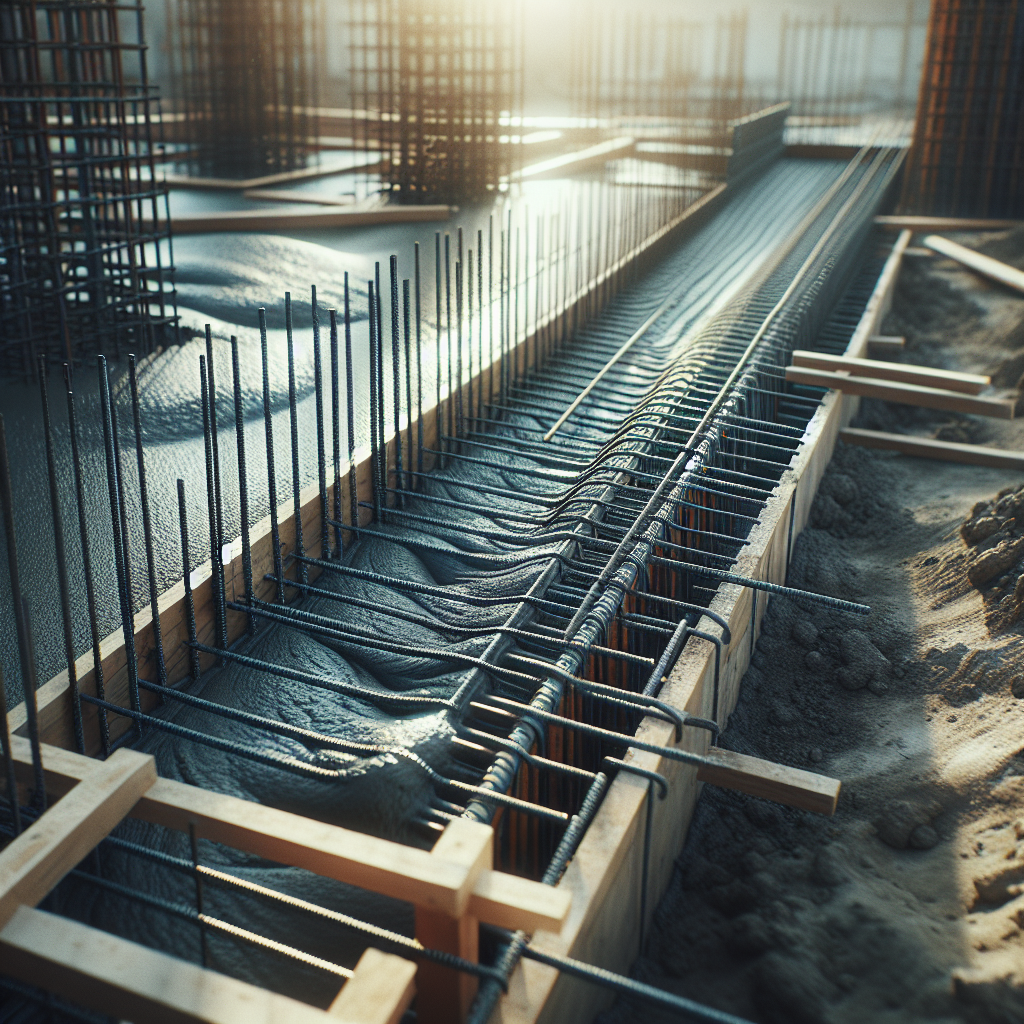
Concrete footings form the base that transfers a building’s loads into the ground. They control settlement, resist frost action, and stabilize columns, walls, and beams.
This article breaks down how footings work, common types, key design considerations and practical installation notes for reliable performance.
How footings support structures
Footings spread concentrated loads over a wider area so the soil can carry them without excessive settlement. They also anchor the structure against uplift and lateral loads.
Proper footing selection and sizing reduce differential settlement and prevent cracking in the structure above. Soil conditions, load magnitude, and environmental factors all affect footing performance.
Common types and when to use each
Several footing types meet different structural needs. Choosing the right one depends on load distribution, geometry, and ground conditions.
Isolated pad (spread) footing
These are used under single columns and are usually square or rectangular. They are efficient when column loads are moderate and soil bearing capacity is adequate.
Pads are easy to form and pour and often reinforced with a simple mesh or small rebar grid to control cracking.
Strip footing
Strip footings run continuously under load-bearing walls. They spread the wall load along a trench-like base and are common in residential foundations.
Depth and width are sized to keep bearing pressure within soil limits and to resist frost heave in cold climates.
Combined footing
When two columns are close and individual footings would overlap, a combined footing supports both loads on one rectangular or trapezoidal pad. It helps maintain uniform soil pressure beneath the footing.
Combined footings are designed to balance load transfer and avoid eccentric loading that could cause rotation.
Raft (mat) foundation
A raft or mat covers a large building area and supports many columns and walls on a single slab. It’s used where soil bearing capacity is low or loads are spread over a wide footprint.
Mats reduce differential settlement by tying the entire floor system together and are often heavily reinforced.
Design considerations and structural details
Designing footings requires balancing structural forces, soil capacity, and durability needs. Several technical factors guide spacing, depth, and reinforcement.
Soil bearing capacity and investigation
A soil report gives the allowable bearing pressure and identifies problematic layers like loose sand, peat, or soft clay. Footing size is based on allowable bearing pressure to limit settlement.
In some conditions, ground improvement or deeper foundations may be necessary instead of shallow footings.
Load calculations and footing sizing
Combine dead loads, live loads, and any concentrated loads to calculate the total load on each footing. The footing area equals the load divided by the allowable soil pressure.
Minimizing eccentricity and providing adequate footing thickness helps prevent tilting and ensures even stress distribution.
Frost depth and minimum embedment
In freezing climates, footings must sit below the frost line to avoid heaving. Local building codes specify minimum depths. Even in mild climates, embedment protects against seasonal moisture changes.
Providing gravel backfill and good drainage reduces the risk of frost action around shallow foundations.
Reinforcement and concrete strength
Rebar controls tensile stresses and reduces cracking. Typical shallow footings use a grid of #3 to #5 bars depending on loads and span between supports.
Concrete strength (usually 20–35 MPa / 3000–5000 psi for footings) is chosen for structural demands and environmental exposure. Adequate cover keeps reinforcement safe from corrosion.
Settlement and differential movement
Design must evaluate expected settlement and keep differential settlement within limits to avoid cracking of walls, floors, or finishes. Uniform footing stiffness and even load distribution help control movement.
When soils are variable, engineers may increase footing size, use a mat foundation, or opt for deep foundations to reach stable layers.
Drainage and moisture control
Water undermines footing performance by weakening soils and increasing frost risk. Design includes slope grading, drainage pipes, and impermeable membranes where needed.
Capillary breaks and gravel layers under slabs and footings help manage groundwater and maintain consistent soil conditions under the foundation.
Installation steps and best practices
Careful installation protects the design intent and extends the life of a footing. Each stage, from excavation to curing, affects final performance.
Site preparation and excavation
Remove organic material and loose soil until firm bearing strata are exposed. Verify elevation and layout using string lines or survey markers to match drawings.
Check side slopes and shoring requirements for safety on deeper excavations and follow local safety rules for personnel and equipment.
Forming, reinforcement placement, and concrete cover
Set forms to the correct dimensions and slope for drainage. Place reinforcement on chairs to maintain concrete cover and prevent direct contact with soil.
Overlap and tie rebar per structural details. Ensure no contamination of the reinforcement by mud or standing water before pouring.
Pouring concrete and compaction
Use mixes with the specified strength and slump. Place concrete continuously to avoid cold joints and consolidate with vibrators or rodding to remove voids.
Keep the surface slightly sloped where required and screed to the proper top elevation. Avoid adding excess water on site, which weakens the concrete.
Curing and protection
Proper curing ensures concrete reaches intended strength. Keep it moist for several days using wet burlap, plastic sheeting, or curing compounds as appropriate for the mix and weather.
Protect footings from rapid drying, freezing, or vandalism during the critical early strength gain period.
Backfill and compaction
Backfill in layers and compact to restore lateral support and prevent future settlement. Avoid heavy equipment directly over fresh footings until adequate strength is reached.
Finish grading should slope away from the foundation to shed water from the building perimeter.
Conclusion
Footings are a small but critical part of any structure. Their design and installation depend on soil, loads and environmental factors.
Following sound structural rules—proper sizing, reinforcement, drainage and curing—helps ensure a stable, durable foundation that protects the structure above.
Frequently Asked Questions
What is the main purpose of a concrete footing?
Its primary role is to spread structural loads over a larger area of soil so the ground can carry the weight without excessive settlement or failure.
How deep should a footing be placed?
Depth depends on local frost depth, soil conditions and load. Building codes set minimum depths to prevent frost heave and to reach competent bearing strata.
When is a raft foundation preferred?
A raft is used when soil bearing capacity is low, loads are spread across many supports, or when you need to limit differential settlement across a building footprint.
How much reinforcement do footings need?
Reinforcement depends on loads, footing thickness and span. Typical shallow footings use a modest rebar grid to control cracking and provide tensile strength where bending occurs.
Can footings be poured in cold weather?
Yes, but precautions are necessary: use warmer mixes, protect against freezing, extend curing time and shield concrete from cold winds to allow proper strength development.