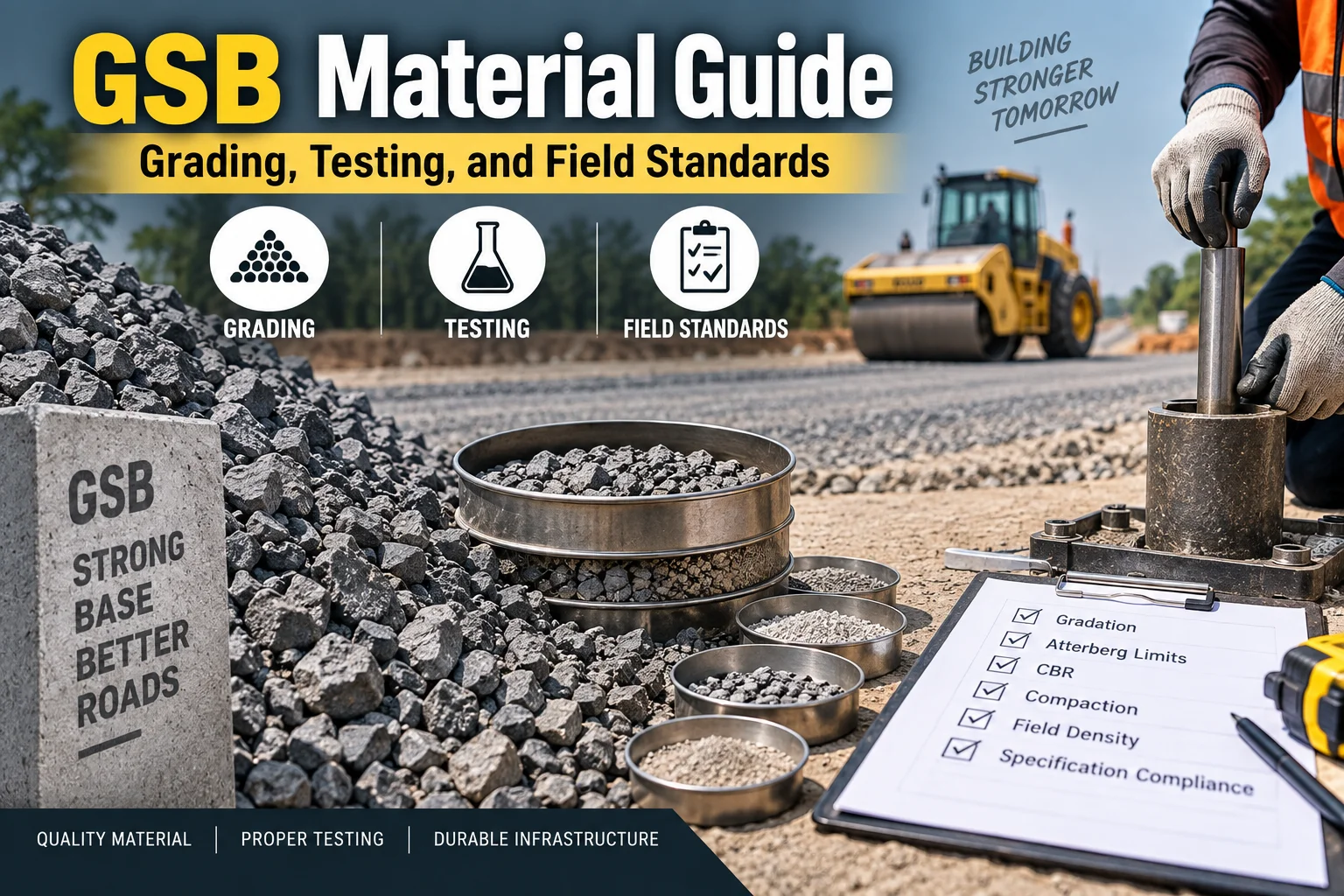
When it comes to flexible pavement layers, gsb material plays a critical role in providing a stable foundation below the base course. GSB stands for Granular Sub-Base, and it is the layer that sits between the prepared subgrade and the upper pavement layers such as WMM or base course. Its job is simple but important: spread wheel loads, improve drainage, and protect the pavement structure from moisture-related damage.
For civil engineers, contractors, and site supervisors, understanding the grading, thickness, and compaction requirements of GSB is essential for quality road construction. The actual requirements depend on the project design and the applicable specifications, but MoRTH provides widely used guidance on material properties, grading, and construction practices.
This article explains gsb material in practical terms, including gsb grading table morth requirements, granular sub base thickness, compaction control, and the importance of cbr value for gsb in road performance.
What is GSB Material in Road Construction?
Granular Sub-Base is a layer made of well-graded granular material such as natural sand, moorum, gravel, crushed stone, or a mixture of these materials. In some cases, recycled or processed aggregates may also be used if they satisfy the specification requirements.
The layer is placed on the prepared subgrade and compacted to form a strong, drainage-friendly platform for subsequent pavement layers. It is not meant to act as a high-strength structural layer like the base course, but it is vital for load distribution and working platform support.
Main functions of GSB
- Provides a stable and uniform working platform for construction.
- Helps distribute loads from upper pavement layers to the subgrade.
- Improves drainage and reduces moisture accumulation.
- Protects the subgrade from contamination and pumping of fines.
- Reduces the risk of differential settlement in the pavement system.
GSB Grading Table as per MoRTH
The gsb grading table morth is used to ensure that the granular material has a proper particle size distribution. A well-graded material contains different particle sizes that help the layer compact densely and resist deformation.
MoRTH specifies grading requirements for GSB through standard grading categories. The selection of grading depends on the source material and project requirement. Since specifications may vary by contract and latest revision, engineers should always check the applicable project documents and current MoRTH provisions.
In practice, the key idea is that GSB must be graded enough to compact well, yet free-draining enough to prevent water retention. Oversized aggregate, excess clay, or poorly graded material can lead to weak spots and construction problems.
Granular Sub Base Thickness: What Should Be Used?
The required granular sub base thickness is not fixed for every road. It depends on the pavement design, traffic loading, subgrade condition, and the adopted standard or project specification. In roadworks, GSB may be provided in one or more compacted layers to achieve the total design thickness.
Thicker GSB may be needed where the subgrade is weak, drainage conditions are poor, or the pavement design requires additional support. In stronger subgrade conditions, the required thickness may be lower. The design engineer should decide the thickness based on traffic and subgrade strength rather than using a single universal value.
Common thickness considerations
- Subgrade bearing capacity and uniformity
- Traffic intensity and axle load repetitions
- Drainage conditions and rainfall exposure
- Construction staging and layer stability
- Specifications in the approved pavement design
For site execution, GSB is often placed in layers that can be compacted properly with available rollers. Very thick loose layers should be avoided because they may not compact uniformly through the full depth.
Compaction, OMC, and GSB Compaction Test
Proper compaction is one of the most important quality-control requirements for gsb material. A compacted layer has lower voids, better load transfer, and improved resistance to settlement. If the layer is not compacted correctly, even good material can fail in service.
Optimum Moisture Content (OMC) is the moisture level at which the material achieves maximum dry density during compaction. Field moisture should be close to this value so that the roller can densify the layer effectively. If the material is too dry, it will not compact properly. If it is too wet, the layer may become unstable and lose strength during rolling.
Typical compaction control steps
- Prepare and level the subgrade surface.
- Spread GSB in a uniform loose layer thickness suitable for compaction.
- Adjust moisture content near the OMC.
- Compact with the specified roller or equipment in the required passes.
- Check density, surface level, and thickness after compaction.
The gsb compaction test usually involves field density checks such as the sand replacement test, core-based methods where applicable, or other approved field density methods. The acceptance criterion is typically based on achieving the required percentage of laboratory maximum dry density, as specified in the contract documents or applicable standards. The exact percentage should not be assumed universally because it may vary by specification.
CBR Value for GSB and Why It Matters
The cbr value for gsb is an important indicator of bearing capacity. CBR stands for California Bearing Ratio, which measures how much resistance a material offers under penetration compared with a standard reference material. For GSB, CBR helps determine whether the material is suitable for sub-base use and whether it can support the design pavement structure.
Higher CBR generally indicates better load-bearing behavior, but the acceptable value depends on the specification and the role of the layer in pavement design. In road projects, CBR testing is often used for subgrade evaluation as well as for granular layer quality assessment when required by the project. Engineers should refer to the relevant standard or design document for acceptance limits.
Why CBR is important in practice
- Helps assess the strength of the material under traffic loading
- Supports pavement thickness design decisions
- Helps compare borrow sources or quarry materials
- Indicates whether improvement or blending is needed
GSB vs WMM: Key Difference
GSB and Wet Mix Macadam (WMM) are both granular pavement layers, but they serve different functions. GSB is the sub-base layer placed below the base, while WMM is typically a stronger base layer placed above GSB.
Understanding this difference helps site engineers avoid material mix-ups and ensure the correct layer is constructed in the correct order.
Construction and Quality-Control Tips for Site Execution
Good GSB construction depends on material quality as much as workmanship. Before laying, the subgrade should be properly trimmed, compacted, and checked for soft spots. Any loose soil, standing water, or contamination can reduce the performance of the layer.
Common site checks
- Confirm approved source and grading of material.
- Check moisture before rolling.
- Ensure uniform spreading without segregation.
- Verify layer thickness after compaction.
- Carry out density and level checks at specified intervals.
- Ensure drainage arrangements are in place during monsoon or wet conditions.
One common mistake is placing too much loose material in a single layer. The top may look compacted, but the lower portion can remain loose. Another mistake is using clayey or contaminated borrow material, which harms drainage and long-term stability.
Practical Example of GSB Use in a Road Project
Consider a rural road or a city access road with a weak subgrade after rain. The engineer may first improve the formation, then place GSB as a working and drainage layer before constructing the WMM base. If the material is properly graded and compacted near OMC, the layer helps create a stable platform for the rest of the pavement works.
This is especially useful where traffic construction vehicles need to move over the formation repeatedly. A well-constructed GSB layer reduces rutting, protects the subgrade, and improves the quality of the upper layers.
Frequently Asked Questions
What is gsb material used for?
GSB material is used as a granular sub-base layer in road construction. It provides support, drainage, and load distribution below the base course.
What is the main requirement in the gsb grading table morth?
The main requirement is a well-graded particle size distribution that compacts well and allows drainage. The exact grading limits must match the applicable MoRTH specification and project documents.
How is granular sub base thickness decided?
Granular sub base thickness is decided based on pavement design, traffic load, subgrade strength, and drainage conditions. It is not the same for all projects.
Which test is used for gsb compaction test?
Field density tests such as the sand replacement test are commonly used, along with other approved methods specified in the contract. The acceptance is usually based on the required dry density level.
Why is cbr value for gsb important?
CBR indicates the load-bearing capacity of the granular material. It helps confirm whether the material is suitable for sub-base use and supports pavement design decisions.
Can GSB be laid in one layer?
That depends on the compacted thickness and equipment used. If the layer is too thick for proper compaction, it should be placed in multiple layers.
Conclusion
gsb material is a key pavement layer that improves support, drainage, and construction stability in road works. Correct grading, suitable thickness, proper moisture control, and reliable compaction testing are all necessary for good performance. For accurate execution, engineers should always follow the approved design, contract specifications, and the applicable MoRTH requirements.
When GSB is selected and compacted properly, it creates a dependable foundation for the layers above and helps improve the long-term performance of the road.