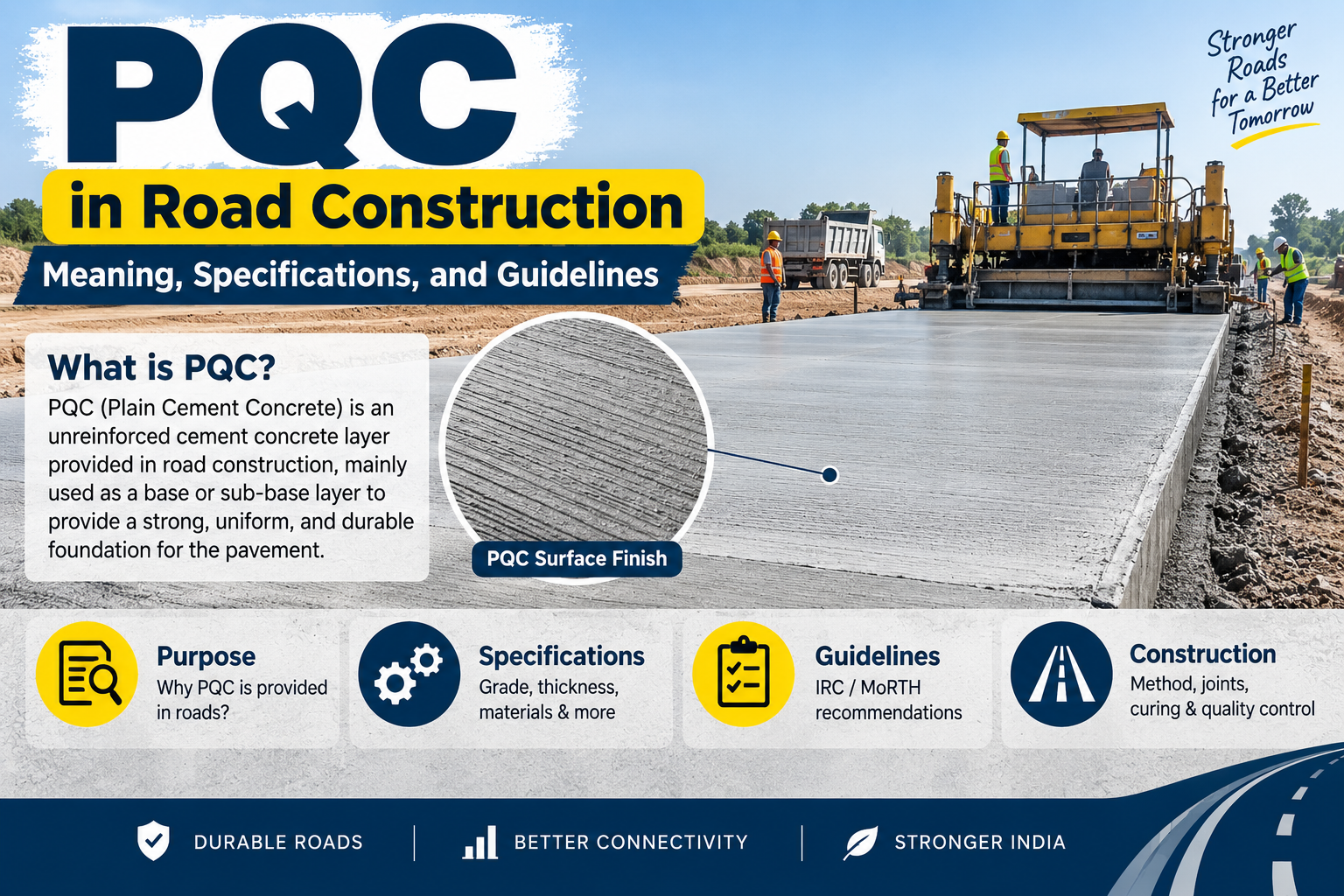
The PQC full form in road construction is Pavement Quality Concrete. It is the specially designed concrete slab used as the main structural and wearing layer in a rigid pavement. The slab is designed for repeated wheel loading, flexural stress, environmental exposure and the project-specific service requirements.
This page explains the term and its role. For detailed design concepts, mix materials and rigid-pavement layers, see our PQC meaning and specification article. For paving sequence, joint construction and field tests, see the PQC construction process.
What Does PQC Mean in Road Construction?
PQC stands for Pavement Quality Concrete. It is the specially designed concrete used to form the main structural and wearing slab of a rigid pavement. The slab carries repeated wheel loads and resists bending stresses while working with the supporting base, sub-base, joints and drainage system.
PQC is not simply any concrete poured on a road. The mixture, flexural performance, slab thickness, joint layout, curing and acceptance tests are selected through the pavement design and project specification.
Where Is PQC Used?
PQC may be specified for rigid-pavement sections on national highways, expressways, urban roads, industrial pavements, port areas and airport pavements. Its use depends on traffic, ground conditions, drainage, construction capability and the project’s pavement design.
Position of PQC in a Rigid Pavement
In a typical jointed rigid pavement, the PQC slab sits above the supporting layer system. Depending on the design, layers below it may include a separation membrane, Dry Lean Concrete (DLC), Granular Sub-Base (GSB) and the prepared subgrade. Not every project uses the same combination or thickness; follow the approved cross-section.
For the detailed explanation of PQC materials, flexural strength, typical specification checks and design considerations, see our PQC meaning and specification guide. For field sequence, paving equipment, joints, curing and tests, see the PQC construction process guide. For slab-thickness design, see PQC concrete thickness.
FAQs on PQC in Road Construction
1. What is the full form of PQC in road construction?
PQC stands for Pavement Quality Concrete. It is the concrete slab used in rigid pavement roads.
2. Is PQC used in flexible pavement?
PQC is the concrete slab used in rigid pavement systems. Flexible pavements are generally built with bituminous layers, although the exact pavement structure depends on the project design.
3. Why is PQC preferred for highways?
PQC may be selected for highways when the rigid-pavement design, traffic, ground conditions, construction resources and whole-life evaluation support its use. Durability and maintenance needs depend on design, materials, joint details, drainage, construction quality and subsequent maintenance.
4. Does PQC thickness remain the same for all roads?
No. Thickness depends on traffic loading, design life, subgrade strength, base layer, and project specifications.
5. What is the main quality issue in PQC construction?
Common issues include poor curing, improper joint cutting, uneven slab thickness, and weak surface finish. These can affect pavement performance.
Conclusion
To sum up, the PQC full form in road construction is Pavement Quality Concrete. It is the concrete slab used as the principal structural and wearing layer in a rigid pavement. Its properties, thickness, joints and acceptance tests are determined by the pavement design and governing project specification. For Indian highway work, follow the approved IRC and MoRTH documents and project drawings rather than assuming a universal mix or dimension.