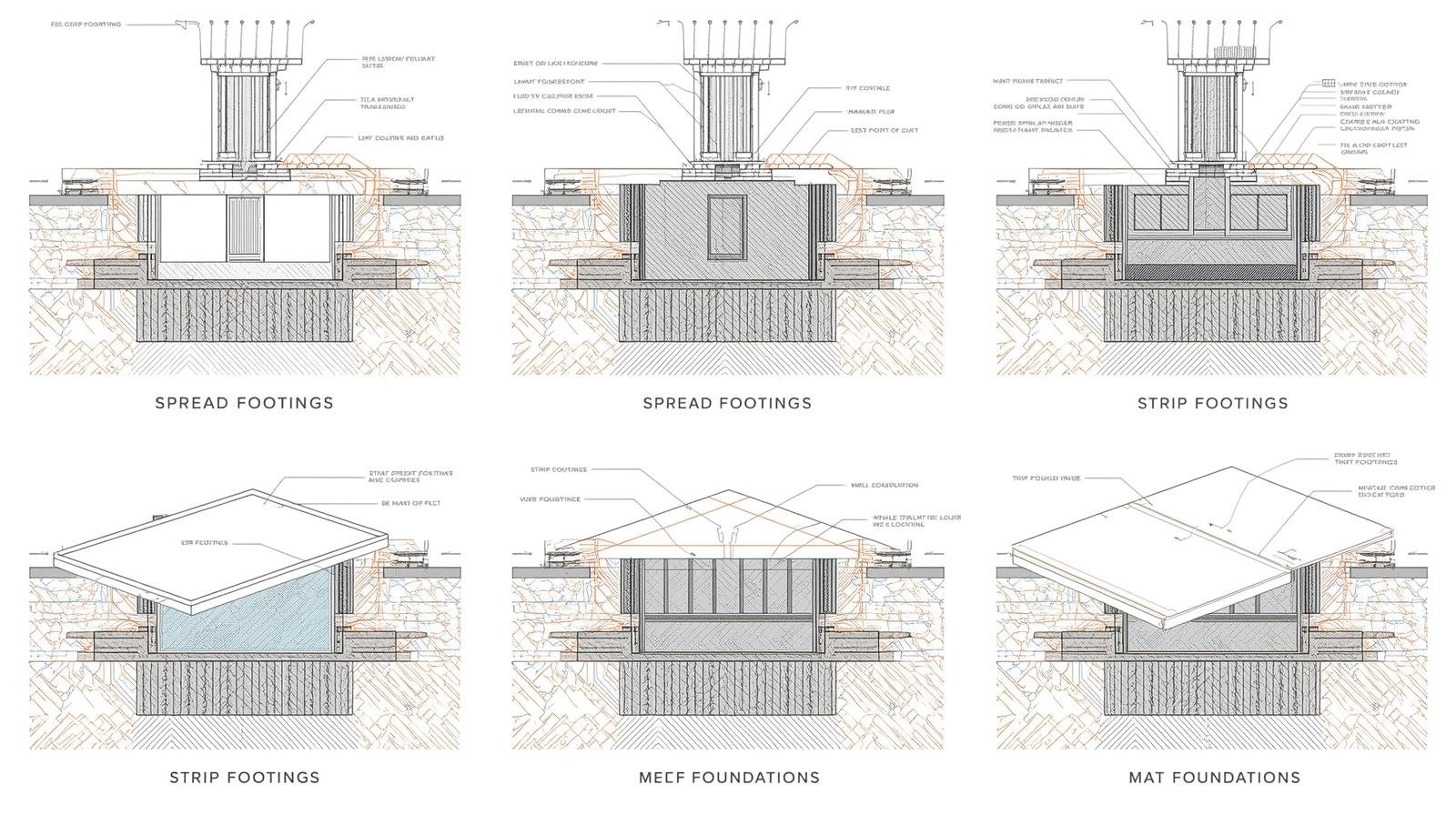
Understanding different footing types is essential in building construction because footings are the structural elements that directly transfer loads from columns and walls to the soil. A footing is a critical part of the foundation system, designed to spread structural loads over a larger area to prevent excessive soil pressure and settlement. The proper selection of footing types ensures structural stability, durability, and safety. Footings are generally classified under shallow foundation systems and are widely used in residential, commercial, and industrial construction projects.
What Is a Footing?
A footing is the lowest part of a foundation that comes in direct contact with the soil. It distributes loads from structural components such as columns and load-bearing walls to the ground. The main purpose of a footing is to prevent differential settlement and provide a stable base for the structure. Footings are usually constructed using reinforced concrete due to its strength and durability.
Classification of Footing Types
Footing types are primarily classified based on their shape, load distribution pattern, and structural requirements. The most common footing types include isolated footing, combined footing, strip footing, strap footing, raft footing, and stepped footing. Each type is selected according to soil bearing capacity, load magnitude, and site conditions.
Isolated Footing
Isolated footing, also known as pad footing, supports a single column. It is one of the most commonly used footing types in residential and low-rise buildings. The shape may be square, rectangular, or circular depending on the column dimensions and load distribution. Isolated footings are economical and simple to construct when soil bearing capacity is adequate. They are suitable where columns are spaced apart and loads are moderate.
Combined Footing
Combined footing supports two or more columns when they are close to each other or when the building is near a property boundary. This type of footing ensures uniform load transfer and prevents unequal settlement. Combined footings may be rectangular or trapezoidal in shape based on structural requirements. They are commonly used in commercial buildings and urban construction projects where space limitations exist.
Strip Footing (Wall Footing)
Strip footing runs continuously under load-bearing walls. It distributes the wall load evenly across the soil surface. This footing type is commonly used in masonry structures and low-rise residential buildings. Strip footings are economical and effective when walls carry significant structural loads.
Strap Footing
Strap footing consists of two isolated footings connected by a rigid beam called a strap beam. The strap beam balances the load between columns, especially when one column is near a property line. This type of footing prevents eccentric loading and ensures uniform pressure distribution. Strap footings are used when property boundaries restrict footing extension.
Raft Footing (Mat Footing)
Raft footing, also known as mat footing, covers the entire building footprint and supports multiple columns and walls. It is used when soil bearing capacity is low and individual footings would overlap. Raft footings reduce differential settlement and provide better load distribution. This type is commonly used in apartment buildings, industrial structures, and areas with weak soil conditions.
Stepped Footing
Stepped footing is used when construction is carried out on sloped or uneven ground. The footing is constructed in steps to maintain structural stability and proper load transfer. It is commonly used in hilly regions and areas with varying ground levels.
Factors Affecting Selection of Footing Types
The selection of footing types depends on soil bearing capacity, building load, groundwater level, environmental conditions, and construction budget. Proper soil testing and structural analysis are necessary before choosing the appropriate footing. Inadequate selection may lead to settlement issues and structural cracks.
Advantages of Proper Footing Design
Well-designed footings provide uniform load distribution and prevent excessive settlement. They enhance structural stability and increase the lifespan of the building. Proper footing selection also reduces maintenance costs and improves resistance against environmental forces such as earthquakes and wind loads.
Conclusion
Footing types play a vital role in the overall performance of a building foundation. From isolated and combined footings to raft and strap systems, each footing type serves a specific structural purpose. Proper design and construction ensure stability, durability, and safety. Selecting the correct footing type based on soil and load conditions is essential for successful and long-lasting construction projects.