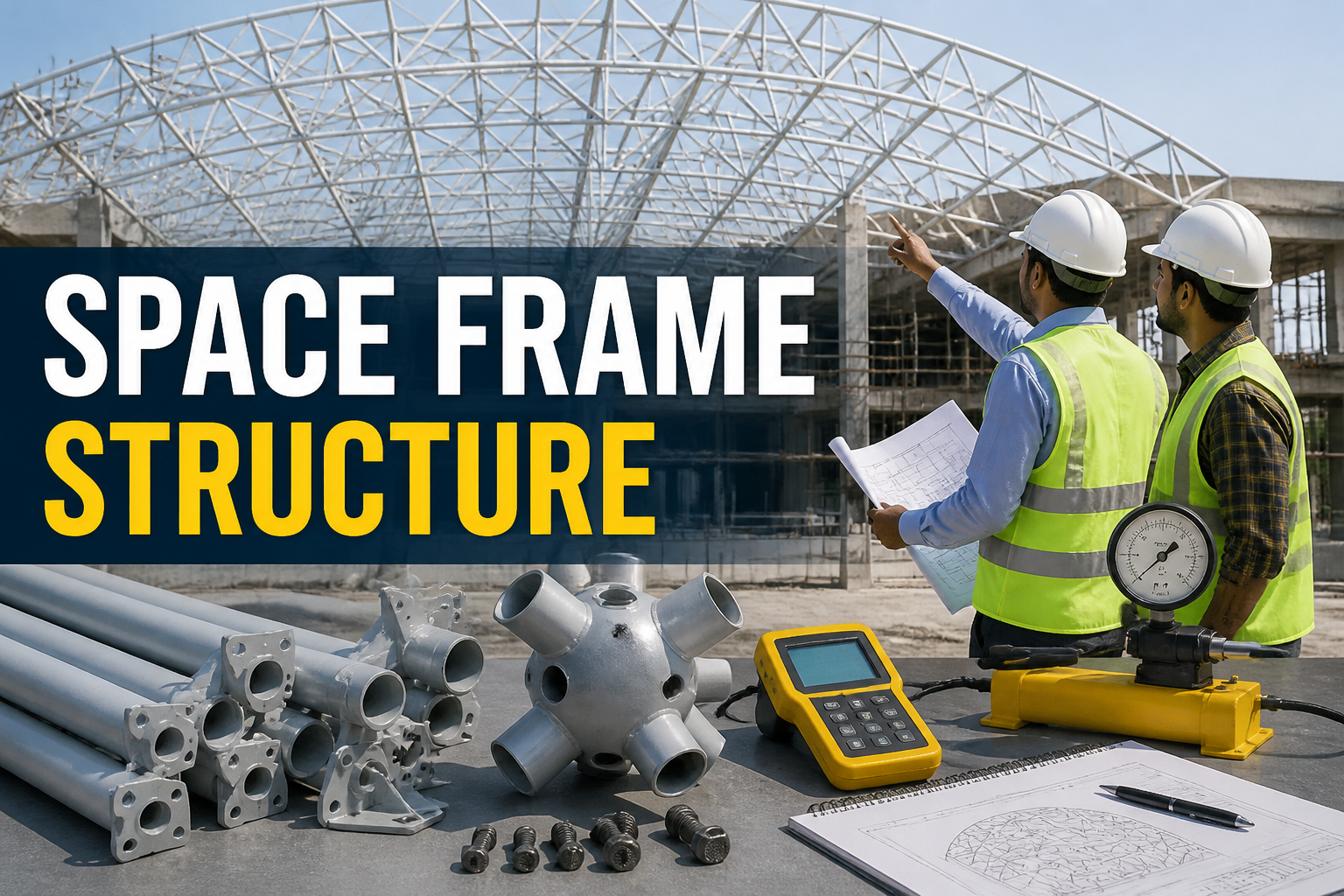
A space frame structure is an innovative architectural solution used widely in various construction projects due to its efficient load distribution and aesthetic appeal. Composed of a network of interconnected struts and nodes, this structure can span large areas without the need for internal supports. Understanding the space frame structure’s meaning, procedures for design and construction, equipment required, and its practical applications is essential for civil engineering professionals.
The structure’s design relies on rigorous engineering principles, balancing aesthetics with functionality. In this article, we will explore different types of space frames, the methodology involved in their construction, and the factors influencing their design and performance.
Types of Space Frame Structures
Space frame structures can be categorized into several types based on their geometry and arrangement:
- Two-Dimensional Frames: Used primarily for smaller structures like roofs and facades.
- Three-Dimensional Frames: Designed for larger applications, providing greater stability and load-bearing capacity.
- Pyramidal Frames: A specific type of three-dimensional frame that features triangular units, enhancing rigidity.
- Cylindrical Frames: Ideal for curved surfaces, such as geodesic domes, combining aesthetics with structural integrity.
Space Frame Structure Meaning
The term “space frame structure” refers to a skeletal framework made up of linear elements connected at joints to form a three-dimensional structure capable of distributing loads evenly. The nodes serve as the junction points where the struts connect, allowing the frame to resist both compressive and tensile forces effectively. This enables space frames to cover vast areas without the hindrance of internal support columns.
Design Procedure for Space Frame Structures
The design of a space frame structure involves several critical steps. Here’s a concise procedure:
- Define the Requirements: Establish load conditions, functional design, and aesthetic considerations.
- Geometry and Shape Selection: Choose the form of the space frame based on the project requirements—triangular, square, or custom forms.
- Material Selection: Common materials include steel and aluminum, selected based on strength requirements and environmental factors.
- Load Calculations: A structural analysis is usually conducted to determine the load distribution, using formulas and finite element methods (FEM).
- Modeling: Use software tools (like SAP2000 or STAAD Pro) to create detailed models of the space frame for further analysis.
- Detailing: Create construction drawings that detail the connections and joints.
Space Frame Structure Equipment
Various tools and equipment are essential during the construction of a space frame structure:
- Steel Fabrication Equipment: Machines for cutting, welding, and assembling the individual struts.
- Construction Cranes: Required for lifting and positioning large frame units.
- Surveying Equipment: Essential for accurate placement of the structure, ensuring proper alignment and levels.
- Fastening Tools: Bolts and braces are used for efficient connections between nodes and struts.
Space Frame Structure Formula
To ensure the safety and reliability of space frame structures, engineers often apply various formulas. One critical formula is the calculation of the axial forces in the struts:
| Parameter | Formula |
|---|---|
| Axial Force, N | N = (P * L) / (A * E) |
Where:
- P: External Load
- L: Length of the strut
- A: Cross-sectional area
- E: Elastic Modulus of the material
Space Frame Structure Applications
The versatility of space frame structures allows them to be utilized in various settings:
- Aerospace and Aviation: Used in hangars and airport terminals due to their large spans.
- Sports Facilities: Common in stadiums and arenas, offering unobstructed views.
- Exhibition Halls: Ideal for trade fairs and exhibitions where large spaces are required.
- Industrial Buildings: Used in warehouses and factories for efficient space utilization.
Quality Checks for Space Frame Structures
Before construction, various quality checks need to be conducted:
- Material Quality: Ensure materials meet the required mechanical properties and standards.
- Welding Inspection: Check the quality of weld joints to prevent structural failures.
- Misalignment Test: Verify the alignment of structural members during assembly.
Common Mistakes in Space Frame Construction
To avoid problems during and after construction, it’s essential to be aware of typical pitfalls:
- Underestimating load factors can lead to structural failures.
- Neglecting proper joint design may result in weak connections.
- Failure to comply with local building codes can lead to regulatory issues.
Frequently Asked Questions
What are the benefits of using space frame structures?
Space frame structures offer advantages such as a lightweight design, large spans without internal supports, and aesthetic versatility.
Are space frame structures expensive to construct?
While the initial costs can be higher due to materials and technology, the long-term benefits often justify the investment.
How do you ensure structural stability in space frames?
Conduct thorough load analysis and quality checks during construction, while also using reliable materials.
What types of materials are best suited for space frames?
Steel and aluminum are most commonly used due to their high strength-to-weight ratios and ease of fabrication.
Can space frames be used in earthquake-prone areas?
Yes, with proper design considerations, space frames can be engineered to withstand seismic activities effectively.
Conclusion
Space frame structures are a testament to modern engineering, combining functionality with creativity. Understanding their types, design procedures, necessary equipment, and applications helps engineers and construction professionals create innovative solutions for complex architectural challenges. By adhering to quality checks and acknowledging common pitfalls, the successful implementation of space frame structures can lead to lasting and impactful constructions.