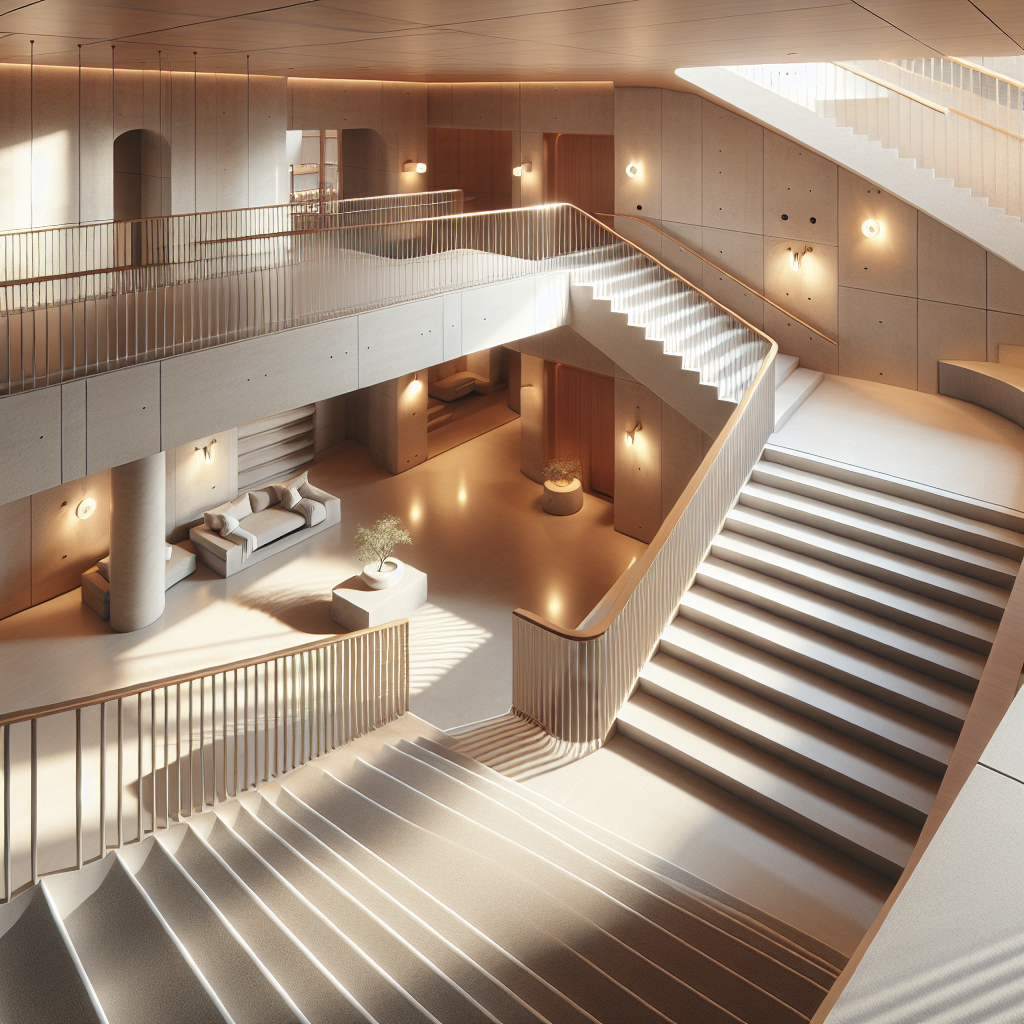
Stair dimensions affect comfort, safety, and the feel of a space. Knowing typical measurements helps when planning a remodel, checking an existing flight, or working with a designer.
This article lays out common riser and tread sizes, key ratios, headroom needs, and practical tips to measure stairs accurately using metric and imperial units.
Core measurements and basic terms
Before taking any numbers, it helps to know the names of the parts. A clear vocabulary prevents errors when sharing measurements or reading technical notes.
Below are the most used terms and the ranges you will usually see in homes and small buildings.
Tread depth (run)
The tread is the horizontal part you step on. Residential treads are commonly 250–300 mm (10–12 in).
Deeper treads feel more comfortable, especially for older users or where shoes have thick soles.
Riser height
The riser is the vertical distance between two treads. A typical riser is 170–190 mm (6.7–7.5 in) in many modern homes.
Lower risers make stairs easier to climb but increase the number of steps needed in a given vertical rise.
Going and total rise
Going refers to the horizontal distance from the nosing of one tread to the next. Total rise is the full vertical height the staircase must cover.
Plan the number of steps by dividing total rise by chosen riser height, then adjust risers slightly to keep them uniform.
Headroom and clear width
Headroom is the vertical space above the tread; a typical minimum is 2000–2100 mm (6.6–7 ft) depending on local rules. Clear width is the unobstructed walking space, often 800–1000 mm (32–40 in) for private homes.
Narrow stairs are possible but require care with handrail placement and usability.
How to measure an existing flight
Accurate measurement makes repair or adjustment simpler and avoids surprises. Use a reliable tape measure and record every value.
Work step by step: measure total rise, count risers, measure treads, check width and headroom.
Measure total rise and run
Stand at the bottom and measure vertically to the finished floor at the top landing. That is the total rise.
Then measure the horizontal distance from the first riser nosing to the last nosing to get the total run.
Count risers and check uniformity
Count the number of risers (including the top landing if it forms a riser). Divide total rise by number of risers to find average riser height.
Risers should be nearly identical; local codes often limit variation between the tallest and shortest riser to 3 mm (1/8 in) to prevent trips.
Measure tread depth and nosing
Measure from the tread nosing back to the next nosing. If nosings overhang, note the overhang amount separately.
Also measure the tread width across the stair; this identifies if treads taper, as in winders.
Check headroom and handrail height
Measure vertically from the tread nosing to any obstruction above. Record the lowest point of headroom along the flight.
Measure handrail height from the tread nosing to the top of the rail. Common handrail heights are 900–1000 mm (35–39 in) in many regions.
Design ratios and common formulas
Designers use simple formulas to balance safety and comfort. One of the most helpful is the relationship between riser and tread.
Adjusting riser height and tread depth together keeps steps predictable and reduces fatigue while walking up or down.
Two-riser plus tread rule
A widely used rule is: 2R + T = 600–660 mm (24–26 in), where R is riser height and T is tread depth. This balances step height and depth for natural stride.
Example: with a 180 mm riser, target tread ≈ 240–300 mm. Many designers use 63–65 cm total in metric (i.e., 2R + T ≈ 630 mm).
Number of risers and landing placement
Divide total rise by chosen riser height to find the number of risers. Aim for an integer; minor adjustments keep risers even across the flight.
Landings should be placed at logical breaks in travel and must meet minimum depth requirements, commonly equal to stair width or more.
Special layouts: winders and spiral stairs
Winders and spirals save space but need extra care on tread depth near the inside edge. Use the walking line (usually 300 mm from the narrow edge) to measure effective tread depth.
Spiral stairs usually have smaller treads at the center and wider at the outer edge; check local codes for minimum tread at the walking line.
Safety, comfort and regulatory points
Codes vary by location, but the core goals are consistent: prevent trips, give adequate support, and allow safe passage in emergencies.
Use the following practical checks during planning or inspection to catch common issues.
Nosing, slip resistance and visual contrast
Nosing can improve foot placement but should not be so deep that it creates a tripping hazard. A common nosing projection is 10–25 mm (0.4–1 in).
Add slip-resistant finishes and visual contrast at the stair edge to help low-light navigation and reduce slip risk.
Handrail and guard requirements
Handrails must be easy to grip and run continuously along the flight. Typical heights are 900–1000 mm (35–39 in) above the tread nosing.
Guards (balustrades) prevent falls from open sides; gaps should be small enough to stop a 100 mm (4 in) sphere from passing through in many jurisdictions.
Lighting and step visibility
Even with perfect dimensions, poor lighting makes stairs dangerous. Illuminate each tread and landing evenly without glare or deep shadows.
Consider step-edge lighting or directional fixtures that highlight the walking path without creating contrast that hides step geometry.
Practical tips when planning changes
Small changes to riser or tread sizes add up quickly. Always re-check the whole flight after any adjustment.
Document each measurement and make sketches showing where each value was taken to help tradespeople and to avoid errors.
Adjusting risers to fit a space
If the number of risers must change, keep the variation between risers minimal. Recalculate tread depth to maintain the comfort formula.
When adding a landing, ensure the landing depth meets recommended minimums and that door swing does not interfere.
Material choices and their effect on dimensions
Materials affect finished dimensions. Thick finishes like stone or multiple layers of flooring on landings change headroom and the top riser.
Account for finished floor heights at both levels before cutting stringers or ordering prefabricated elements.
Recording a measurement checklist
- Total rise (mm/in)
- Number of risers
- Individual riser heights
- Average tread depth at nosing and walking line
- Stair width and clear width
- Headroom at critical points
- Handrail height and guard details
Keeping a checklist ensures nothing is missed during planning or inspection.
Conclusion
Knowing common stair measurements and how they interact makes planning and evaluating stairs simpler and safer. Use consistent units and double-check values before any construction step.
Balance comfort, space, and safety by applying the riser-tread relationship, checking headroom, and confirming handrail placement.
Frequently Asked Questions
What is a common riser height in homes?
Typical riser heights are 170–190 mm (6.7–7.5 in). Many modern projects target about 175–180 mm for a comfortable climb.
How deep should each tread be?
Residential tread depths are often 250–300 mm (10–12 in). Use the walking line to check effective depth on curved or winder steps.
How much headroom is needed?
Minimum headroom is commonly around 2000–2100 mm (6.6–7 ft) depending on location. Higher headroom improves comfort and accessibility.
What is a safe handrail height?
Handrail height typically sits between 900 and 1000 mm (35–39 in) above the tread nosing. The exact required height can vary locally.
How do I calculate the number of steps?
Divide the total rise by your chosen riser height. Round to a whole number and then adjust risers slightly to make them all equal while keeping them within comfortable limits.
Is there a formula to balance step comfort?
A common formula is 2R + T ≈ 600–660 mm (24–26 in). This helps keep walking rhythm natural by balancing riser height and tread depth.