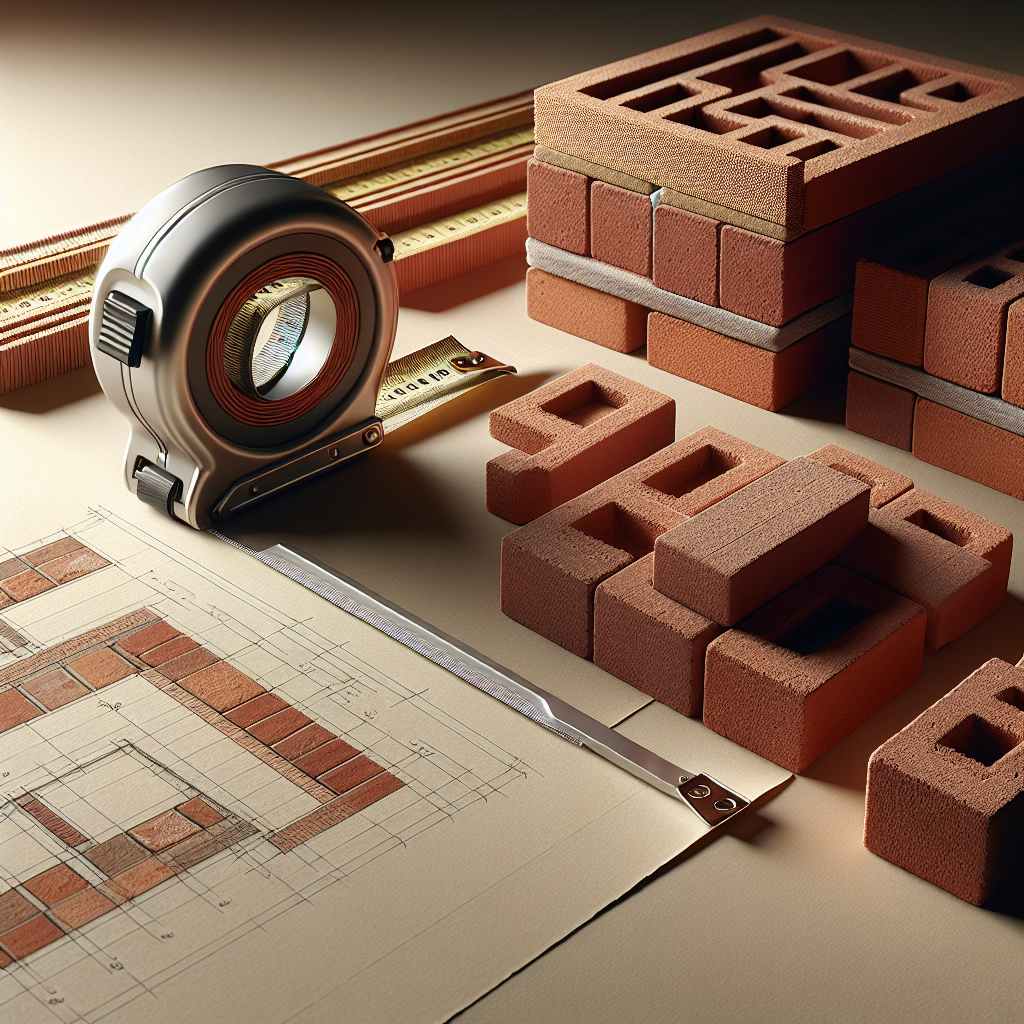
Bricks are one of the oldest and most reliable building units. Knowing common brick sizes, how mortar affects overall dimensions, and which types suit a task makes planning easier and reduces waste.
This article breaks down typical measurements, material choices, and simple calculation methods so you can estimate quantities, pick the right product, and understand how bricks fit in common structures.
Common brick sizes and how they are measured
Most bricks are described by three dimensions: length, width (or depth), and height (or thickness). Manufacturers often quote nominal sizes that include mortar joints, while actual brick dimensions are slightly smaller.
Understanding the difference between nominal and actual numbers helps when estimating how many bricks a wall or pathway will need.
Typical metric and imperial measurements
In many countries, a frequently encountered clay brick measures 215 mm long, 102.5 mm deep, and 65 mm high. This size results in a convenient nominal module of 225 x 112.5 x 75 mm when a 10 mm mortar joint is added.
In places using imperial units, a common modular brick has actual dimensions around 190 mm by 90 mm by 57 mm (7 1/2 x 3 5/8 x 2 1/4 inches). With mortar, the nominal size becomes roughly 200 x 100 x 65 mm. Always check local standards.
Variations and specialized sizes
Some projects use larger bricks like king-size or jumbo units to speed up construction. Conversely, thin bricks or brick slips are used where weight or thickness is limited.
Paving bricks and engineering bricks also differ in size and may be thicker to resist heavy loads or frost.
Material types and how they affect dimensions
Brick material influences strength, porosity, and often the available sizes. Clay and concrete are the two main families, with subtypes tailored to finishing or structural needs.
Choosing the right material depends on exposure, load, thermal performance, and aesthetic preference.
Clay bricks
Fired clay units are common for walls and facades. They come in a wide range of colors and textures and generally adhere to standard modular dimensions, which makes planning predictable.
Clay facing bricks are usually manufactured to tighter dimensional tolerances to ensure a neat appearance.
Concrete bricks
Concrete bricks can be molded to exact sizes and often used where uniformity or specific compressive strength is required. They may also be slightly larger or heavier than clay equivalents.
Color and surface finish are achieved with pigments and surface treatments rather than firing.
Engineering and paver bricks
Engineering bricks are dense, high-strength units often used below damp-proof courses or in foundations. They are available in standard and slightly larger sizes to meet structural needs.
Paving bricks are thicker and may be square or rectangular to accommodate foot or vehicle traffic. Their thickness changes how many are needed per square metre.
Mortar joints, nominal size, and the real footprint
Mortar joints change the finished size of a brick assembly. A typical joint thickness is 10 mm, but it can vary from 6 mm to 15 mm depending on local practice and brick tolerance.
When designers use nominal sizes that include joint thickness, layout math becomes simpler; however, using actual brick dimensions gives exact counts and less waste.
Nominal vs actual: an example
Take a brick with actual dimensions 215 x 102.5 x 65 mm. With a 10 mm mortar joint, the nominal module becomes 225 x 112.5 x 75 mm. That nominal figure is what often appears on drawings.
When calculating quantities, decide whether to base your math on nominal or actual sizes and be consistent throughout the project.
Impact of joint width on appearance and strength
Wider joints give a more traditional look and can hide slight size variations, while thin joints look crisp but require more precise bricks and workmanship.
Joint width also slightly reduces the number of bricks needed per square metre but increases mortar volume.
How to estimate quantities quickly and accurately
Estimating bricks requires a simple formula and attention to openings such as doors and windows. Using consistent units (metric or imperial) and including wastage will yield reliable numbers.
Below are practical steps you can follow to compute required quantities with confidence.
Step-by-step calculation method
- Decide whether to use nominal or actual brick dimensions including mortar joint thickness.
- Calculate the area of the wall or surface in square metres (length x height).
- Compute the area covered by one brick (face area): length x height of the unit as it will appear in the wall, including joints.
- Divide the wall area by the brick face area to get the number of bricks needed.
- Add a sensible allowance for breakage and cuts—commonly 5–10% for walls, 10–15% for paving or complex patterns.
Example calculation
For a wall 5 m long and 2.5 m high, area = 12.5 m2. If using a nominal module of 0.225 m length x 0.075 m height, brick face area = 0.016875 m2.
Bricks needed = 12.5 / 0.016875 ≈ 741. Add 10% wastage → total ≈ 815 bricks.
Patterns, bonds, and how they influence material needs
Different laying patterns (bonds) affect how bricks are cut and how many start/stop joints occur. Some bonds require more cutting or special units, which impacts the number ordered.
Thinking ahead about pattern selection reduces surprises and can cut material and labor costs.
Common bonds and material implications
Stretcher bond is the most economical and widely used for single-thickness walls. Header bond and English or Flemish bonds create different visual effects but may need more bricks because of extra cutting for corner and end details.
Stack bond is easy to lay but weaker structurally unless reinforced, and it tends to use the same number of bricks but more mortar per area in some cases.
Corner and jambs: ordering special units
Openings and corners often require end-cut bricks or specially manufactured units. When these are significant, order extra full bricks to be cut on site or request bullnose or corner units to save labor.
Plan any arches, sills, or decorative details early to ensure availability in the chosen size and finish.
Practical considerations when choosing sizes and types
Beyond raw dimensions, think about thermal performance, durability, color consistency, and how the brick will be fixed or bonded to other materials.
Local climate and exposure to water or freeze-thaw cycles should influence the choice of material and finish.
Durability and exposure
In wetter or colder climates, opt for dense, low-absorption units that resist frost damage. Engineering bricks or frost-resistant facing bricks are typical choices.
In milder climates, a wider range of facing or textured bricks can be used without concern for freeze-thaw resistance.
Thermal and acoustic properties
Thicker bricks and cavities within masonry can improve thermal performance. Where insulation is crucial, incorporate cavity walls or insulated blocks rather than relying solely on brick thickness.
Massive brickwork also provides good sound attenuation in many residential and commercial settings.
Conclusion
Knowing common brick measurements, how mortar affects module size, and the influence of material choice helps you estimate quantities and select the right unit for each task.
Careful planning around bonds, openings, and exposure saves money and ensures a durable finished surface.
Frequently Asked Questions
What is the difference between nominal and actual brick size?
Actual size refers to the brick unit produced by the manufacturer. Nominal size adds the mortar joint to the actual dimensions and is often used in drawings to simplify layout calculations.
How much mortar joint is commonly used?
A 10 mm joint is common in many places, but joints can vary from about 6 mm to 15 mm. The choice depends on local practice, the brick’s tolerance, and the desired appearance.
How many bricks are needed per square metre?
The number depends on the nominal module. Using a 225 x 75 mm module, you get roughly 59–60 bricks per square metre of wall. Always calculate using your chosen module and add wastage.
Do different materials change the sizing rules?
Materials themselves don’t change modular theory, but concrete, clay, and engineering bricks vary in exact dimensions, tolerances, and weight, so verify sizes when ordering.
Are there standard sizes for paving bricks?
Paving units tend to be thicker and sometimes square. Common sizes include 200 x 100 mm slabs or larger paver formats; thicknesses often range from 50 mm for foot traffic up to 80 mm or more for vehicle loads.