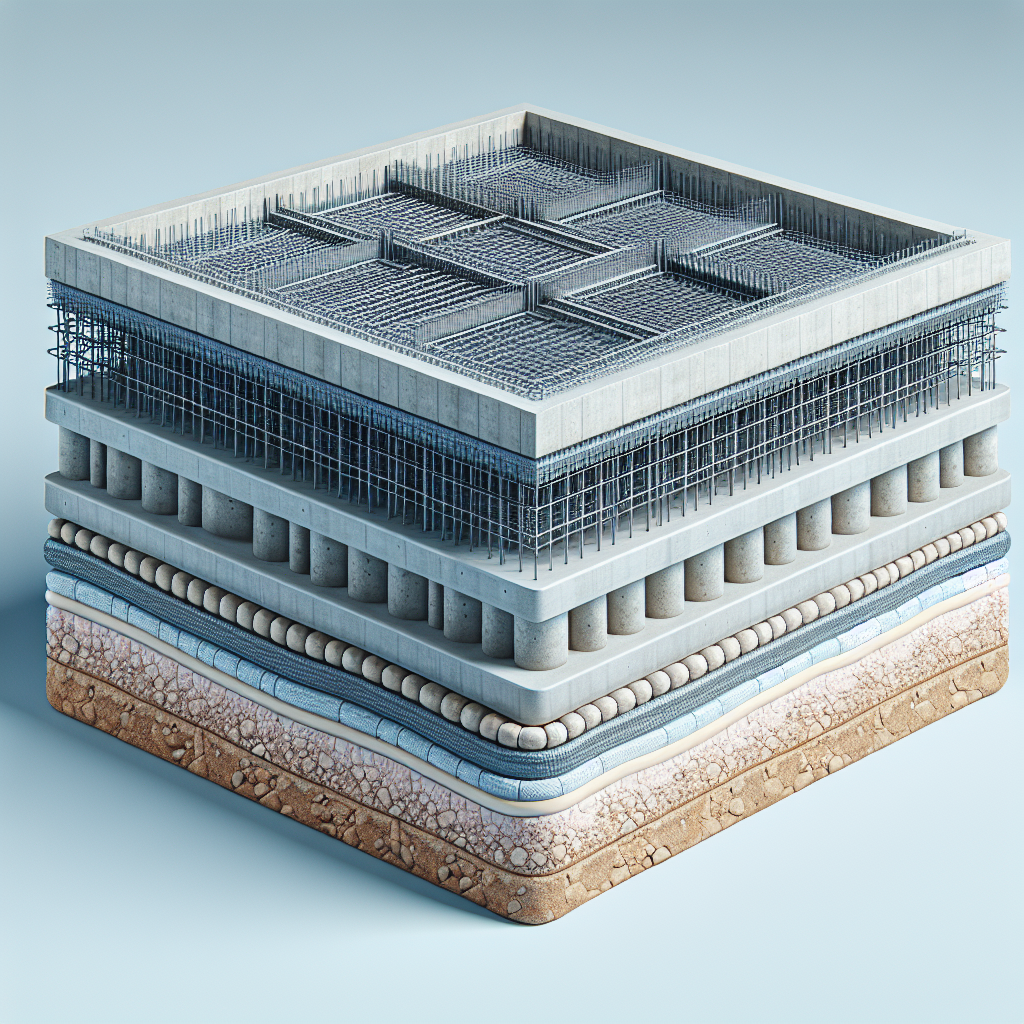
A raft foundation spreads building loads across a large area of ground, creating a single reinforced concrete slab beneath a structure. It is often chosen when soil has low bearing capacity or when column loads are close together and a series of isolated footings would interfere with each other.
This article explains core ideas behind a raft slab, the main checks designers run, common construction choices, and the ways to keep settlement and stress under control. The aim is to give clear, practical information that helps make better decisions on site and at the drawing board.
When a raft works best
Raft foundations are most useful where the soil is weak to medium strength and the loads are distributed or closely spaced. Rather than concentrating load under individual pads, the raft spreads pressure across the footprint.
They also suit basements and sites with varying subsoil conditions, because a continuous slab can reduce differential settlement and act as a stiff diaphragm.
Common site indicators
Look for shallow bearing strata, a high water table, or soft soils with low allowable bearing pressure. When column spacing is tight, using individual footings may be impractical or more expensive than a single slab.
Comparing with other options
A raft is often cheaper than piled solutions when the required pile depth is large. It can be simpler than combined footings when many loads need to be covered. But when soils are very weak or loads are extremely high, deep foundations remain the right choice.
Key design checks and calculations
Design of a raft slab relies on checking bearing pressure, bending and shear, and expected settlements. Calculations must ensure the slab safely transfers loads to the ground and that settlement remains within limits acceptable to the structure.
Simple checks often cover gross stress, punching at columns, and overall bending. More detailed models use plate and soil interaction analyses to predict deflection and stress distribution.
Bearing pressure and load distribution
Estimate the total vertical load from the building, including live, dead, and imposed loads. Divide by the plan area to get the average pressure. Check that the peak pressure under any zone does not exceed soil capacity.
- Use conservative soil parameters from tests.
- Apply load factors and consider temporary construction loads.
- Factor in surcharge and adjacent excavation effects.
Bending, shear and punching shear
Design slab thickness and reinforcement to resist bending moments from the soil reaction and applied loads. Near columns, check for punching shear since concentrated column loads can cause local failure of the slab.
- Compute bending moments using strip or finite element methods.
- Provide adequate shear reinforcement or increase slab thickness at heavy load points.
- Detail adequate cover and anchorage for reinforcement.
Settlement assessment
Settlement control is critical. Predict both overall and differential settlement using consolidation and elastic settlement methods. Allowance must be made for seasonal moisture changes in some soils.
- Use consolidation parameters from lab tests.
- Estimate differential settlement between loaded and less-loaded areas.
- Reduce risk by improving ground when needed or stiffening the slab locally.
Slab geometry and reinforcement layout
Slab thickness depends on load levels, bending moments, and shear checks. Thicker slabs reduce deflection and punching risk but increase cost. Reinforcement layout must manage both global bending and local stresses.
Typical rafts include continuous top and bottom reinforcement, with extra bars around columns and under walls. Effective design considers crack control, durability, and ease of construction.
Choosing slab thickness
Start with a practical minimum (often 200–300 mm for small buildings) and increase where bending, shear, or punching checks demand. For basements or heavy loads, slabs of 400 mm or more are common.
Reinforcement patterns
Design a mesh or bar pattern to handle positive and negative moments. Use a grid of primary bars at calculated spacing and secondary distribution bars to limit crack widths.
- Place heavier bars under columns and load concentrations.
- Provide edge reinforcement where slab meets walls or stiffening beams.
- Check cover requirements for durability in ground-contact conditions.
Stiffening beams and ribs
Adding beams or ribs to the raft increases stiffness and can reduce slab thickness. These elements are helpful around heavy columns, openings, or areas with high local moments.
Stiffening also controls differential movement, and can simplify punching shear checks when properly detailed.
Construction and material choices
Quality during excavation, formwork, concrete placement, and curing affects long-term performance. Good site practice reduces the risk of future problems related to cracking or unexpected settlement.
Material choices like concrete grade, admixtures, and reinforcement type influence durability and cracking resistance. Consider exposure conditions, groundwater, and chemical risks when specifying materials.
Preparing the subgrade
Compact the subgrade and remove soft spots. A blinding layer of lean concrete or compacted aggregate provides a stable working platform and reduces contamination of the slab underside.
Concrete mix and placement
Use a mix that achieves the target strength and workability with attention to shrinkage and permeability. Proper curing prevents early-age cracks and improves durability, especially where the slab is in contact with soil or groundwater.
- Specify minimum cement content and limit water-cement ratio.
- Consider admixtures to reduce shrinkage or improve flow.
- Place concrete in layers and avoid cold joints where possible.
Joints and waterproofing
Control joints reduce random cracking in large slabs. Where the raft forms a basement slab, incorporate effective waterproofing layers and sealed construction joints to prevent water ingress.
Detail movement joints between slab and walls, and ensure continuity of the waterproofing membrane across such joints when required.
Monitoring, maintenance and common issues
Simple monitoring during and after construction can detect unexpected movement early. Regular checks on cracks, settlement, and waterproofing performance protect long-term function.
Common problems include excessive differential settlement, cracking from restraint, and poor waterproofing leading to dampness. Address root causes rather than only treating symptoms.
Site monitoring techniques
Use benchmarks, settlement plates, and periodic surveys to track movement. Early detection allows corrective work, such as grouting voids or local underpinning, before damage becomes severe.
Repair approaches
Minor cracks are often cosmetic, but active leaks or growing displacement require structural assessment. Injection grouting, underpinning, or reinforcement repair are potential remedies depending on the cause and location.
Conclusion
Raft slabs are a flexible solution where soils are variable or footing spacing is tight. Proper assessment of soil behavior, careful design checks for bending and shear, and solid construction practice are the pillars of success.
When those aspects are addressed, a raft foundation can be cost-effective and durable. Attention to drainage and waterproofing helps ensure the slab performs well over time.
Frequently Asked Questions
The questions below cover common concerns about design choices, expected settlements, and construction details related to raft foundations.
What soil tests are essential before using a raft?
At minimum, carry out standard penetration or similar in-situ tests and a few undisturbed samples for lab consolidation tests. These give bearing capacity, compressibility, and stratigraphy needed for settlement and bearing checks.
How is slab thickness decided?
Thickness comes from bending, shear and punching checks, plus practical limits for reinforcement cover and constructability. Start from a reasonable minimum and increase where analysis shows high moments or shear.
Can a raft limit differential settlement?
Yes, a continuous slab tends to distribute loads and reduce local variations in settlement. However, it cannot eliminate settlement if the entire soil mass consolidates unevenly; ground improvement may be needed in those cases.
When should stiffening beams be added?
Add beams when local loads are high, when there are large openings, or where slab thickness would otherwise become excessive. Beams improve stiffness and reduce required slab depth in many designs.
How important is waterproofing for basement rafts?
Very important. Proper waterproofing and sealed construction joints prevent water paths into the building and protect concrete and reinforcement from corrosion in the long term.