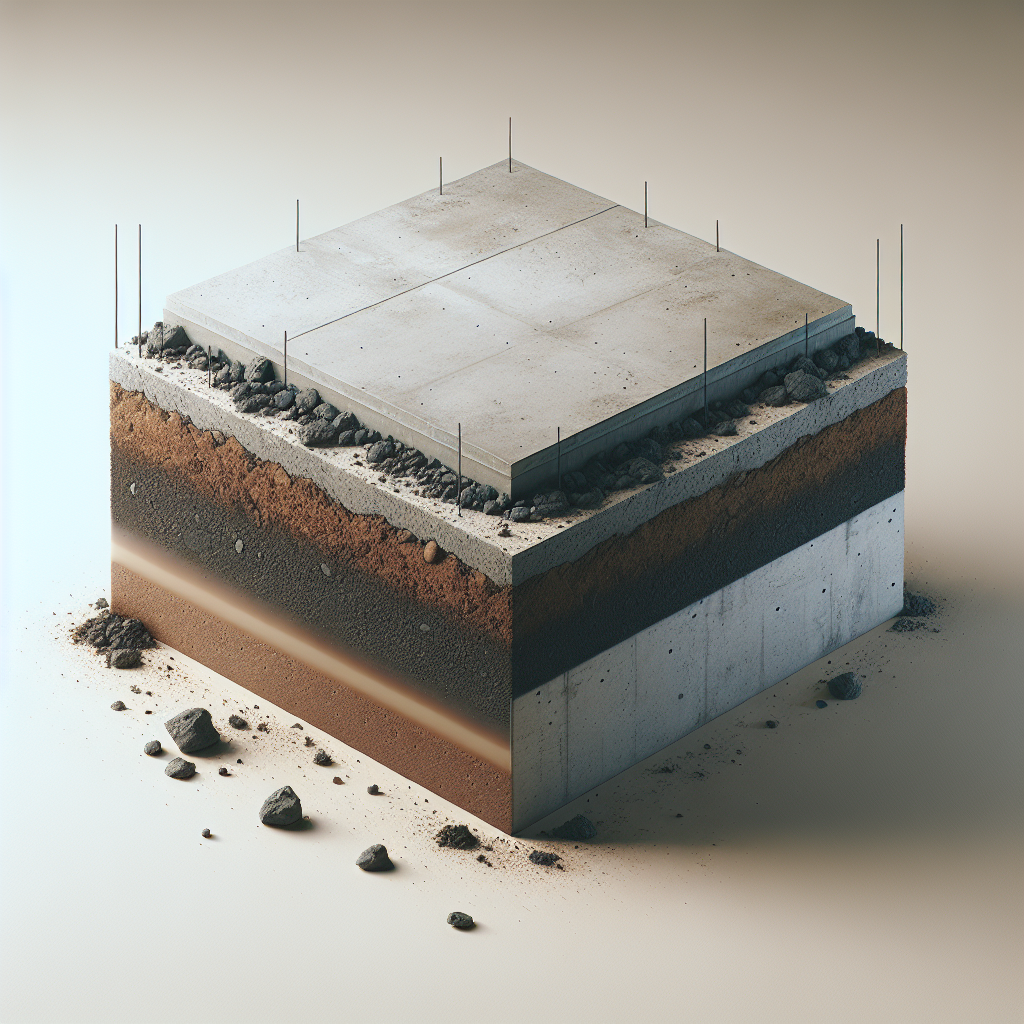
An isolated pad under a single column is one of the simplest ways to transfer building loads to soil. This post breaks down how these pads work, when they are practical, and what to check during design and construction.
The aim is to explain key concepts in plain language, highlight common choices, and list simple calculations and quality checks you can use on site or in drawings.
Basic concept and purpose
An isolated pad sits below a single load-bearing column and spreads the load over a wider area of soil. It reduces bearing stress so the ground can safely support the structure above.
These pads are common under columns with moderate loads and where soil conditions are reasonably uniform and strong enough without deep foundations.
How loads travel
Load from floors and roofs travels down the column to the pad. The pad compresses the soil under it. Uniform distribution and adequate depth help limit settlement and tilting.
Designers check bearing pressure, settlement limits, and reinforcement needs so the pad performs without excessive cracking or sinking.
When they make sense
Use this type of footing when column loads are not excessive and the soil has adequate bearing capacity at shallow depth. It is cost-effective for small-to-medium buildings.
If loads are large, or soil is weak or variable, other foundation types may be safer and more economical in the long run.
Common types and how they differ
Isolated pads come in several geometric shapes and variations. The right shape depends on column layout, load magnitude, and site constraints.
Shape controls how pressure spreads in the ground and how reinforcement is arranged in the concrete pad.
Square and rectangular pads
These are the most frequent choices because they are easy to form and reinforce. Rectangular pads suit rectangular columns or where plan spacing is asymmetric.
They provide predictable load spread and are efficient for regular column grids.
Circular pads
Circular pads offer uniform stress distribution around a central column and can be efficient when space is tight. Forming is slightly more complex but less reinforcement is often needed near corners.
They are common under round columns or where radial symmetry matters.
Sloped or stepped pads
Stepped pads reduce the depth of concrete while keeping edge thickness for reinforcement anchorage. Sloped pads use a taper to reduce volume but may need careful formwork.
These shapes save material on larger pads while maintaining structural performance.
Key design principles and basic calculations
Designing a pad means checking bearing capacity, controlling settlement, sizing the pad, and arranging reinforcement. Each step focuses on safety and durability.
Below are the essential checks and simple formulas often used in preliminary design.
Bearing pressure and pad size
Start by dividing the column load by allowable soil bearing pressure to estimate the required plan area. Use a safety factor and reduce allowable pressure if soil data is limited.
Area required = Column load / Allowable bearing pressure. Choose a shape and dimensions that meet or exceed this area.
Depth and edge conditions
Depth controls punching shear and bending capacity. Minimum clear cover and embedment of reinforcement matters for durability and anchorage.
Typical thickness is determined from bending checks and practical limits for formwork; often a few hundred millimetres for light loads and larger for heavy loads.
Settlement checks
Estimate immediate settlement from elastic theory or use empirical methods. Settlement should be uniform across the structure to avoid differential movement.
If predicted settlement is large or uneven, consider soil improvement or alternative foundation types.
Reinforcement basics
Reinforcement resists bending and controls crack widths. Provide top and bottom bars where bending moments demand, with adequate development length and spacing.
Detailing must allow for concrete cover, ties, and shear links near column faces to prevent punching failure.
- Check one-way and two-way bending as applicable.
- Verify shear capacity near column; thickening or shear reinforcement may be needed.
- Provide anchorage length based on bar diameter and concrete strength.
Construction steps and common issues on site
Good construction practices are as important as correct calculations. On-site inspection and simple checks reduce the risk of future problems.
Follow a clear sequence and record key measurements and material properties during work.
Site preparation and excavation
Excavate to the required depth, providing stable sides and a flat base. Remove soft or organic material and replace with compacted fill if needed.
Check base level and compactness before placing reinforcement; uneven or loose base leads to differential settlement.
Formwork and reinforcement placement
Set formwork so edges are straight and firm. Place reinforcement on chairs to maintain required cover and avoid direct contact with soil.
Confirm bar positions and lap lengths before pouring concrete. Small deviations can reduce capacity and cause cracking.
Concrete mix, pouring and curing
Use a mix suitable for structural pads with proper workability and strength. Avoid excessive water that weakens concrete and increases shrinkage.
After pouring, cure adequately to develop strength and reduce cracking. Poor curing leads to surface crazing and reduced durability.
Common problems and how to spot them
Cracking, uneven settlement, and water damage are the usual issues. Early inspection helps find minor problems before they grow.
Look for hairline cracks, tilting columns, pooling water, or spalling concrete and note their location and size.
- Cracks near column faces may indicate high local stresses or missing reinforcement.
- Settlement that is greater near certain columns suggests weak pockets in the soil below.
- Persistent water can cause softening; provide drainage or waterproofing.
Conclusion
Pad footings are a practical, economical method to support individual columns when soil and load conditions allow. Understanding how loads spread, how to size pads, and how to build them correctly reduces the chance of future problems.
A clear set of checks during design and site supervision keeps performance predictable and long lasting.
Frequently Asked Questions
Below are concise answers to common questions about these foundation pads, focusing on practical concerns and simple checks.
These answers assume typical building loads and common soil conditions; unusual situations may need specialist input.
How is pad size estimated quickly?
Divide the total column load by the allowable bearing pressure of the soil to find the needed area. Round up to a practical shape and add a safety margin.
Verify depth and reinforcement with bending and shear checks afterwards.
What depth is usually required?
Depth depends on bending, shear, and cover requirements. For small loads a thickness of a few hundred millimetres may suffice; larger loads need thicker pads.
Also consider frost depth and local codes that might demand minimum embedment or insulation.
When should this approach be avoided?
Avoid when soil is very weak, highly variable, or when column loads are very large. Also skip this type if high water table or risk of scour exists without mitigation.
In such cases, deeper foundations or ground improvement are more reliable.
How to reduce the risk of differential settlement?
Improve or compact weak spots, use uniform footing sizes where possible, and ensure even load distribution in the structure above.
Perform soil investigations and treat or replace poor soils before construction if necessary.
What are signs of poor workmanship to watch for?
Look for reinforcement touching soil, inadequate cover, poor compaction at the base, and concrete that was not cured. Misplaced formwork or wrong bar lapping are also common issues.
Document observations and have corrective steps before loads are applied.