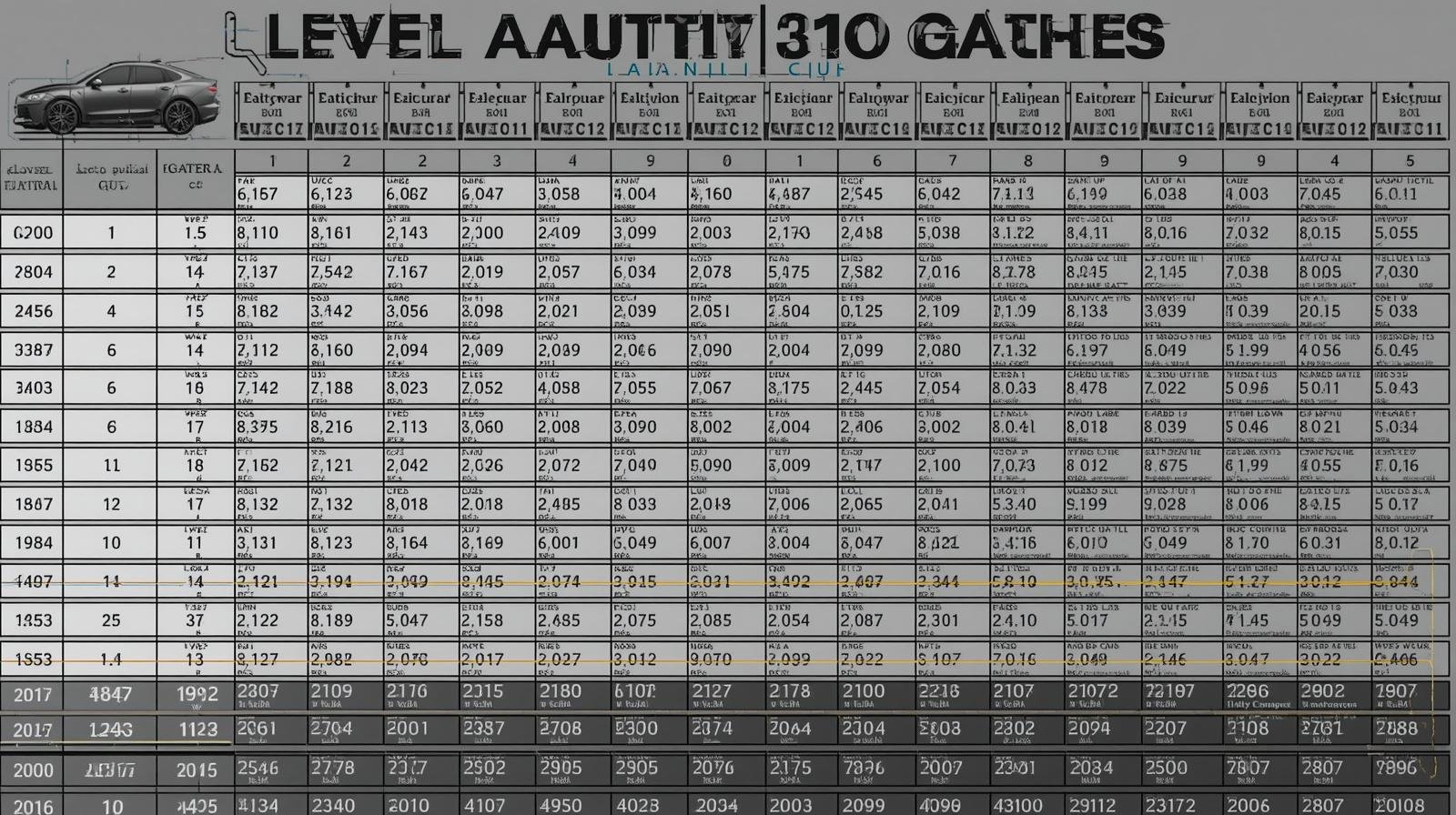
An auto level calculation table is a structured field-book format for recording backsight (BS), intermediate sight (IS), foresight (FS), Height of Instrument (HI) and Reduced Level (RL). This article shows a sample layout and Excel formulas that you can build in your own workbook. It is a template-format tutorial; no separate downloadable workbook is attached to this page.
Why use an Auto Level Calculation Table?
Leveling is a routine but critical survey task. A clear table helps you avoid errors and speeds up field and office work. Using an auto level calculation tableexcel template reduces manual arithmetic and keeps your level book tidy.
- Faster calculations and fewer mistakes
- Consistent record keeping in a level book
- Easy sharing and backups with Excel
Key concepts: HI, RL, BS, FS
Before using a template, know the basic terms.
- HI (Height of Instrument): the vertical height of the instrument above a reference point.
- RL (Reduced Level): the elevation of a point relative to a datum.
- BS (Back Sight): a reading taken on a known point to find HI.
- FS (Fore Sight): a reading taken on a new point to compute its RL.
How the Excel Template Works
The auto level calculation table Excel template – level book format HI RL booking sheet sample example free download 2026 is arranged to compute HI and RL automatically when you enter BS and FS readings. Columns are laid out to match standard field practice.
Typical column layout
| Column | Description |
|---|---|
| Station / Point | Benchmark, detail point or change point (CP) |
| BS | Backsight reading on a known RL or CP |
| IS | Intermediate sight on a detail point |
| FS | Foresight, normally on the CP before shifting instrument or on the closing point |
| HI | Height of instrument line of sight for the current setup |
| RL | Reduced level of the station |
| Remarks | BM, CP, detail point, date and field notes |
Sample Booking Sheet (Simple Example)
Here is a compact sample booking sheet you can recreate in Excel. This shows how values flow from BS/FS to HI and RL. Use this as a starting point for your level book.
| Station / description | BS (m) | IS (m) | FS (m) | HI (m) | RL (m) |
|---|---|---|---|---|---|
| BM1 (known) | 1.500 | — | — | 105.500 | 104.000 |
| CP1 (old setup: FS) | — | — | 0.980 | 105.500 | 104.520 |
| CP1 (new setup: BS) | 1.200 | — | — | 105.720 | 104.520 |
| P2 (IS) | — | 0.850 | — | 105.720 | 104.870 |
| P3 (FS) | — | — | 1.100 | 105.720 | 104.620 |
How to Set Up the Excel Formulas
Formulas keep the table automatic and error-resistant. Keep each row short and consistent for mobile readability.
- HI = RL of known point or CP + BS. If no BS is entered on a new row, carry forward the previous HI.
- RL = HI − IS for a detail point.
- RL = HI − FS for a foresight or change point.
- At a change point, the old setup records an FS; after moving the instrument, the new setup records a BS on the same point. The CP RL does not change.
Example formula notes you can copy into cells:
- HI cell (example row 3):
=IF(B3<>"",F2+B3,E2)— use the previous row’s RL plus a new BS, otherwise carry forward the previous HI. - RL cell (example row 3):
=IF(B3<>"",F2,IF(C3<>"",E3-C3,IF(D3<>"",E3-D3,F2)))— a BS row carries forward the CP RL; an IS or FS row calculates RL from the current HI.
These are example formulas for a worksheet with columns B=BS, C=IS, D=FS, E=HI and F=RL, with the previous row’s RL in F2 and HI in E2. Adjust row numbers and cell references to match your own sheet. Validate the formulas with a known test example before using the workbook for site records.
Tips for a Clean Level Book
- Keep short, clear station names.
- Enter benchmark RL once at the top.
- Use data validation to prevent blank BS/FS entries.
- Include a remarks column for weather or instrument notes.
- Save a copy after each field session.
Using the Template in the Field
Prepare the template on your laptop or tablet. In sticky or wet conditions, take notes on paper and transfer them later. For most jobs, the auto level calculation table template works the same: record BS and FS, and the sheet computes HI and RL.
Common workflow
- Set up instrument on tripod and level it.
- Take BS on a benchmark and enter the value.
- Compute HI automatically from the template.
- Take FS to new points and get RL instantly.
- Move instrument as needed and repeat.
Build the Level Book in Excel
Copy the column layout and sample rows above into a new Excel worksheet, add the formulas using your own cell references and test the sheet with a benchmark and at least one change point. This article explains the format and formula logic; it does not currently provide a separate workbook download.
Common Mistakes and How to Avoid Them
- Mixing units: always confirm meters vs feet.
- Forgetting to carry benchmark RL to new sheets: add it to the header.
- Entering BS/FS into the wrong columns: use cell color cues.
- Not saving a backup: use cloud storage or versioning.
Frequently Asked Questions
What is an auto level calculation table used for?
It records survey readings and automatically calculates HI and RL. The table makes leveling faster and reduces arithmetic errors in the level book.
Can I use the template offline on a phone or tablet?
Yes. Save the Excel file locally or use a spreadsheet app that supports formulas. For rough conditions, record on paper and transfer data later to keep the template intact.
Is there a free sample I can download for 2026?
Yes. Look for “Auto level calculation table Excel template – level book format HI RL booking sheet sample example free download 2026” to find current free downloads. Choose a trusted source or create your own using the column layout shown here.
How do I handle multiple instrument setups in one sheet?
Start a new block for each setup. Repeat the benchmark RL or use a running header. Label setups clearly to avoid confusion when computing final RLs.
Conclusion
A well-structured Auto Level Calculation Table Template saves time and reduces errors. Use the simple excel template layout to keep a tidy level book and to manage HI and RL calculations with confidence. Explore sample booking sheet examples and adapt them to your workflow to work smarter on site. Learn more by testing a template and practicing with real readings to build muscle memory and accuracy.