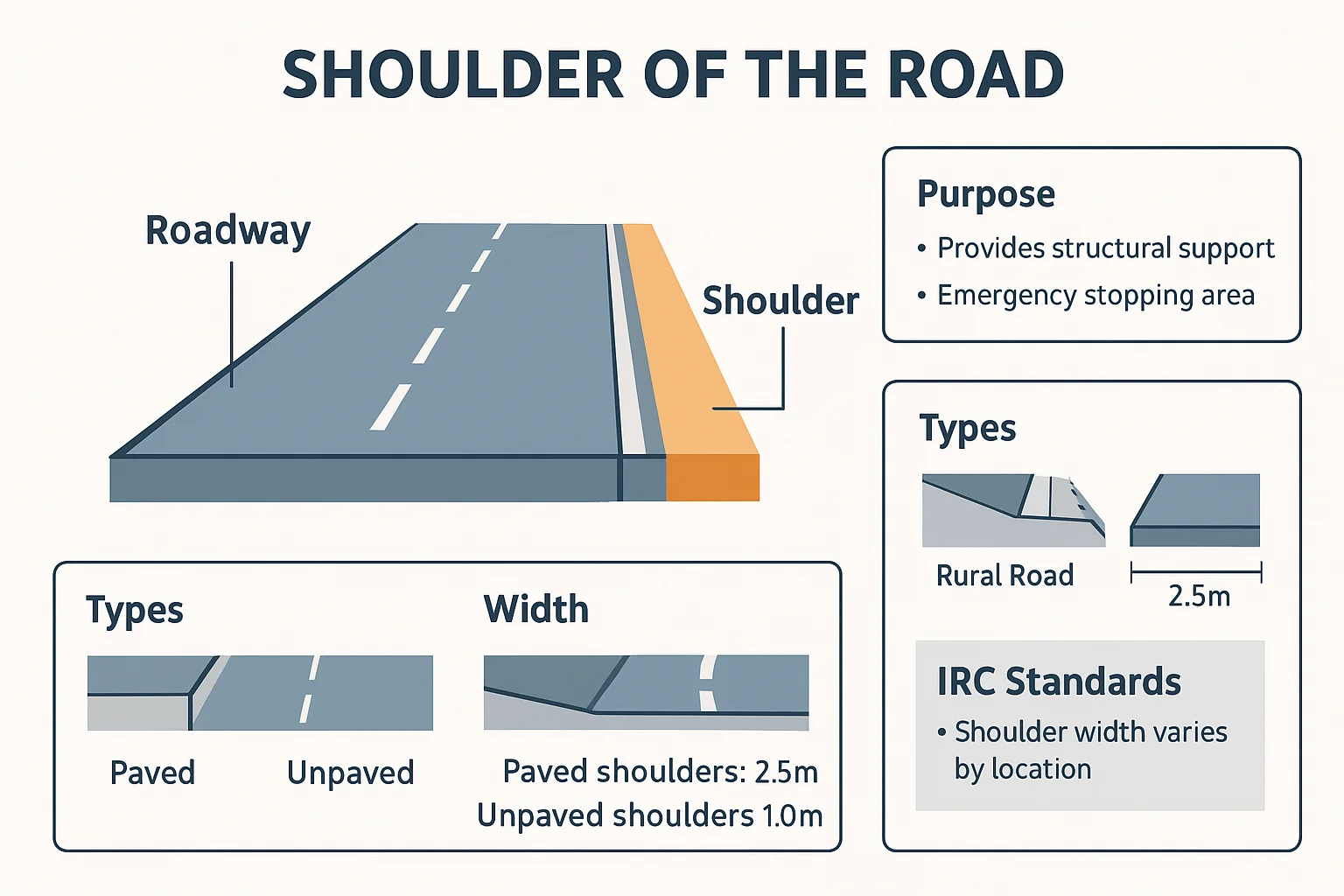
The shoulder of the road meaning in highway engineering is simple: it is the strip of land provided along the edge of a roadway, outside the traffic lanes. It supports road safety, vehicle stopping, lateral support to the pavement, and drainage, while also offering space for emergencies and maintenance work.
In practical terms, the road shoulder is not just an unused margin. It is an essential part of the road cross-section, and its design affects traffic safety, pavement durability, and overall road performance. For civil engineering students and site engineers, understanding shoulder details is important for road planning, execution, and inspection.
This article explains the shoulder of the road meaning, its functions, types of road shoulder, IRC-related width considerations, and how it fits into the road cross-section.
What Is the Shoulder of the Road?
The shoulder is the portion of the roadway adjacent to the carriageway, extending up to the edge of the road formation or pavement edge. It provides support to the pavement edge and a safe area for stopped vehicles, pedestrians in some cases, and roadside maintenance activities.
In highway engineering, the shoulder is usually designed with a surface and slope that are different from the main carriageway. It may be paved, stabilized, or earthen depending on road class, traffic conditions, and project specifications.
Functions of Road Shoulder
The shoulder serves several important purposes in road design and construction:
- Emergency stopping space: It allows vehicles to stop safely in case of breakdown or emergency.
- Support to pavement edge: It reduces edge failure and helps distribute load near the pavement boundary.
- Drainage support: It helps guide water away from the carriageway and prevents water stagnation at the edge.
- Safety margin: It provides recovery space for drivers when a vehicle drifts out of the lane.
- Maintenance access: It gives space for inspection, minor repairs, sign placement, and utility work.
- Roadway widening reserve: In some projects, shoulders can help in future road widening or temporary traffic management.
Types of Road Shoulder
The types of road shoulder mainly depend on surface material and construction detail. The most common classification includes paved, earthen, gravel, and stabilized shoulders.
| Type | Description | Typical Use | Main Advantage |
|---|---|---|---|
| Paved shoulder | Constructed with bituminous, cement concrete, or similar hard surfacing | Highways, expressways, roads with heavy traffic | Better durability and safer vehicle stopping |
| Earthen shoulder | Built with compacted soil or native earth material | Low-volume roads and rural roads | Low cost and simple construction |
| Gravel shoulder | Made with compacted granular material | Roads needing improved drainage and moderate support | Better than earthen shoulder in wet conditions |
| Stabilized shoulder | Improved with mechanical stabilization, additives, or bound layers | Projects needing added strength without full paving | Improved stability and reduced erosion |
Paved Shoulder vs Earthen Shoulder
The comparison of paved shoulder vs earthen shoulder is important because each has a different purpose and performance level.
- Paved shoulder: Offers better structural support, cleaner edge protection, and safer use during emergencies. It is common on higher-category roads.
- Earthen shoulder: Is economical and suitable for lighter traffic, but it may erode, soften in rain, and require more frequent maintenance.
In simple words, paved shoulders are preferred where traffic speed, traffic volume, and safety demand are higher. Earthen shoulders are used where cost is a major factor and traffic demand is lower.
Shoulder Width as Per IRC: What You Should Know
The road shoulder width IRC recommendation depends on road category, traffic volume, terrain, and design speed. There is no single universal width for every road, because shoulder width is a project-specific design element.
As a general highway engineering principle, wider shoulders are preferred on high-speed and high-traffic roads because they improve safety and provide more recovery space. On rural or low-volume roads, narrower shoulders may be acceptable if the design standards and site conditions permit.
When studying road shoulder width IRC requirements, always check the applicable IRC document and project drawings. The exact width may vary based on:
- Road classification
- Urban or rural location
- Traffic intensity
- Right-of-way constraints
- Terrain and drainage conditions
- Whether the shoulder is paved or unpaved
For field work, the important point is not just width, but also uniformity, compaction, drainage slope, and shoulder edge alignment with the carriageway.
Shoulder Cross-Section and Road Camber
The shoulder is closely connected with the road camber, which is the cross slope provided on the carriageway to drain rainwater quickly. A proper camber prevents water from entering the pavement layers and reduces damage from moisture.
In most road sections, the shoulder is given a slope that helps water move away from the road surface and not toward it. The shoulder slope is usually kept compatible with the carriageway slope so that water does not pond at the pavement edge.
Here is the basic idea of the cross-section:
- The carriageway has a camber for surface drainage.
- The shoulder follows an outward slope for drainage.
- The edge should be properly compacted to avoid settlement.
- There should be a smooth transition between pavement and shoulder.
If the shoulder is lower than the pavement edge by too much, vehicles may experience a hazard during emergency stopping. If it is too high, water can collect on the carriageway edge.
Construction Considerations for Road Shoulder
Good shoulder construction is essential for performance and safety. The material, compaction, and finishing must suit the type of shoulder being built.
- Prepare the formation: Clear loose soil, vegetation, and unsuitable material from the shoulder area.
- Shape the section: Provide the required width and slope as per drawings.
- Place material in layers: Use approved material, whether soil, granular material, or paving material.
- Compact properly: Achieve adequate density to reduce settlement and edge failure.
- Finish to line and level: Maintain smooth junction with the road edge and drainage slope.
- Check drainage: Ensure water flows away from the pavement surface.
Common Quality-Control Checks
- Width and level as per approved drawings
- Compaction quality of shoulder layers
- Surface evenness and joint at pavement edge
- Drainage slope and absence of water ponding
- Edge stability after traffic loading and rain
Practical Example
On a two-lane highway, the carriageway carries moving traffic while the shoulder provides a safe stopping area for a stalled vehicle. If the shoulder is paved, the vehicle can stop on a stronger surface with lower risk of rutting or sinking. If the shoulder is earthen, the same vehicle may sink or create edge damage, especially during monsoon conditions.
This is why shoulder selection should always match traffic conditions, rainfall, maintenance needs, and the road’s expected service life.
Advantages and Limitations of Shoulder Provision
Advantages:
- Improves road safety
- Reduces pavement edge distress
- Supports drainage and maintenance
- Provides emergency stopping space
Limitations:
- Requires additional land and construction cost
- Earthen shoulders may erode if not maintained
- Poor shoulder compaction can cause settlement and edge cracking
Frequently Asked Questions
What is the shoulder of the road meaning in simple words?
It is the strip beside the carriageway used for emergencies, support, drainage, and maintenance. It is a part of the road cross-section, not just leftover space.
Why are shoulders important in highway engineering?
They improve safety, protect the pavement edge, and provide space for stopped vehicles and maintenance work.
What are the main types of road shoulder?
The main types are paved shoulder, earthen shoulder, gravel shoulder, and stabilized shoulder.
Which is better: paved shoulder or earthen shoulder?
Paved shoulders are generally better for high-speed or heavy-traffic roads. Earthen shoulders are economical but need more maintenance and are less durable in wet conditions.
Does IRC prescribe one fixed road shoulder width?
No. The road shoulder width IRC recommendation depends on road class, traffic, terrain, and project conditions. Always refer to the relevant standard and design drawings.
How does road camber affect the shoulder?
Road camber helps drain water from the carriageway, and the shoulder slope supports this drainage by moving water away from the pavement edge.
Conclusion
The shoulder of the road meaning in highway engineering goes beyond a simple edge strip. It is a functional part of the road system that improves safety, drainage, pavement support, and maintenance access. Choosing the right type, width, and construction detail is essential for durable road performance.
Whether the project uses a paved shoulder or an earthen shoulder, proper design and execution matter. For accurate planning, always follow the applicable standards, drawings, and project specifications for shoulder width, slope, and materials.