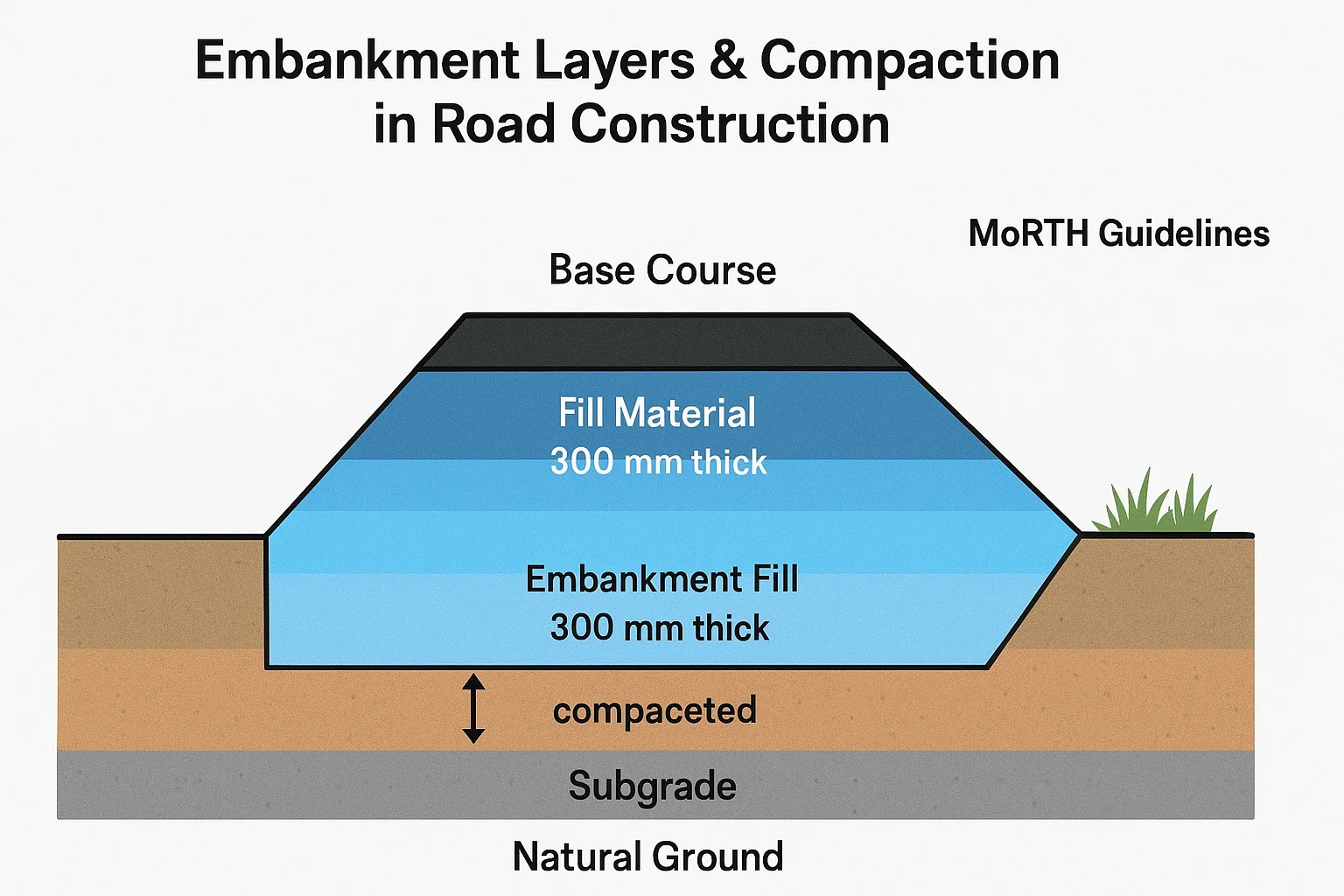
An embankment in road is the raised earthwork that supports the pavement above natural ground level. It is one of the most important parts of road construction because it transfers wheel loads safely to the foundation soil and helps achieve the required road profile, drainage, and design level.
In simple terms, if the embankment is weak, poorly compacted, or improperly drained, the pavement above it can settle, crack, or fail early. That is why embankment work must follow proper soil selection, layer-wise placement, moisture control, compaction, and quality testing as per project specifications and relevant MoRTH requirements, including MoRTH Section 300.
What Is an Embankment in Road?
An embankment is a compacted fill made using approved soil or other suitable material to raise the road formation level. It may be constructed where the natural ground is low, uneven, waterlogged, or not suitable for the designed road profile.
The embankment is not just “filled soil.” It is a structural foundation layer. Its strength depends on proper material selection, adequate moisture content, and achieved density.
Road Embankment Construction Steps
The basic road embankment construction steps are straightforward, but each stage matters for long-term performance.
- Clearing and grubbing – Remove vegetation, organic material, loose debris, and unsuitable topsoil.
- Foundation preparation – Grade and compact the existing ground where the embankment will rest.
- Material selection – Use approved fill material free from harmful organic matter, rubbish, and oversized deleterious material.
- Layer-wise spreading – Place soil in thin, uniform layers rather than dumping it in one thick mass.
- Moisture conditioning – Adjust the water content close to the optimum moisture content (OMC) for effective compaction.
- Compaction – Compact each layer with the right roller or equipment until required density is achieved.
- Testing and acceptance – Verify field density, moisture, line, level, and slope before placing the next layer.
Materials Used in Embankment Construction
The material used for embankment construction depends on project documents, soil availability, and suitability criteria. Commonly used materials include approved earth, moorum, light clayey soil, granular soil, and in some projects selected fill from borrow areas.
Key material properties are usually checked for:
- Plasticity and workability
- Presence of organic matter
- Gradation and particle size distribution
- Moisture behavior
- Suitability for compaction
Very soft, organic, or highly expansive soil is generally not preferred unless specifically treated or approved for use under the project requirements.
Importance of MDD and OMC
Two of the most important parameters in embankment work are Maximum Dry Density (MDD) and Optimum Moisture Content (OMC). These come from laboratory compaction testing and help determine how the soil should be compacted in the field.
MDD is the maximum dry density achievable for a soil under a specified compaction effort. OMC is the moisture content at which that maximum density is achieved. In practice, material placed too dry will not compact properly, and material too wet may pump, deform, or lose strength.
A good embankment layer is usually compacted near its OMC, because that is where the soil particles rearrange most effectively under roller action.
Compaction of Embankment Soil
Compaction improves soil strength, reduces settlement, and lowers permeability. In road work, the number of roller passes is not universal; it depends on the soil type, layer thickness, roller type, moisture condition, and target density. So, rather than relying on a fixed number, site engineers should use trial stretches and field control to confirm the required result.
Good compaction practice usually includes:
- Spreading soil in uniform loose layers
- Breaking clods and removing oversized lumps
- Adjusting water content before rolling
- Rolling from the edges toward the center or as per approved method
- Checking density before proceeding to the next lift
If the layer is too thick, the lower portion may remain loose even if the top looks compacted. That is a common cause of poor embankment performance.
Field Dry Density Test and Core Cutter Method
Field compaction must be verified by testing. For cohesive soils, one common method is the field dry density test core cutter method. It helps determine the in-situ dry density of the compacted layer and compare it with the laboratory MDD.
The general idea is simple: a known volume of soil is extracted carefully with a core cutter, the wet mass is measured, moisture content is determined separately, and dry density is calculated. The result shows whether the layer has reached the required compaction level specified by the project.
For granular materials, other methods such as sand replacement or nuclear density testing may be used, depending on site conditions and approval. The chosen method should match the soil type and project procedure.
MoRTH Section 300 and Embankment Requirements
MoRTH Section 300 covers earthwork, excavation, and embankment-related provisions for road works. It is important because it defines the expected workmanship, material handling, placement, compaction, and quality control approach for embankment construction.
In practice, this means the contractor and engineer must ensure that the embankment material is suitable, placed in controlled layers, compacted properly, and tested frequently. Project specifications may also prescribe the accepted degree of compaction, layer thickness, drainage requirements, and treatment of weak foundation soils.
Since requirements can vary with soil type, road category, and contract documents, engineers should always follow the latest project-specific MoRTH provisions rather than assuming a single universal value.
Subgrade CBR Value and Its Link to Embankment Performance
The subgrade CBR value is a measure of the supporting strength of the subgrade soil. While CBR is not the same as embankment density, it is closely connected to road performance because the embankment ultimately supports the pavement layers and affects how loads are transferred to the subgrade.
If the subgrade is weak, the embankment design or treatment may need improvement through compaction, replacement, stabilization, or drainage control. A strong, well-compacted embankment helps maintain a stable platform for pavement construction.
Typical Quality-Control Checks on Site
For reliable embankment work, the site team should check more than just visual appearance.
- Material source and approval
- Moisture content before compaction
- Layer thickness control
- Field dry density test results
- Line, level, camber, and side slopes
- Drainage and protection against erosion
Common construction mistakes include placing wet soil during rain, compacting thick lifts, ignoring edge settlement, and allowing traffic on unfinished layers. These issues often lead to uneven settlement and later pavement distress.
Practical Example
Consider a road section passing through a low-lying area. The natural ground is below the design formation level, so an embankment in road is needed. The engineer first ensures the foundation is cleared and compacted. Approved borrow soil is then spread in thin layers, moisture-adjusted, and compacted with a suitable roller.
After each layer, the field density is checked using an appropriate test method. If the result is below the target required by the project, the layer is reworked before the next lift is placed. This step-by-step control prevents differential settlement and helps the pavement remain stable over time.
Advantages and Limitations of Proper Embankment Work
| Aspect | Benefit or Limitation |
|---|---|
| Proper compaction | Improves strength and reduces settlement |
| Layer-wise construction | Makes quality control easier and more reliable |
| Moisture control | Helps achieve better density and uniformity |
| Poor drainage | Can weaken the embankment and damage the road |
| Unsuitable soil | May cause swelling, shrinkage, or instability |
FAQ
What is the purpose of an embankment in road construction?
It raises the road to the required level and provides a stable foundation for pavement layers.
Why are MDD and OMC important in embankment work?
They tell the engineer the moisture condition and density range needed for effective field compaction.
How is field compaction checked on site?
By comparing field dry density with laboratory density values using approved methods such as the core cutter or sand replacement test, depending on soil type.
Is there a fixed number of roller passes for embankment compaction?
No fixed universal number applies. It depends on the soil, moisture content, roller type, and required density.
What does MoRTH Section 300 cover?
It covers earthwork and embankment-related requirements, including material handling, placement, compaction, and quality control provisions for road works.
How does subgrade CBR value affect embankment performance?
CBR indicates the strength of the supporting soil. A weak subgrade may require improved embankment treatment, better drainage, or stabilization measures.
Conclusion
A well-built embankment in road construction depends on proper material selection, controlled layer placement, moisture management, effective compaction, and reliable field testing. Understanding MDD, OMC, field density checks, and MoRTH Section 300 requirements helps ensure a stable formation that supports the pavement for the long term.
For civil engineers and site teams, the key is simple: do not treat embankment work as loose filling. Treat it as a structural layer that needs disciplined execution, testing, and quality control at every stage.