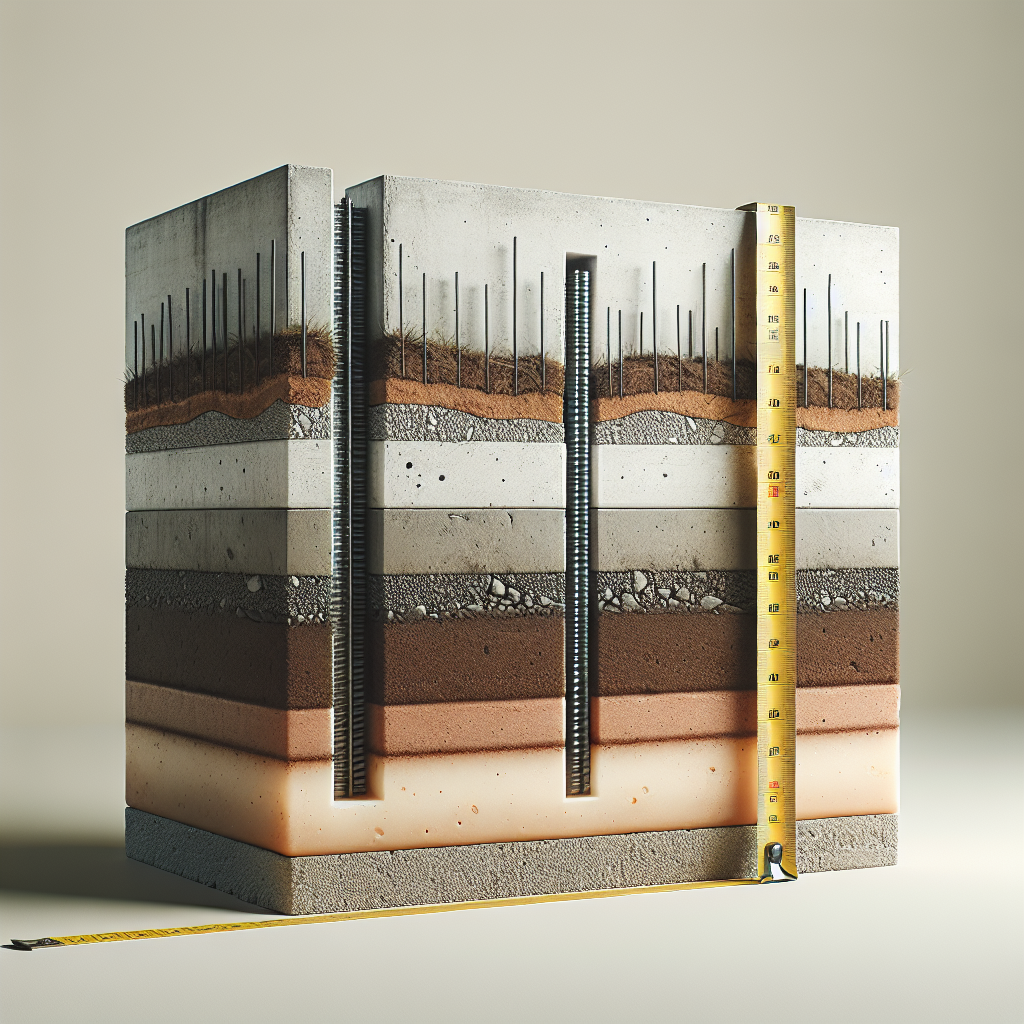
Getting footing depth right keeps a building safe and limits future repairs. Even small mistakes in depth can lead to settlement, cracking, or frost damage.
This article explains how to estimate footing depth in a clear way, which factors to check, and common pitfalls to avoid. Examples and simple steps help turn concepts into useful numbers.
Why correct footing depth matters
The depth of a footing controls how loads are transferred into the ground and how the foundation resists frost and moisture changes. Too shallow and the footing may sit on weak or seasonal soil. Too deep and the cost rises without clear benefit.
Design decisions must balance safety, durability, and cost. That balance begins by knowing soil behavior and the loads the footing must carry.
Safety and long‑term performance
Deeper footings often reduce the risk of differential settlement because they reach firmer material. They also protect against frost heave in cold climates.
Cost and constructability
Excavation, formwork, and concrete volume increase with depth. Practical depth choices reflect site access, groundwater level, and excavation methods available.
Key factors that influence depth
Several site and structural variables determine the minimum and preferred depth. Ignoring any of them can lead to an unsafe or inefficient solution.
Each factor should be considered together rather than in isolation.
Soil type and bearing capacity
Soil that carries higher loads allows shallower footings. Soft clays and loose sands usually need deeper footings or ground improvement. A simple soil test can give a rough bearing value used in calculations.
Frost and climate
In cold regions, footings must sit below frost depth to avoid heave. Local codes provide frost depth values. If frost protection is ignored, movement in winter can damage the structure.
Water table and drainage
A high groundwater level reduces effective soil strength and can cause buoyancy issues. Consider drainage or deeper footings when water is near the planned depth.
Load type and distribution
Point loads from columns need different sizing than continuous wall loads. Heavier loads require either larger footing area or greater depth to reach suitable bearing strata.
Simple calculation method you can follow
The following method provides a direct way to estimate footing depth and size for shallow spread footings. It uses basic inputs you can obtain from a site visit and simple tests.
Work step by step, checking assumptions at each stage.
Step 1: Gather essential site data
Collect approximate soil type, rough bearing capacity, frost depth, and water table. If an official soil report exists, use that. Otherwise local tables and observations give a starting point.
- Soil type: clay, silt, sand, gravel
- Estimated bearing: e.g., 50–200 kN/m² depending on soil
- Frost depth from local code
- Groundwater presence
Step 2: Calculate required area
Divide the load to be carried by the allowable bearing capacity to get the footing area. Use a factor of safety typical in local practice.
Example: if column load = 300 kN and allowable bearing = 150 kN/m², area = 300 / 150 = 2.0 m².
Step 3: Choose footprint and depth
From area, pick practical footing dimensions. Depth is set by three main needs: reach competent soil, be below frost, and provide adequate thickness to resist bending.
Minimum thickness for spread footings often ranges from 200 mm to 500 mm depending on load and construction. Deepening may be needed to reach better soil or damp-proofing levels.
Step 4: Check punching and bearing stresses
Ensure perimeter shear and punching shear capacity of the slab is adequate. If not, increase thickness or provide reinforcement. Verify that contact pressure does not exceed allowable values at the soil interface.
Practical examples and numbers
Examples help turn abstract ideas into useful planning tools. Below are two simplified scenarios with common numbers.
These are illustrative only; site-specific checks remain important.
Example A: Small residential column
Column load: 200 kN. Estimated allowable soil bearing: 100 kN/m². Frost depth: 0.6 m.
Area needed = 200 / 100 = 2.0 m². A square footing 1.5 m × 1.5 m gives 2.25 m² and is acceptable.
Depth choice: minimum thickness 300 mm for concrete strength plus embedment below frost. To reach 0.6 m below grade the excavation must expose solid soil; total depth from finished floor may be 0.9–1.0 m depending on slab thickness and clearance.
Example B: Strip footing under wall
Wall load per metre: 40 kN/m. Soil allowable: 120 kN/m². Required strip width = 40 / 120 = 0.33 m, practical width choose 0.5 m.
Depth: keep below frost depth and keep concrete thickness at 200–300 mm. If frost depth is 0.8 m, the bottom of the strip should be at least 0.8 m below finished grade.
Common mistakes and practical checks
Routine errors often come from assumptions that skip site realities. Simple checks catch most issues early and save cost later.
Use these checks before finalizing depth and size.
Assuming a single soil layer
Many sites have layered soils with a weak surface and firmer layers below. Relying only on the top layer can lead to undersized footings. Probe or test to confirm.
Ignoring seasonal water changes
Water levels can vary with seasons, drainage changes, or construction activity. Plan for the worst reasonably likely condition rather than the dry season only.
Skipping load distribution checks
Concentrated loads near a foundation edge cause higher stresses. Check eccentricity and consider increasing footing width or adding reinforcement.
Materials, reinforcement and installation notes
Material choices and reinforcement details affect needed depth and durability. Good practice reduces risk during and after construction.
Think about concrete strength, cover, and reinforcement location relative to the bearing surface.
Concrete and reinforcement basics
Use minimum cover to reinforcement that protects steel from corrosion and provides proper load transfer. Typically 50–75 mm cover is used for ground-contact elements, but local practice varies.
Drainage and moisture control
Good drainage around footings prevents saturation and reduces the chance of soil strength loss. A perimeter drain, gravel bedding, or a damp‑proof membrane may be appropriate.
Conclusion
Estimating footing depth blends soil understanding, load calculations, and local climate needs. Simple rules and checks produce practical, safe results.
Always confirm key assumptions like bearing capacity and frost depth before committing to final dimensions. Thoughtful planning reduces surprises and keeps costs reasonable.
Frequently Asked Questions
How deep should a footing be in cold climates?
Depth must be below local frost depth to avoid heave. Add concrete thickness and any slab depth above the footing to find total excavation depth. Local codes list frost depths for regions.
What if the groundwater is close to the surface?
High groundwater reduces effective bearing capacity and can cause buoyancy. Drainage, dewatering during construction, or deeper footings may be needed. Treat water as a key factor in depth decisions.
Can shallow footings be used on clay?
Shallow footings are possible if clay has sufficient bearing capacity and settlement can be controlled. Soft or highly compressible clay often requires deeper foundations or ground improvement.
Should footings always reach competent rock?
No. Many spread footings sit on compacted soil with satisfactory bearing. Rock is not required unless soil strength is inadequate for loads or settlement limits demand it.
How much extra depth is needed for safety?
Beyond frost and bearing considerations, allow extra depth for construction tolerance, topsoil removal, and minor settlement. This often means adding 50–150 mm beyond the calculated minimum depending on site conditions.