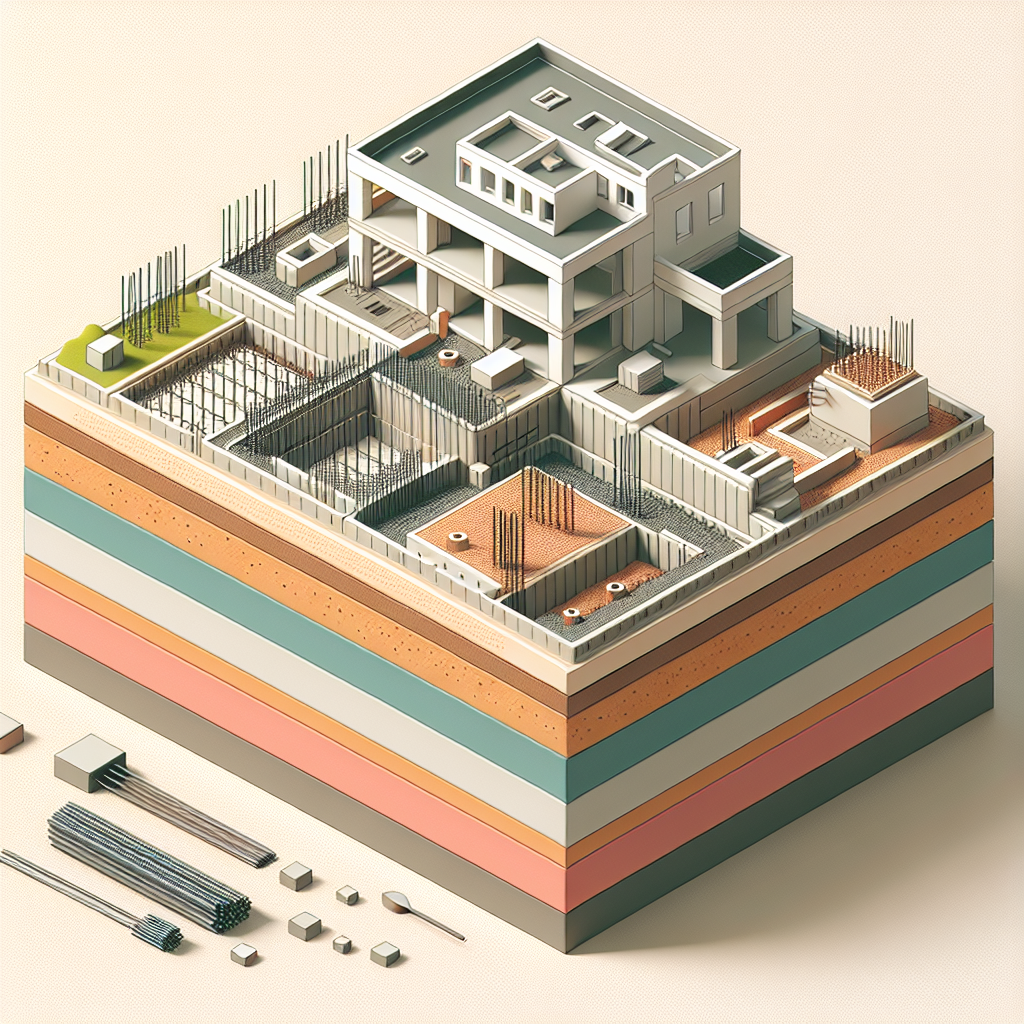
Good foundations start with clear thinking and careful checks. This article explains how to assess soil, pick the right footing type, run essential calculations, and manage on-site work so foundations last.
Each section breaks complex ideas into simple actions you can apply on most small to medium projects. Read through the steps and use the checklists to avoid costly surprises.
Understanding soil and load behavior
Before any digging, learn what the ground will do under a load. Soil type and water level affect bearing capacity, settlement, and the kind of foundation that will work best.
Testing and observation let you reduce risk and choose a solution that matches site conditions.
Soil investigation essentials
Start with a visual survey: note vegetation, slope, and signs of water pooling. Then arrange at least one borehole or test pit in the building footprint to inspect soil layers.
- Identify topsoil, sand, silt, clay, gravel, and rock layers.
- Measure groundwater depth during dry and wet periods.
- Collect samples for basic lab tests if possible (grain size, Atterberg limits).
Interpreting bearing capacity
Bearing capacity is how much vertical load soil can safely carry. Use empirical charts for common soils, but adjust for moisture and depth.
- Granular soils often have higher bearing capacity and drain well.
- Cohesive soils (clays) can have low strength and high settlement.
- Saturated layers reduce capacity; consider dewatering or deeper footings.
Choosing the right foundation type
Match the structure’s loads and soil results to a foundation that controls settlement and distributes weight evenly. Options vary from shallow spread footings to deeper solutions.
Practical choices focus on simplicity, cost, and performance on the specific site.
Shallow foundations overview
Shallow foundations sit close to the surface and are common for light to moderate loads on good soils. They are easier and faster to build.
- Strip footings: good for load-bearing walls along continuous lines.
- Pad footings: isolated bases under columns or piers.
- Raft/slab foundations: spread load across an entire slab area when soil is weaker or loads are distributed.
When to consider deep foundations
Deep foundations transfer loads to stronger layers below weak topsoil. They are chosen when shallow solutions risk excessive settlement.
- Piles: driven or bored elements reaching firm strata.
- Caissons: large-diameter drilled shafts for heavy concentrated loads.
- Choose deep options when bearing capacity at shallow depth is inadequate.
Key calculations and safety checks
Accurate calculations ensure the foundation can carry loads with an acceptable safety margin. Keep checks simple and verifiable.
Work with clear assumptions and record all values used in each step.
Load estimation basics
Combine dead loads (structure weight) and live loads (occupancy, furniture) to find the total vertical load on each footing. Include snow or storage if relevant.
- Sum loads from walls, floors, roofs, and concentrated loads.
- Apply appropriate safety factors per local standards.
- Consider load eccentricity and moments from lateral forces.
Footing size and bearing check
Divide the load on a footing by allowable soil bearing pressure to get the required area. Then set footing dimensions to provide that area with sensible proportions.
- Allowable pressure = ultimate bearing capacity / factor of safety.
- Check pressure distribution — eccentric loads cause triangular or trapezoidal patterns.
- Ensure dimensions allow proper reinforcement cover and construction access.
Settlement estimation
Estimate settlement to confirm it is within acceptable limits. For many sites, elastic settlement formulas give a conservative value; for clays, consolidation estimates matter.
- Immediate settlement tied to elastic compression of soils.
- Consolidation settlement occurs slowly in fine-grained soils under sustained load.
- If predicted settlement is large or differential, consider stiffer foundations or ground improvement.
Construction steps and quality control
Construction turns calculations into reality. A clear sequence and simple checks at each stage prevent mistakes and reduce rework.
Document inspections and keep materials traceable to ensure consistent quality on site.
Site preparation and layout
Clear the footprint, remove organic topsoil, and set levels using a stable datum. Mark foundation lines with accurate offsets and check diagonals for squareness.
- Trim vegetation and remove soft spots.
- Use string lines, batter boards, or laser layout tools for precision.
- Record existing slopes and plan drainage away from the foundation.
Concrete and reinforcement practice
Select concrete strength and reinforcement to match design loads and exposure. Proper placement and curing are as important as mix strength.
- Ensure minimum cover to reinforcement to prevent corrosion.
- Use well-matched mix, and avoid excess water on site that weakens concrete.
- Cure concrete for the required time to reach intended strength.
Backfill and drainage
After foundations reach required strength, place backfill in layers and compact. Provide drainage to keep water away from structural elements.
- Use free-draining fill near footings when possible.
- Install perimeter drains or passive slopes to move water away.
- Compact in lifts to reduce future settlement and ensure stability.
Common problems and practical fixes
Even simple foundations can face issues if the site is tricky or workmanship slips. Spotting problems early saves time and money.
Address defects with straightforward repairs based on the cause and severity.
Poor or soft soil
If tests show weak soils, options include deeper foundations, widening footings, or ground improvement like compaction or stone columns.
- Increasing footing size reduces pressure on weak layers.
- Preloading or installing wick drains speeds consolidation where settlement is expected.
- Use lightweight fills to lower loads when possible.
Cracking and differential movement
Small cracks are often cosmetic, but wide or growing cracks indicate movement. Check the pattern and measure changes over time.
- Stitching or epoxy injection can repair non-structural cracks.
- For movement driven by poor drainage, fix water paths and underpin if necessary.
- Monitor repaired areas to confirm stability.
Conclusion
Solid foundations come from clear site knowledge, correct selection, and disciplined construction. Each stage — soil testing, type selection, calculations, and building — must align with the others.
Keep records and carry out simple checks during work to avoid surprises and get durable, safe results.
Frequently Asked Questions
How deep should a footing be?
Depth depends on frost line, soil type, and surface loads. Minimum depth is often set by local climate to avoid frost heave, and deeper depths may be needed to reach stable soil layers.
When is a raft slab a better choice?
A raft slab spreads load over a wide area and works well where soils are weak but consistent, or where differential settlement must be minimized across the whole structure.
Can drainage change foundation performance?
Yes. Poor drainage raises groundwater and weakens soils, lowering bearing capacity and increasing settlement risk. Managing water near foundations is essential.
Is reinforcement always required in footings?
Most concrete foundations benefit from reinforcement to control cracking and add tensile capacity. The amount and type depend on load and soil conditions.
When should the ground be improved instead of using deep foundations?
Ground improvement is worth considering when weak layers are shallow and improvement methods (compaction, stone columns) can economically achieve the needed capacity. Deep foundations suit sites where improvement is impractical or too costly.