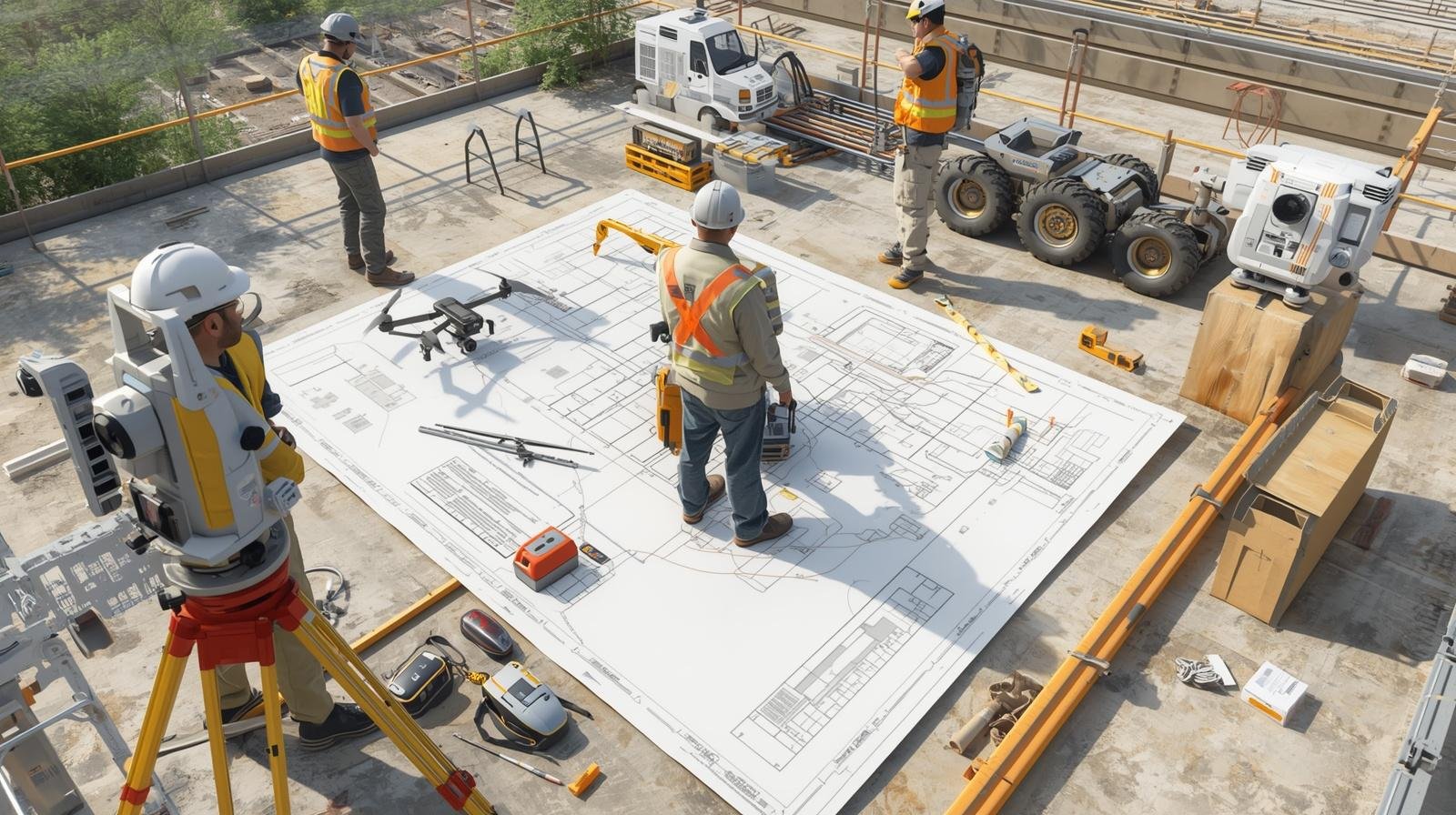
Surveying methods civil engineering is the backbone of accurate construction. In this article I explain plane, geodetic, aerial surveying and modern methods in clear, simple language. You will see practical construction examples and learn which method fits each task.
Overview of Surveying Methods
Surveying collects spatial data for design and construction. This section gives a short intro before we break down each method.
Plane Surveying
Plane surveying assumes the earth is flat over a small area. It is simple and works well for local projects like small roads, buildings, and site layouts.
- Used for small to medium sites
- Equipment: total station, level, tape
- Good for layout, stakeout, and volume checks
Geodetic Surveying
Geodetic surveying accounts for the earth’s curvature. Use it for large networks, national mapping, and long baselines.
- Used for large projects and control networks
- Equipment: GNSS, high-precision theodolites
- Provides high accuracy over long distances
Aerial Surveying
Aerial surveying uses aircraft or drones to map large areas quickly. It is ideal for topography, corridor mapping, and site monitoring.
- Fast coverage of large or hard-to-reach areas
- Equipment: UAVs (drones), manned aircraft, photogrammetry software
- Good for topographic maps, orthophotos, and change detection
Modern Methods: GNSS, LiDAR and UAV
Modern methods combine sensors and software. GNSS gives precise positions. LiDAR and photogrammetry create dense 3D models. These modern methods speed up work and reduce field time.
- GNSS for control and positioning
- LiDAR for dense elevation data and vegetation filtering
- UAV photogrammetry for high-resolution imagery and models
When to Use Plane, Geodetic, Aerial and Modern Methods
Choosing the right method depends on project size, accuracy, cost, and site access. Read the short notes below before diving into examples.
Small Construction Sites
Use plane surveying for building layouts, foundation control, and simple topography. It is cost effective and fast.
Large Projects and Networks
Choose geodetic surveying for long roads, railways, and national grids. It keeps coordinates consistent over long distances.
Site Mapping and Monitoring
Aerial surveying and UAVs are best for site mapping, stockpile measurement, and progress monitoring. They reduce safety risk and give frequent updates.
High Precision and 3D Needs
Use GNSS and LiDAR when you need precise control points, 3D models, or to capture complex terrain. These modern methods often combine to give the best result.
Practical Construction Examples
Below are clear examples showing how surveying methods apply in real construction tasks.
Road Construction
For a new road, start with geodetic control. Use aerial LIDAR or photogrammetry for corridor mapping. Plane surveys handle detailed cross sections during construction.
- Establish GNSS control along the route.
- Use LiDAR for terrain and vegetation clearing limits.
- Set out centerline, slopes, and profiles with total stations.
Building Foundations
Plane surveying covers building layout and foundation levels. Use a precise level and total station for stakeout and elevation checks.
- Mark control points with GNSS or local control.
- Verify foundation depth with leveling surveys.
- Confirm as-built position with a final survey.
Bridge Alignment
Bridges need geodetic control for long spans. Use combined methods: GNSS for control, total stations for alignment, and laser scanning for as-built checks.
Earthworks and Volume Calculation
Use aerial photogrammetry or LiDAR to build terrain models before and after excavation. Calculate volumes accurately and monitor changes over time.
Comparison Table: Methods at a Glance
Quick comparison to help choose the right method.
| Method | Accuracy | Best Use | Common Equipment |
| Plane Surveying | Medium (cm to decimeters) | Small sites, layouts | Total station, level, tape |
| Geodetic Surveying | High (mm to cm) | Long baselines, control networks | GNSS, high precision theodolite |
| Aerial Surveying | Variable (cm to meters) | Large area mapping, monitoring | UAV, aircraft, photogrammetry |
| Modern Methods (LiDAR, GNSS) | Very high (cm to mm) | 3D models, complex terrain | LiDAR scanners, GNSS, drones |
Best Practices on the Field
Short tips to improve accuracy and efficiency on site.
- Always start with well-distributed control points.
- Check equipment calibration daily.
- Use redundant measurements for reliability.
- Combine methods when needed: GNSS control + total station detail.
- Document and store raw data for future checks.
Surveying Methods Civil Engineering Complete: Integration and Workflow
Combining plane, geodetic, aerial, and modern methods gives the best results. Typical workflow blends control, mapping, and detail surveys.
- Plan control network (geodetic or GNSS).
- Collect broad area data (aerial LiDAR or photogrammetry).
- Do detailed plane surveys for construction stakeout.
- Perform as-built surveys and compare against design.
Frequently Asked Questions
What is the difference between plane and geodetic surveying?
Plane surveying treats the earth as flat for small areas. Geodetic surveying accounts for the earth’s curvature and is used for large areas and high-accuracy networks.
When should I use aerial surveying?
Use aerial surveying for large sites, inaccessible areas, and when you need quick topographic maps or repeat monitoring with drones or aircraft.
Are modern methods like LiDAR better than traditional surveys?
Modern methods give dense 3D data and speed. But they are best when combined with traditional control surveys to ensure accuracy and traceability.
Can GNSS replace total stations?
GNSS is excellent for positioning, but total stations remain useful for high-precision local work, vertical control, and places with GNSS signal issues.
Conclusion
Surveying methods in civil engineering range from simple plane surveys to advanced geodetic and aerial techniques. Use the right mix for your project to save time, cut cost, and improve accuracy. Combining methods often gives the best result for modern construction challenges.