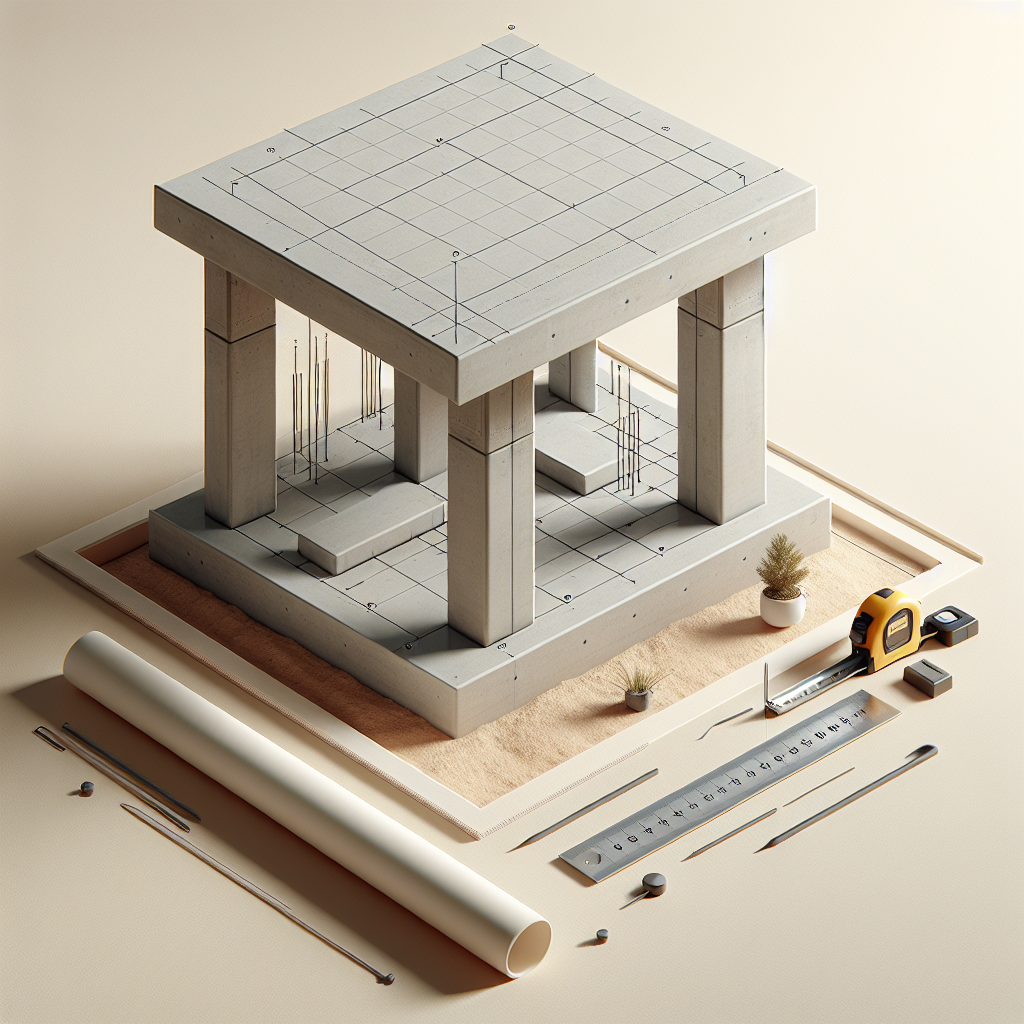
When two columns are close together or a column sits near a property line, a single continuous footing often makes sense. This article explains how to size and check a combined footing with clear steps and a worked example.
Keep the approach practical: establish loads, find required area from soil pressure, place the centroid, check eccentricity, and then size bending and shear. Short explanations and lists help you apply the method reliably.
Basic idea and when to use a single footing
A combined footing supports two or more columns on the same concrete slab. It transfers column loads to the soil while keeping bearing stress within allowable limits.
Common reasons to use a single footing are columns close together, one column near a boundary, or when isolated footings would interfere with each other. The slab acts as a bridge to spread load and control differential settlement.
Types of combined footings
Rectangular footings are the most common, simple to analyze and construct. Trapezoidal shapes are used when column loads differ significantly; they reduce concrete where less load is present.
Continuous footings extend under several columns and behave like a beam on soil. The design approach still follows the same checks: bearing, eccentricity, bending, and shear.
Key terms to know
- Net column load: the total vertical load each column transmits to the footing.
- Allowable bearing pressure: the safe soil pressure value used to size the footing area.
- Centroid of loading: the point where resultant load acts; footing must be shaped so the soil pressure distribution is acceptable.
- Eccentricity: offset between resultant load and geometric center; large eccentricity leads to non-uniform bearing.
Step-by-step sizing approach
Start with loads and soil data. Work through an area check first, then centroid and eccentricity, and finish with bending and shear calculations.
Design assumptions should be documented: material strengths, safety factors, and clear dimensions for column sizes.
1. Determine required area
Add all vertical loads from columns that the footing will carry. Divide the total by the allowable soil pressure to get the required plan area.
- Required area = (P1 + P2 + … + Pn) / q_allow
Choose a practical plan shape and dimensions that meet the area requirement and site constraints.
2. Position the centroid and check eccentricity
Calculate the position of the resultant load relative to the footing’s geometric center. If the eccentricity is too large, soil pressure becomes triangular or even tensile at edges, which is not acceptable.
One common rule: limit eccentricity so that compressive zone remains within the footing; if e < B/6 (for width B), the pressure remains compressive across the section.
3. Compute bending moments and shear forces
Model the footing as a beam strip between columns and edges. For rectangular footings, take a unit width strip (1 m) and calculate bending moment due to column loads transferred as reactions at column locations.
Shear checks include both one-way shear near column faces and punching shear around column perimeters. Check whichever governs.
4. Reinforcement layout basics
Select longitudinal bars to resist bending and provide minimum shear reinforcement as needed. Use development length and spacing rules from concrete codes for detailing.
Place distribution bars perpendicular to the main reinforcement to control cracking and improve load transfer between columns.
Worked numerical example
This example shows the method without exhaustive code checks. It illustrates the main calculations so you can follow the steps on a real project.
Assumptions: two columns, loads known, and a rectangular footing is preferred due to site limits.
Given data
- Column A load = 420 kN
- Column B load = 280 kN
- Distance between column centres = 3.0 m
- Allowable soil pressure q_allow = 150 kN/m2
- Column sizes neglected for plan area; checks near columns will account for column width.
Step 1 — required area
Total load = 420 + 280 = 700 kN. Required area = 700 / 150 = 4.667 m2.
Choose a practical width and length. If site constraints limit width, pick width B = 1.2 m and compute length L = area / B = 4.667 / 1.2 = 3.889 m. Round to a neat value: L = 3.90 m.
Step 2 — centroid and eccentricity check
Place footing so mid-distance between columns aligns with the slab centre, unless a boundary pushes the slab one way. Here assume symmetric placement, columns at x = 0 and x = 3.0 m along the slab centreline.
Compute resultant location: X_res = (420*0 + 280*3.0) / 700 = 1.2 m from Column A. Midpoint of slab length (if slab length equals 3.90 m) lies at 1.95 m from one edge; but for eccentricity we compare load centroid to geometric centroid of plan. If loads are within the slab and the centroid lies within B/6 limits, the pressure is acceptable.
Step 3 — soil pressure distribution
With total area 4.667 m2 and chosen plan 1.2 x 3.90 m, uniform pressure equals total load divided by area = 700 / 4.667 = 150 kN/m2, as expected.
If the loading centroid shifts, compute edge pressures using eccentric loading formulas. For simple checks, ensure eccentricity e_x < L/6 and e_y < B/6 to avoid tensile pressure.
Step 4 — bending moment and reinforcement (strip method)
Take a 1 m wide strip along the centreline between columns, spanning full length. Convert column loads to equivalent strip loads by dividing column loads by strip width if treating load as point loads.
For simplicity, compute bending about an axis perpendicular to strip: Max moment near mid-span due to two point loads P1 and P2 spaced at their actual positions.
- Place origin at left edge of strip. Column A at x_a, Column B at x_b.
- Use beam formulas to find shear and moment diagrams. For approximate design, take maximum bending moment as controlling value and provide reinforcement accordingly.
Assume a design bending moment M_design = 85 kNm per metre strip (this is a simplified representative value for illustration). Using concrete section properties and permissible steel stress, compute required As.
- Assume effective depth d = 450 mm and lever arm z ≈ 0.9d = 405 mm.
- Required tensile force = M_design / z = 85,000 / 0.405 = 209,877 N ≈ 210 kN.
- Assume yield strength fy = 500 MPa, area per mm2 = 1/ (N per mm2) so As = 210,000 / 500 = 420 mm2.
- Select 2 bars of 12 mm diameter: area ≈ 2 x 113 = 226 mm2 — insufficient. Use 4 bars of 12 mm: 452 mm2, acceptable.
Detail bars uniformly across strip width with spacing according to code; check minimum and maximum spacing and cover.
Step 5 — shear and punching checks
Check one-way shear at a distance d from column face. Compute shear force from reactions transferred by strips; compare to concrete shear capacity. If V_ed > V_rd,c provide shear reinforcement.
Punching shear around each column is critical when loads are concentrated. Compute punching perimeter at d/2 from column face and compare punching shear stress to allowable. Provide shear reinforcement if necessary.
Practical detailing and common checks
Concrete cover, bar spacings, and reinforcement continuity must be detailed clearly on drawings. Typical cover for footings is larger than for beams due to soil contact.
Also consider temperature and shrinkage reinforcement as continuous mesh or distributed bars to reduce cracking risk.
Settlement and compatibility
Even if footing size meets bearing pressure, check expected settlement. Two adjacent columns with different loads can cause differential settlement; widening the slab or stiffening it can help.
Use approximate settlement formulas or consult geotechnical data. If settlement is large or uneven, consider soil improvement or a deeper foundation type.
Edge and eccentricity fixes
If a column sits close to a property line, the slab may need to be extended more on the opposite side to shift the centroid inward. Alternatively, a cantilevered portion can balance moments but may increase bending demands.
Trapezoidal plan shapes reduce concrete where lower pressure is needed and concentrate width where loads are higher.
Common mistakes to avoid
Engineers and detailers should watch for these recurring issues that lead to redesign or poor performance.
- Underestimating soil pressure or neglecting soft layers below shallow depth.
- Ignoring eccentricity checks that lead to tensile soil pressure at edges.
- Not checking punching shear around columns, which is a frequent omission.
- Using minimum reinforcement without checking spacing and development lengths.
Address these early to avoid costly fixes during construction.
Conclusion
Designing a single footing for multiple columns follows a clear sequence: area from loads and soil pressure, centroid and eccentricity checks, bending and shear checks, and detailing reinforcement. Practical choices about shape and dimensions simplify construction and reduce material use.
Keep calculations transparent with assumptions recorded, and always check key failure modes like punching shear and uneven settlement before finalizing dimensions.
Frequently Asked Questions
How is the required footing area calculated?
Sum the vertical loads that the slab must carry and divide by the allowable soil pressure. The result gives the minimum plan area. Choose a practical shape and dimensions that meet this area and site constraints.
What causes eccentric pressure and why is it a problem?
Eccentric pressure happens when the load centroid does not match the footing centroid. It produces a non-uniform soil pressure that can lead to tensile stresses at one edge and reduce effective bearing area. Limiting eccentricity keeps pressure compressive.
When must punching shear be checked?
Always check punching shear around column perimeters if loads are concentrated. Punching often controls design near small, heavily loaded columns and must be evaluated using a perimeter at roughly d/2 from the column face.
Can a footing be tapered or trapezoidal?
Yes. A trapezoidal plan can be efficient when column loads differ significantly. It reduces concrete where less bearing is required but requires extra care calculating centroid and stress distribution.
What is a simple way to size reinforcement initially?
Use the strip method: take a 1 m wide strip and compute bending moment due to column loads. Using assumed effective depth and lever arm, compute required steel area and then select bars and spacing per practical limits and code requirements.