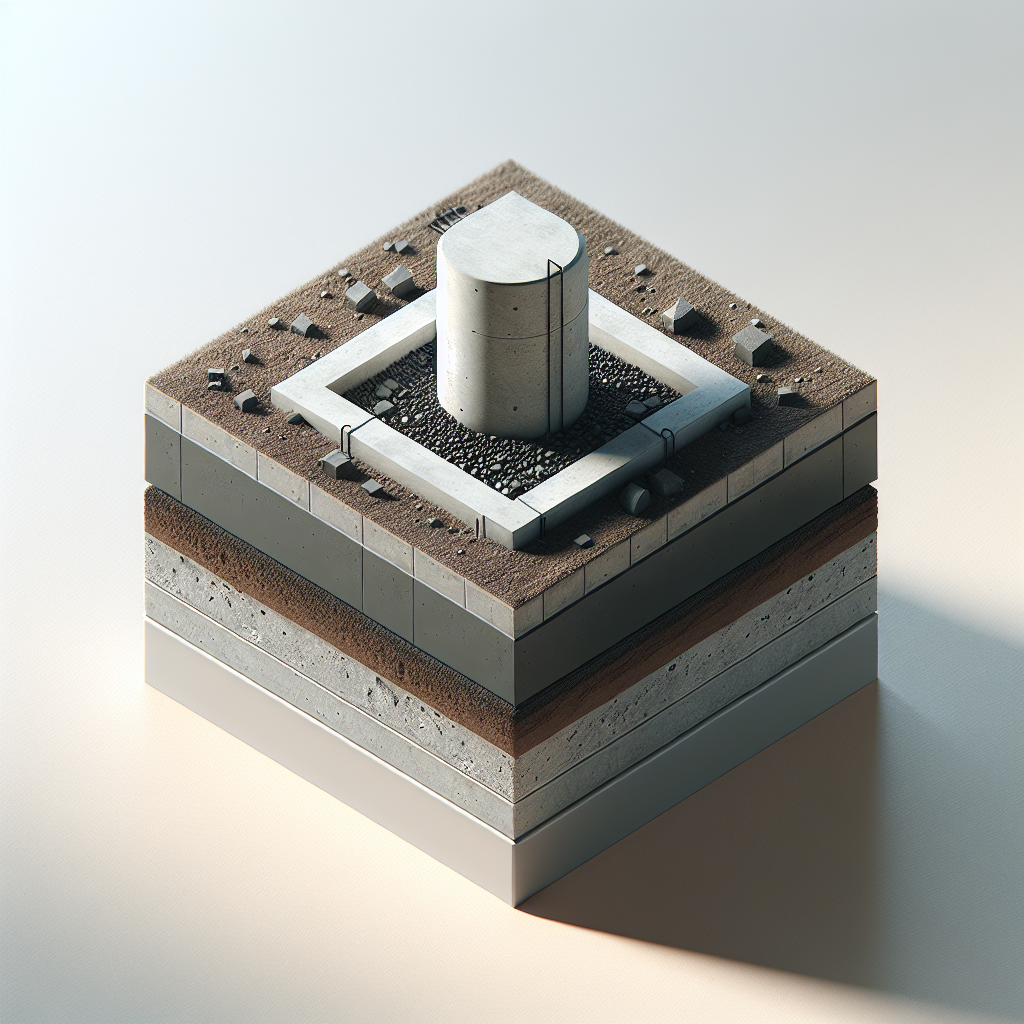
A clear, stepwise approach makes sizing and checking an isolated footing straightforward. This post breaks the process into simple calculations and practical checks you can follow on a small project.
The example uses realistic loads and soil data, then walks through area selection, depth checks, bending and shear verification, and reinforcement suggestions. Numbers are rounded for clarity.
Basic concepts and load assumptions
Before any calculation, list the loads that the footing must carry and the soil capacity beneath it. That information defines the required area and the checks you must do for strength and serviceability.
Typical inputs are column axial load, column dimensions, soil allowable bearing pressure, concrete and steel strengths, and any eccentricity or lateral load effects.
Loads used in the example
For a worked example, assume a column axial load of 500 kN. The column cross-section is 400 mm x 400 mm. No significant lateral load is included in this simple case.
Soil and material data
Assume an allowable soil bearing pressure of 200 kN/m2. Use concrete strength f’c = 25 MPa and steel yield f_y = 415 MPa. These choices influence footing size and reinforcement.
Sizing the footing
The basic sizing step computes the plan area needed so the pressure on soil does not exceed its allowable capacity. For a rectangular or square footing, area = factored load / allowable soil pressure.
Choose a practical plan shape that centers the column and allows sufficient edge distance for reinforcement and formwork.
Calculate required plan area
Required area = 500 kN / 200 kN/m2 = 2.5 m2. A square footing with this area has side length = sqrt(2.5) ≈ 1.58 m.
Round to a practical size. Select a square footing 1.6 m x 1.6 m. That gives plan area 2.56 m2 and a pressure of 500 / 2.56 ≈ 195 kN/m2, which is below allowable.
Check edge and cover dimensions
With a 400 mm column centered on a 1.6 m footing, clear cover from column face to edge is (1600 – 400) / 2 = 600 mm. This is ample for reinforcement placement and formwork.
Ensure a minimum concrete cover of 50 mm to top reinforcement and at least 75 mm to bottom bars if the footing sits on compacted soil or blinding.
Depth selection and settlement considerations
Footing thickness controls bending capacity and punching shear resistance, and it affects settlement. Start with a practical depth, then check structural demands.
Settlement depends on soil stiffness, bearing stress increase and foundation width. For a stiff site with low settlement risk, choose a depth mostly for strength. For compressible soils, consult a geotechnical report.
Initial thickness estimate
For a pad this size, a starting thickness of 350 mm is common. That gives rigid behavior and room for reinforcement. However, structural checks for bending and punching shear will confirm or change that value.
Settlement note
Compute immediate settlement using elastic theory or use empiric charts if a geotechnical report is available. If expected settlement exceeds service limits, increase footing size, improve soil, or add a deeper foundation.
Structural checks: bending and shear
Once plan size and thickness are chosen, check bending (flexure), one-way shear and punching shear. These checks prevent cracking and brittle failures under working loads and factored loads.
Use factored loads per applicable design codes. Here we present simplified checks using the unfactored axial load as a conservative quick check; multiply by load factors in final design.
Bending moment estimate
Consider the footing as a one-way strip spanning from column face to edge. For a square pad, check both directions. The ultimate soil pressure distribution can be approximated as uniform when the column is centered.
Take a strip width equal to the column width plus twice the effective depth when computing bending resistance for a one-way check.
Numerical bending check (approximate)
Use a simple approach: the bending moment at the column face for a one-way strip of width B_s equals q_u * L^2 / 2, where q_u is ultimate soil pressure and L is clear length from column face to edge.
With a safety factor not applied here, q = 195 kN/m2. For the strip in one direction, clear length L = (1.6 – 0.4) / 2 = 0.6 m. Moment M ≈ q * L^2 / 2 = 195 * 0.6^2 / 2 ≈ 35.1 kN·m per meter width.
Convert to design moment per meter. Next find required steel using M = 0.87 f_y A_s z. Take effective depth d = thickness – cover – bar diameter/2. With thickness 350 mm and cover 50 mm, assume d ≈ 350 – 50 – 16/2 ≈ 287 mm ≈ 0.287 m.
Assume internal lever arm z ≈ 0.9 d ≈ 0.258 m. Solve for A_s ≈ M / (0.87 f_y z) = 35.1 / (0.87 * 415 * 0.258) ≈ 0.38 x 10^-3 m2/m = 380 mm2 per meter width.
This suggests a practical reinforcement layout of 4 bars of 12 mm every 300 mm in one direction and similar in the other, subject to minimum reinforcement rules.
Shear checks
One-way shear: check at a section located d away from the column face. Compute shear force V_u as soil pressure times area outside that section.
Punching shear: critical at a perimeter around the column at d/2 from the face. Use codes to find allowable punching shear and compare with punching shear force divided by the critical perimeter.
Punching shear estimate
Critical perimeter u_o around a square column 0.4 m x 0.4 m at distance a = d/2 ≈ 0.143 m is u_o = 4*(0.4 + 2a) ≈ 4*(0.4 + 0.286) = 4*0.686 = 2.744 m.
Punching shear stress v = V_u / (u_o * d). For V_u take total column load 500 kN minus soil reaction inside u_o area. Area inside u_o = (0.4 + 2a)^2 ≈ 0.686^2 ≈ 0.471 m2. Soil reaction inside = q * area ≈ 195 * 0.471 ≈ 91.8 kN. So V_u ≈ 500 – 91.8 ≈ 408.2 kN.
Then v = 408.2 / (2.744 * 0.287) ≈ 408.2 / 0.787 ≈ 518.8 kN/m2 ≈ 0.519 N/mm2. Compare this to concrete punching shear capacity v_c per code; with f’c=25 MPa, v_c might be around 0.25-0.4 N/mm2 depending on factors and reinforcement. This indicates a check is necessary; increasing thickness or adding shear reinforcement (or increasing footing size) may be required.
Reinforcement layout and detailing
After confirming required steel area, lay out bars to provide uniform distribution and meet spacing and cover rules. Provide bottom bars in both directions and top bars around column to control local stresses and shrinkage cracking.
Keep bar spacing within maximum limits (often 3d or 300 mm) and ensure minimum reinforcement percentage to control temperature and shrinkage cracks.
Suggested bar arrangement
Based on earlier bending demand, provide bottom reinforcement of 4-12 mm bars at 300 mm centers in both directions. That yields approximate areas close to the computed requirement and meets minimum spacing rules.
Place top reinforcement around the column edges to resist negative moments near the column face, typically 2-10 mm bars at 200-300 mm spacing, depending on detailing practices and code minimums.
Development and anchorage
Provide sufficient bar development length or mechanical anchorage, especially for bars near the column where stresses concentrate. Hooks or extended lap lengths may be needed depending on available embedment and code rules.
Construction and practical notes
Proper execution matters as much as correct design. Compaction of the bearing layer, clean blinding, correct bar placement and curing all influence footing performance.
Check formwork accuracy, maintain cover with chairs or chairs plus spacers, and avoid disturbing reinforcement during concrete placement.
Soil preparation
Compact the native soil or provide a granular fill and a blinding layer to create a uniform bearing surface. Remove any soft spots and ensure a level base before placing reinforcement.
Concrete placement and curing
Use proper concrete consolidation to avoid voids under bars, and cure the slab for at least seven days to gain strength and reduce cracking. Cold or hot weather measures may be necessary.
Conclusion
Isolated footings are economical and effective when soil conditions are adequate and loads are moderate. Start with clear load and soil data, size the plan area to satisfy bearing limits, then confirm depth by checking bending, shear and punching shear.
Practical choices—such as rounding plan sizes, selecting a conservative thickness, and arranging reinforcement uniformly—help ensure a durable, safe footing.
Frequently Asked Questions
The questions below address common points that arise when sizing and checking a small isolated footing.
How do I pick the footing plan size?
Divide the design load by the allowable soil pressure to get the required area. Pick a regular shape (square or rectangular), center the column, and round to a practical dimension that gives a pressure below allowable.
What thickness should I start with?
Start with a practical thickness like 300–400 mm for small footings. Then check bending and punching shear. Increase thickness if punching shear or bending demand exceeds capacity.
When is punching shear a problem?
Punching shear becomes critical when concentrated loads act over a small column area relative to footing thickness. If computed punching shear stress exceeds concrete capacity, increase thickness or provide shear reinforcement or enlarge the footing.
How much reinforcement is needed?
Compute reinforcement from bending moment demands using appropriate design formulas. Provide minimum distribution reinforcement even if calculated steel is small, to control cracking and thermal effects.
What if soil reports show low bearing capacity?
If allowable pressure is low, increase footing area, use a combined or raft foundation, or switch to deeper foundations like piles. Soil improvement is another option if practical and economical.
Is it acceptable to center the column on the footing?
Yes. Centering gives uniform pressure and simplifies design. If eccentric loads exist, check pressure distribution and adjust shape or reinforcement accordingly.