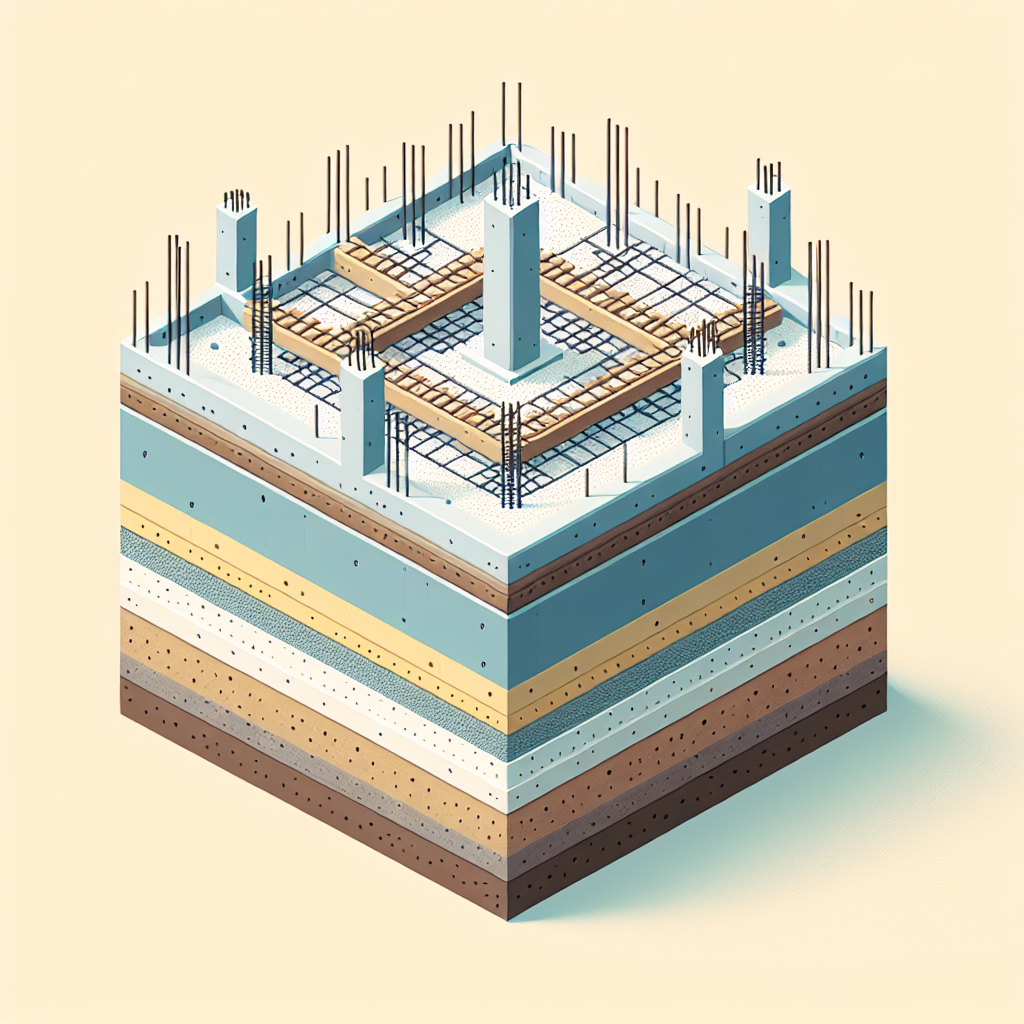
A combined footing is a single concrete foundation that supports two or more columns. It transfers column loads to the soil when individual footings would overlap or when columns are close to property lines.
This article explains how to approach design, sizing, reinforcement, and common checks in simple terms. It focuses on real-world concerns like load distribution, shear, bending, and settlement control.
When a combined footing is appropriate
Combined foundations are used when columns are close enough that separate footings would intersect, or when edge conditions prevent a symmetric isolated footing. They also help when unequal column loads need a common base to balance pressures.
The decision depends on column spacing, soil bearing capacity, and architectural constraints. Early coordination with the structural layout and geotechnical data saves time during detailed design.
Typical scenarios
Common situations include near-boundary columns, adjacent heavily loaded columns, or stepped column lines where continuous foundation would be inefficient. Combined footings can be rectangular or trapezoidal based on load distribution and soil limits.
Advantages and trade-offs
They reduce differential settlement risk between close columns and can be more economical than deep foundations in many sites. The trade-offs include increased formwork and excavation and more complex reinforcement detailing.
Design principles and workflow
Start with accurate column loads and soil bearing capacity. The basic idea is to size the footing so that the bearing pressure under the soil does not exceed allowable limits and stresses in the concrete and reinforcement are safe.
Key checks include flexural capacity, one-way and punching shear, eccentricity limits, and settlement. A clear step-by-step workflow helps to avoid missing critical checks.
Step-by-step approach
- Collect loads: dead, live, wind, and any eccentric effects from superstructure.
- Obtain soil data: allowable bearing pressure, unit weight, and consolidation characteristics.
- Assume a trial footing outline and calculate area = sum of vertical loads / q_allow.
- Determine centroid of loads and ensure pressure distribution is acceptable under the footing.
- Check bending moments and shear at critical sections; size depth and reinforcement accordingly.
- Verify eccentricity limits, minimum reinforcement, and development lengths.
- Review settlement estimates; if unacceptable, consider soil improvement or deeper foundations.
Pressure distribution concept
Assume a linear pressure distribution under the footing when eccentricity exists. If eccentricity e < b/6 (where b is footing width), pressure remains compressive across the base. For larger eccentricity, one edge may lift, requiring design adjustments.
Compute pressures using resultant load and centroid location. This helps decide whether a rectangular or trapezoidal plan is more efficient.
Sizing, reinforcement and structural checks
Size the plan area to keep average bearing pressure within the allowable limit. Then determine the required depth and reinforcement to resist bending and shear from column reactions and eccentricity-induced moments.
Design values depend on material strengths and code-specific factors. The following checks are common in most practice scenarios.
Bending moment and flexural design
Calculate bending moments about critical sections at column centers and at section lines a distance d from the column face. Use the pressure resultants to find net moments on the footing slab in both directions.
Select an effective depth d such that the required area of tension steel meets minimum and serviceability criteria. Provide distribution steel in the orthogonal direction as needed.
Shear checks
One-way shear: Check shear at a section one effective depth from the column face. If V_u exceeds allowable shear, increase depth or provide shear reinforcement.
Punching shear: Around column perimeters, calculate punching shear demand. For truncated column edges near a property line, asymmetric shear checks are especially important.
Eccentricity and centroid alignment
Find the centroid of column loads and compare to the centroid of the planned footing area. If the eccentricity causes nonuniform pressure, adjust plan shape or shift the footing so that bearing pressure remains compressive and within allowable limits.
Minimum reinforcement and crack control
Provide minimum top and bottom reinforcement to control shrinkage and temperature cracking. Codes specify limits on bar spacing and area; apply those under typical slab-on-grade reinforcement practices.
Detailing practicalities and common checks on site
Detailing affects constructability and long-term performance. Reinforcement laps, bar sizes, and spacing must be clear on drawings and simple enough for reliable placement during pouring.
On site, pay attention to formwork, compaction, and curing. Small mistakes in these areas cause larger issues like uneven settlement or localized failure.
Reinforcement layout tips
- Keep main bars continuous across the midspan and anchor with sufficient development at ends.
- Use distribution bars perpendicular to main reinforcement to control cracking.
- Avoid congestion near columns; use shifted anchors or dowels when necessary.
Edge conditions and truncated columns
Where a column lies close to a property line, the footing may be truncated. In such cases, the centroid shifts and bending/shear demands increase on the remaining soil. Consider offsetting the column or enlarging the base toward the free side.
Trapezoidal plans are often efficient when column loads differ substantially. A wider portion under the heavier column reduces eccentricity and pressure peaks.
Settlement and differential movement
Estimate immediate and consolidation settlement using soil compressibility parameters. Even when pressures are within allowable limits, settlements can be high on compressible soils.
Design to minimize differential settlement between adjacent columns; a single combined footing helps by tying foundations together and spreading loads.
Conclusion
Combined footings offer an effective foundation option when columns are closely spaced or site constraints prevent isolated footings. Proper load balancing, sizing, and reinforcement checks keep bearing pressures safe and control bending and shear demands.
Clear, practical detailing and attention to site execution reduce the risk of settlement and cracking. Use a systematic workflow: collect data, size area for bearing, check structural demands, then finalize reinforcement and constructability details.
Frequently Asked Questions
What distinguishes a rectangular combined footing from a trapezoidal one?
Rectangular plans are simpler and work when column loads are similar. Trapezoidal footings taper the width toward a lighter column, shifting the centroid to balance eccentricity and reduce peak pressures under the heavy column.
How do I check eccentricity effects quickly?
Compute the resultant load centroid and compare its offset to the footing centroid. If eccentricity e is less than b/6 in a given direction, pressure stays compressive. For larger e, adjust plan area or shape to avoid uplift on one edge.
When is a combined footing not recommended?
A combined footing is not ideal if soil conditions produce excessive settlement that cannot be equalized across columns, or when columns are far apart making the footing impractically large. In those cases, deep foundations or isolated pad footings may be better.
How are shear and punching checked around columns?
One-way shear is checked at a section one effective depth from the column face. Punching shear is examined around a perimeter at roughly d/2 from the column edges; calculate shear stress and compare with allowable values, adding shear reinforcement if needed.
What role does soil investigation play?
Soil data drive the allowable bearing pressure, expected settlements, and decisions about whether soil improvement is required. A good report reduces guesswork and leads to safer, more economical foundation dimensions.