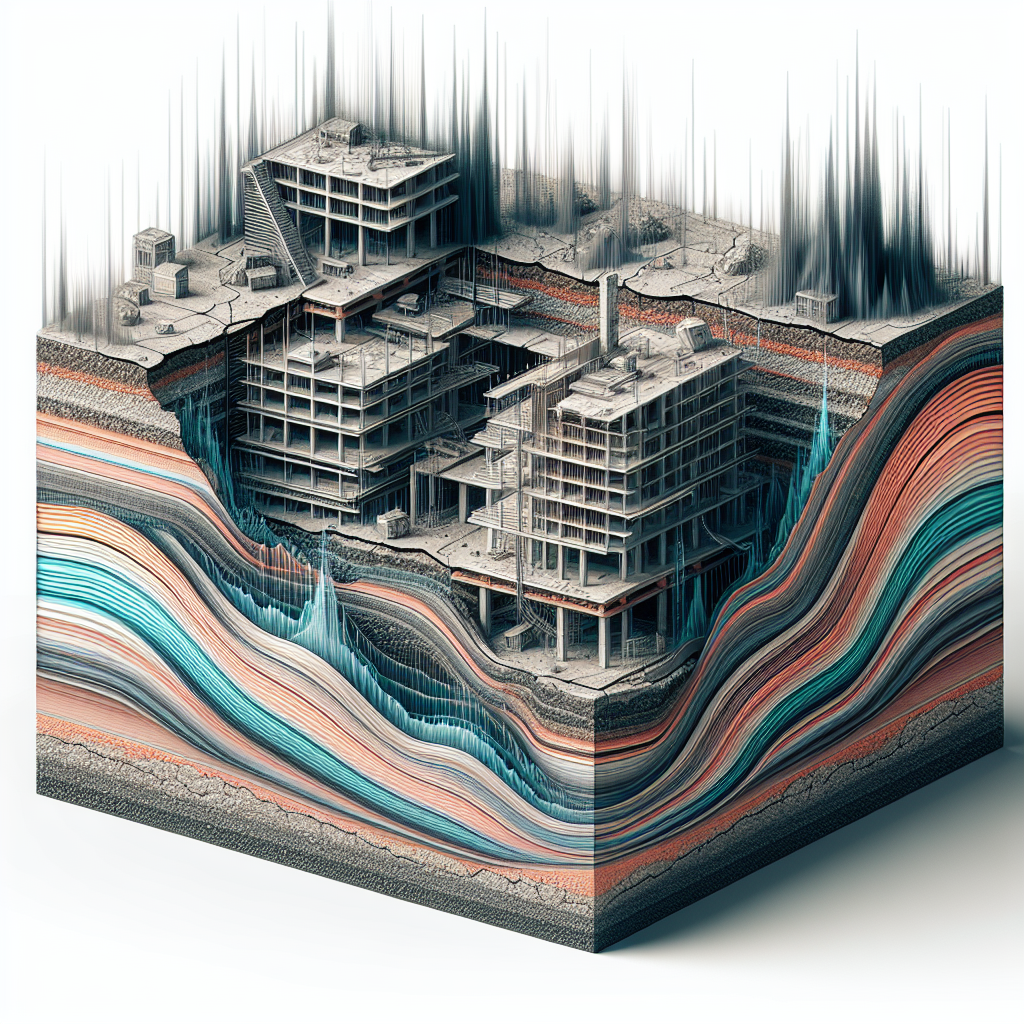
Earthquakes test the link between a structure and the ground beneath it. A well-thought-out foundation reduces damage by controlling how seismic forces transfer into a building.
This article explains practical principles for designing foundations that behave predictably during shaking, focusing on soil behavior, foundation choices, analysis methods, and construction details.
Why foundations matter during seismic events
Foundations control stiffness and damping at the base of a structure. If the foundation is too stiff or too flexible relative to the superstructure, unexpected forces and damage patterns can arise.
Settlement, liquefaction, and foundation rocking are common failure modes in earthquakes. Anticipating these helps designers limit deformation and reduce repair needs after a quake.
How base conditions change performance
Local soil stiffness and layering influence natural periods and amplification of ground motion. Soft soils tend to increase displacement demands, while stiff rock transmits higher accelerations.
Groundwater and saturation affect pore pressure during shaking. Rising pore pressure can lead to loss of strength and large settlements.
Interaction with the superstructure
Mismatch between foundation and structure stiffness creates torsion, differential settlement, or pounding between adjacent elements. Designing the foundation in concert with the structure reduces these risks.
Careful detailing at connections limits the chance of brittle failures where the foundation and structure meet.
Soil evaluation, foundation types, and analysis methods
A clear site investigation is the backbone of any seismic-resistant foundation concept. Without it, design assumptions may be unsafe or overly conservative.
Once site conditions are known, choosing the right foundation type and analysis approach ensures the system will meet performance targets under expected shaking.
Site investigation essentials
Collect boreholes, standard penetration test (SPT) or cone penetration test (CPT) data, groundwater level, and laboratory soil tests. Map any lateral spread, landslide risk, or fill zones.
Classify soils by stiffness and liquefaction susceptibility. Documenting layering and potential compressible zones helps set appropriate foundation depths.
Common foundation types and seismic behavior
Shallow foundations like spread footings and mats are economical when competent soil exists near the surface. They work well if settlements remain small and uniform.
Deep foundations—piles and drilled shafts—bypass weak near-surface layers and transfer loads to deeper, stiffer soils or rock. They also resist uplift and lateral loads when designed for seismic demands.
Combined systems, such as pile-supported rafts, can control settlements while limiting lateral movement. Choice depends on soil, structural loads, and acceptable deformation levels.
Analysis methods to predict seismic response
Equivalent static methods give quick checks but are limited for complex systems. Dynamic analyses—time-history or response spectrum—capture inertia and SSI (soil-structure interaction) effects more reliably.
Simple SSI models adjust structural stiffness and damping to reflect flexible foundations. Advanced finite-element models simulate nonlinearity in soil and foundation components under large displacements.
Construction detailing, monitoring, and repairs
Design intentions must survive construction and service life. Poor detailing, material defects, or bad sequencing can negate careful analysis.
Quality control and monitoring during construction reduce surprises. Post-earthquake assessment and repair planning shorten downtime after a seismic event.
Concrete and reinforcement practices
Ensure proper cover, lap lengths, and splicing aligned with seismic demands. Detailing to avoid brittle failure is critical, especially at pile caps and grade beams.
Use ductile detailing where large inelastic deformations could occur. Confinement in critical regions increases energy dissipation capacity.
Pile and deep foundation considerations
Pile toe and shaft capacity must consider cyclic degradation. Design for reduced lateral and axial capacity under repeated loading if needed.
Anchorages and load transfer zones require careful placement of reinforcement and proper grouting to avoid bond loss during shaking.
Monitoring and construction verification
Field tests such as pile integrity tests, dynamic load tests, and plate load tests confirm assumptions about capacity and stiffness.
Instrumentation during construction and after commissioning can detect unexpected movement, allowing timely adjustments or repairs.
Conclusion
Designing foundations to perform under earthquake loading blends soil knowledge, appropriate foundation choice, and robust detailing. Successful outcomes rely on clear site data and analysis that reflects realistic soil-structure interaction.
Well-detailed connections and quality construction keep the intended seismic behavior intact, while monitoring helps catch issues early. Prioritizing predictable deformation and ductility reduces long-term repair costs and improves safety.
Frequently Asked Questions
What factors most influence foundation performance in earthquakes?
Soil stiffness and layering, groundwater conditions, and the relative stiffness between foundation and structure play major roles. Liquefaction, large settlements, and differential movement are common problems to watch for.
When should a deep foundation be preferred over a shallow one?
Choose deep foundations when near-surface soils are weak, compressible, or liquefaction-prone, or when large lateral loads or uplift must be resisted. Deep systems transfer loads to firmer layers and limit settlements.
How does soil-structure interaction change seismic design?
Interaction alters the natural frequencies, damping, and distribution of forces. Accounting for SSI can reduce predicted forces in some cases but may increase displacement demands, so it should be included in critical projects.
Can foundation rocking be beneficial?
Controlled rocking can dissipate energy and reduce demands on the superstructure if designed properly. However, it must be limited to avoid excessive residual settlements or damage to non-structural elements.
What construction checks help ensure seismic performance?
Confirm as-built pile positions and lengths, reinforcement placement, concrete quality, and grout integrity. Conduct load and integrity tests where uncertainty exists, and document groundwater and soil changes during construction.