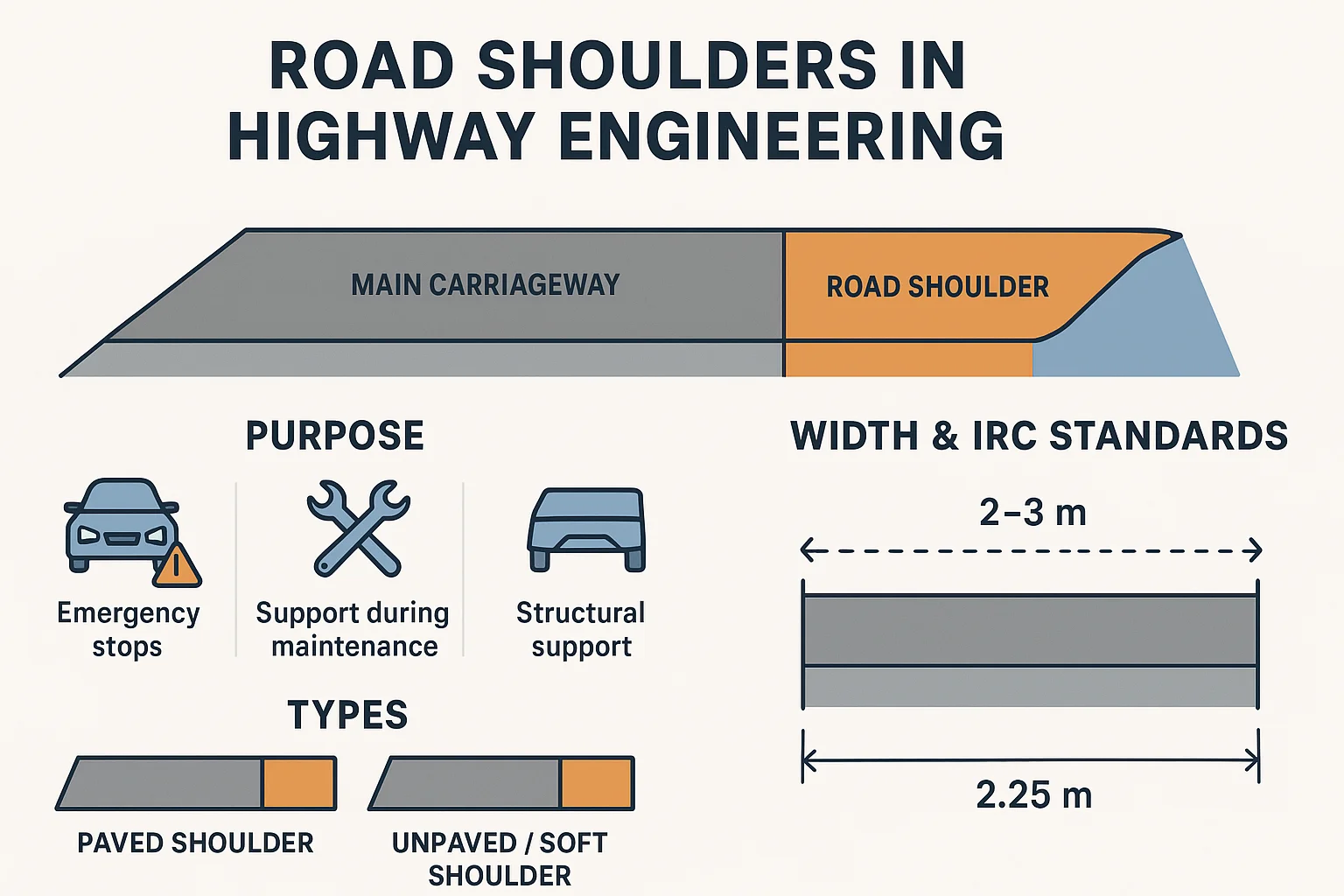
Road shoulders are the portions of a road provided between the edge of the carriageway and the side drain, verge, or embankment slope. They may look like simple side strips, but in highway engineering they play an important role in safety, drainage, emergency stopping, lane support, and pavement protection.
For civil engineering students, site engineers, contractors, and highway practitioners, understanding road shoulders is essential because shoulder design affects cross-section performance, maintenance needs, and overall road safety. In this article, we will explain the purpose of shoulders, the main types of road shoulder, their construction, the idea of road shoulder width IRC, and how they fit into a proper road cross-section.
What Are Road Shoulders?
A road shoulder is the strip adjacent to the main traffic lane. It is not normally meant for regular traffic movement, but it provides additional space at the edge of the pavement. Depending on the road type and traffic conditions, shoulders may be paved, stabilized, gravelled, or earthen.
In simple terms, road shoulders act as a safety and support zone beside the carriageway. They help prevent edge breakage, allow vehicles to stop in emergencies, and improve drainage by supporting the cross slope of the pavement.
Purpose and Functions of Road Shoulders
The main purpose of road shoulders is to improve the functionality and safety of the highway. Their functions are not limited to one use; they serve the road structure, users, and maintenance team.
- Emergency stopping space: Breakdown vehicles can move out of the traffic lane safely.
- Road safety: They provide recovery space for drivers who drift near the edge.
- Pavement support: Shoulders help support the edge of the carriageway and reduce edge cracking.
- Drainage assistance: With proper slope, shoulders help water run off the roadway quickly.
- Maintenance access: They give space for inspection, repairs, and utility work.
- Temporary traffic use: In some cases, shoulders may be used for slow-moving or diverted traffic during incidents or works.
Types of Road Shoulder
The types of road shoulder are generally selected based on traffic volume, road class, climate, budget, and maintenance strategy. The basic classifications are shown below.
| Type | Material / Finish | Main Use | Typical Feature |
|---|---|---|---|
| Paved shoulder | Bituminous, concrete, or similar hard surface | Highways, expressways, urban arterial roads | Good strength, better durability, easier cleaning |
| Earthen shoulder | Compacted soil | Low-volume roads, rural roads, temporary sections | Low cost, but more erosion and maintenance |
| Gravel shoulder | Graded granular material | Intermediate roads, areas with limited paving | Better than soil, but needs periodic maintenance |
| Stabilized shoulder | Soil mixed with stabilizing material | Where improved strength is needed without full paving | More stable than earthen shoulder |
Paved Shoulder vs Earthen Shoulder
The comparison between paved shoulder vs earthen shoulder is important because both serve different road conditions.
- Paved shoulder: Stronger, cleaner, more durable, and better for high-speed roads.
- Earthen shoulder: Cheaper and easier to construct, but it is more vulnerable to erosion, rutting, and water damage.
Paved shoulders are usually preferred on major highways because they provide a more reliable edge support and improve safety during vehicle breakdowns. Earthen shoulders may be acceptable on low-traffic roads, but they require proper compaction and regular upkeep.
Road Shoulder Width IRC: What Engineers Should Know
The road shoulder width IRC depends on the type of highway, terrain, traffic importance, and design standards applicable to the project. IRC provisions are used in India as a design reference, but the exact shoulder width may vary with road category and project-specific requirements.
In practice, wider shoulders are generally provided on high-speed and high-volume roads because they improve safety and allow more recoverable space. Narrow shoulders may be seen on lower-class roads where right of way, cost, or terrain constraints limit the cross-section.
Since standard shoulder width is not universal for all roads, designers should refer to the relevant IRC code and project drawings for the exact requirement. For field execution, the important point is that the shoulder must be wide enough for the intended operational and maintenance function and must match the approved cross-section.
Cross-Section Details and Road Camber
Shoulders are closely connected to the road cross-section. The surface of the carriageway and shoulder should guide rainwater away from the pavement edge. This is where road camber becomes important.
Camber is the cross slope provided on the road surface to drain rainwater. If the shoulder slope is not coordinated with the carriageway camber, water may pond at the edge, leading to pavement damage and reduced riding quality.
For a good road section:
- The shoulder should generally follow the carriageway slope or provide suitable outward drainage.
- The transition between pavement and shoulder should be smooth to avoid edge drop-off.
- Side drains should receive runoff efficiently without allowing water to stagnate near the edge.
In flexible pavements, proper shoulder support is especially important because edge regions are more prone to distress if they are left unsupported or exposed to moisture.
Construction of Road Shoulders
The construction method depends on whether the shoulder is paved, granular, or earthen. However, the basic construction principle remains the same: provide a stable, compacted, and properly sloped strip beside the carriageway.
Typical construction sequence
- Prepare the subgrade and shape the shoulder area to the required level and cross slope.
- Compact the foundation layer properly to achieve uniform support.
- Place the selected shoulder material in layers, if applicable.
- Compact each layer thoroughly to avoid settlement later.
- Provide the final surface finish and ensure smooth transition with the carriageway edge.
- Check drainage slope, edge line, and interface with side drain or embankment.
Quality-control points on site
- Check line, level, and cross slope during construction.
- Ensure compaction is uniform, especially near the pavement edge.
- Avoid loose material on the carriageway side that may cause skidding.
- Prevent shoulder level from becoming lower than the pavement edge for long stretches.
- Make sure water does not collect at the interface between pavement and shoulder.
Advantages and Limitations
| Aspect | Advantages | Limitations |
|---|---|---|
| Paved shoulder | Durable, safer for emergency stopping, less erosion, better edge support | Higher initial cost, needs proper workmanship |
| Earthen shoulder | Low cost, simple to construct, suitable for rural roads | Prone to erosion, rutting, and frequent maintenance |
Practical Example
Consider a two-lane highway carrying mixed traffic and occasional heavy vehicles. If the road has only a narrow or poorly compacted shoulder, the pavement edge may break down due to repeated loading and water ingress. In contrast, a properly graded and compacted shoulder provides support to the edge, offers a safe stopping space, and improves the road’s service life.
On a rural road, an earthen shoulder may be acceptable if traffic is light and maintenance is regular. But where monsoon rainfall is heavy, even an earthen shoulder must be shaped and compacted carefully to reduce erosion and side cutting.
Common Mistakes in Shoulder Construction
- Providing inadequate compaction near the pavement edge.
- Leaving the shoulder lower than the carriageway for long stretches.
- Using unsuitable material without checking drainage behavior.
- Ignoring the coordination between road camber and shoulder slope.
- Not maintaining shoulder edge after monsoon damage or traffic wear.
FAQ: Road Shoulders
What is the main function of road shoulders?
Road shoulders provide safety space, pavement edge support, drainage help, and room for emergency stopping or maintenance work.
What are the main types of road shoulder?
The common types are paved shoulder, earthen shoulder, gravel shoulder, and stabilized shoulder, depending on road importance and soil conditions.
Why is a paved shoulder better than an earthen shoulder?
A paved shoulder is stronger, more durable, and better for high-speed or high-traffic roads. An earthen shoulder is cheaper but needs more maintenance and is more vulnerable to erosion.
How is road shoulder width decided?
The required width is decided based on road class, traffic, design speed, terrain, and the applicable IRC guidelines or project specifications.
How does road camber affect shoulders?
Road camber helps rainwater drain off the surface. If the shoulder slope is not coordinated properly, water may collect at the edge and damage the pavement.
Can shoulders carry regular traffic?
No, shoulders are not meant for normal traffic movement. They are intended mainly for emergency use, support, and maintenance access.
Conclusion
Road shoulders are a small but critical part of highway design. They improve safety, support the pavement edge, assist drainage, and provide space for emergencies and maintenance. Choosing the right shoulder type, maintaining proper compaction, and following the applicable road shoulder width IRC guidance are all essential for a reliable road cross-section.
For any highway project, good shoulder design should work together with road camber, drainage, and pavement structure to deliver better performance and fewer edge-related failures.