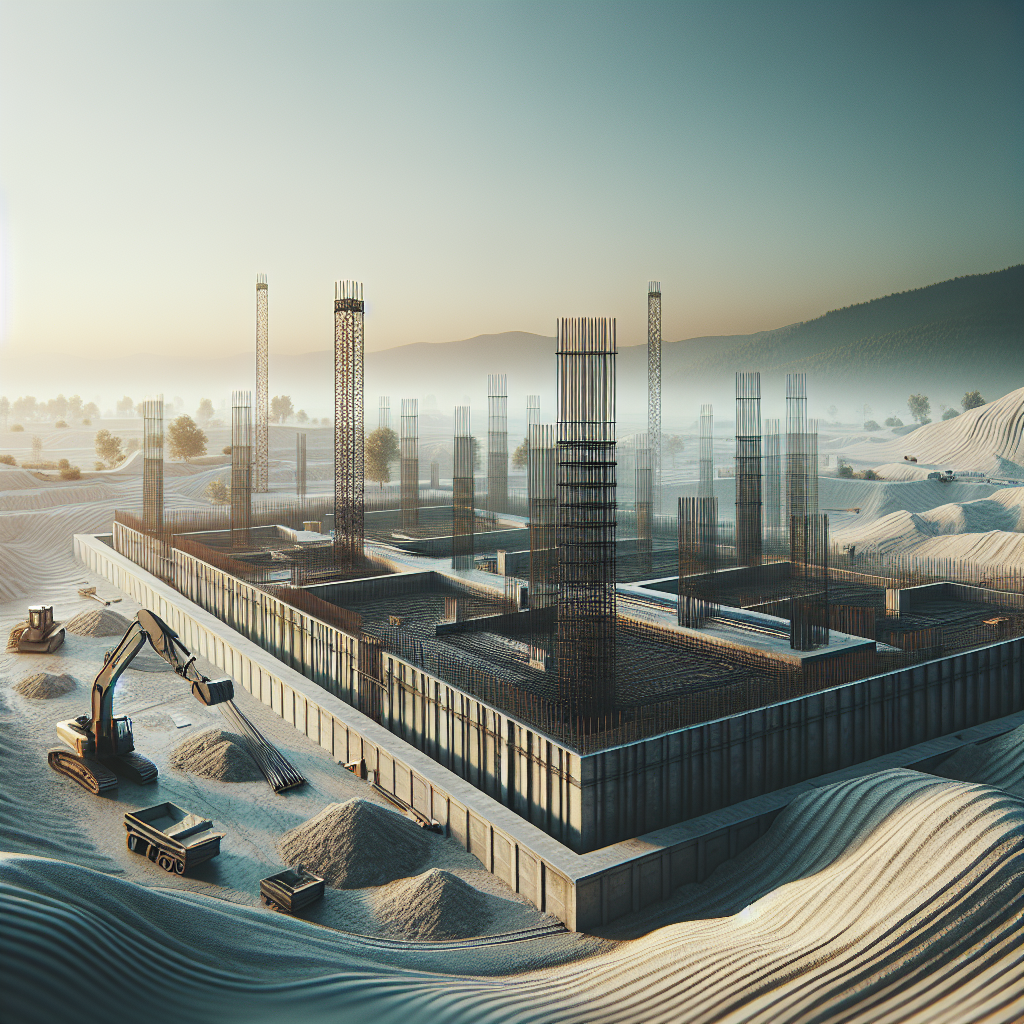
Foundations transfer loads from a building to the ground and control settlement, so choosing the right type is essential for safety and longevity. Understanding options helps match soil conditions, building type, and budget.
This guide breaks down common foundation systems, when each is appropriate, and key design factors to consider during planning and construction.
Shallow Foundations: When the Ground Near Surface Works
Shallow foundations spread building loads close to the surface where soil has adequate bearing capacity. They are economical and common for low- to mid-rise structures on stable soils.
Typical shallow systems are simple to construct and require less excavation compared to deep foundations. They are sensitive to frost, moisture changes, and weak near-surface soils.
Spread or Isolated Footings
Spread footings support single columns by spreading the load over a larger area of soil. They are square, rectangular, or circular concrete pads sized for bearing pressure limits.
These footings are cost-effective for detached columns or light framed structures where loads are relatively small and soil is uniform.
Strip Footings
Strip footings run continuously under load-bearing walls. They are long and narrow, transferring wall loads to a wider soil area.
This type suits masonry and timber walls on even soil, and it simplifies construction for linear load paths like party walls or foundation walls.
Combined Footings
Combined footings support two or more nearby columns when their individual footings would overlap or when columns are close to property lines.
The shape is often trapezoidal or rectangular, designed to balance loads and limit differential settlement between supported columns.
Raft or Mat Foundations
Mat foundations cover the entire building footprint with a thick slab, distributing loads evenly across poor or variable soils.
They are useful where shallow soils have low bearing capacity or when column spacing is tight. Mats control differential settlement and can act as a ground floor slab.
Deep Foundations: Reaching Stronger Soil or Rock
Deep foundations shift loads to deeper layers when near-surface soil cannot safely carry the structure. They are essential for heavy buildings, bridges, and sites with soft topsoil.
Common deep systems transfer load by end bearing on dense strata or by skin friction along the shaft, depending on soil and design.
Pile Foundations (Driven and Bored)
Piles are long, slender elements of timber, concrete, or steel driven or cast into the ground. They carry loads by end bearing, friction, or a combination of both.
Driven piles are hammered into the ground and suit dense soils. Bored (or drilled) piles are made by excavating a shaft and casting concrete in place, useful around existing structures or in dense obstructions.
Caissons (Drilled Shafts)
Caissons are large diameter drilled shafts that reach competent layers or rock. They are usually reinforced and poured with concrete in a controlled sequence.
Caissons are ideal for heavy point loads like columns or bridge piers where concentrated strength and stiffness are needed at depth.
Under-reamed Piles
Under-reamed piles have one or more bulbous enlargements along the shaft. They provide extra bearing in expansive or soft soils and resist uplift forces.
This type suits sites with high groundwater or clay soils that undergo seasonal volume changes, reducing the risk of heave or settlement.
Special Foundations and Ground Improvement Techniques
Some projects require bespoke foundation solutions or soil enhancement when standard shallow or deep options are impractical. These techniques reduce risk and extend buildability on difficult sites.
Choices depend on site access, environmental constraints, cost, and long-term performance requirements.
Floating and Compensation Foundations
Floating foundations balance the weight of the structure by removing soil to offset added load, commonly used in soft clay. The idea is to maintain original stress in the soil to limit settlement.
Also called compensated footings, these systems are sensitive to construction accuracy and are typically used for large structures over very compressible soils.
Soil Stabilization and Ground Improvement
Ground improvement methods change near-surface soil properties to increase bearing capacity and reduce settlement. Techniques include compaction, vibro-replacement, grouting, and soil mixing.
Geosynthetics like geotextiles and geogrids improve load distribution and reduce differential settlement in shallow foundations and road bases.
Seismic and Lateral Load Considerations
In earthquake-prone areas, foundations must resist lateral loads, ground liquefaction, and differential movements. Special detailing, deep anchors, or rigid mats may be required.
Designs often incorporate ductile detailing, base isolation pads, or piled raft systems to protect structural integrity during seismic events.
Design Factors: How to Choose the Right System
Selecting a foundation type is a multi-step decision that balances soil data, structural loads, water table, budget, and construction logistics.
A concise geotechnical investigation is the starting point; it informs bearing capacity, compressibility, groundwater level, and the presence of weak layers or obstructions.
Soil and Site Investigation
Boreholes, Standard Penetration Tests (SPT), and laboratory soil tests determine engineering parameters. These results guide whether shallow or deep options are feasible.
Site topography, nearby structures, and potential for erosion or flooding also influence foundation depth and protection measures.
Load and Structural Requirements
Heavier structures, tall buildings, or concentrated loads typically need deeper support or large mats. Lighter residential buildings often use shallow systems for economy.
Consider future expansions and service loads. Some foundations perform better under dynamic or uneven loading than others.
Water Table and Drainage
High groundwater affects excavation, buoyancy, and concrete curing. Waterproofing, dewatering during construction, or deeper foundation placement may be necessary.
Proper drainage and grading around foundations reduce long-term moisture variation that can cause heave or settlement.
Construction Access and Cost
Site access dictates whether heavy piling rigs or large excavations are practical. Urban sites with limited space often favor piled solutions or mini-piles.
Initial cost, lifecycle cost, and maintenance needs should be compared. A slightly higher upfront cost for a superior foundation can prevent expensive repairs later.
Conclusion
Understanding the strengths and limitations of shallow, deep, and special foundation types helps teams choose a safe, cost-effective solution. Soil data and structural needs lead the selection process.
Early coordination between engineers, geotechnical specialists, and contractors reduces surprises and keeps projects on schedule and within budget.
Frequently Asked Questions
Below are concise answers to common queries about foundation selection, performance, and maintenance.
What determines choice between shallow and deep foundations?
The key factors are soil bearing capacity, depth of competent strata, structural loads, and site constraints. If near-surface soils can safely carry the load, shallow options are preferred. Otherwise, deeper solutions transfer load to stronger layers.
How does soil type affect foundation design?
Clay, silt, sand, and rock behave differently under load and moisture changes. Clays can shrink or swell, sands may settle differently, and rock provides high bearing but may be irregular. Testing identifies required foundation depth and mitigation measures.
Are mat foundations better than piles for large buildings?
Mats can be efficient when loads are spread and near-surface soils are moderately competent. Piles are better where deep bearing layers exist or when differential settlement must be minimized. Often a piled raft combines both benefits.
What are common signs of foundation problems?
Cracks in walls, doors or windows that stick, uneven floors, and visible settlement are typical warning signs. Causes range from soil movement to drainage issues and should be assessed by a professional.
Can foundation issues be repaired without full replacement?
Many problems are fixable through underpinning, grouting, drainage correction, or adding piles. The right remedy depends on the cause and extent of damage, and a geotechnical or structural engineer should evaluate options.