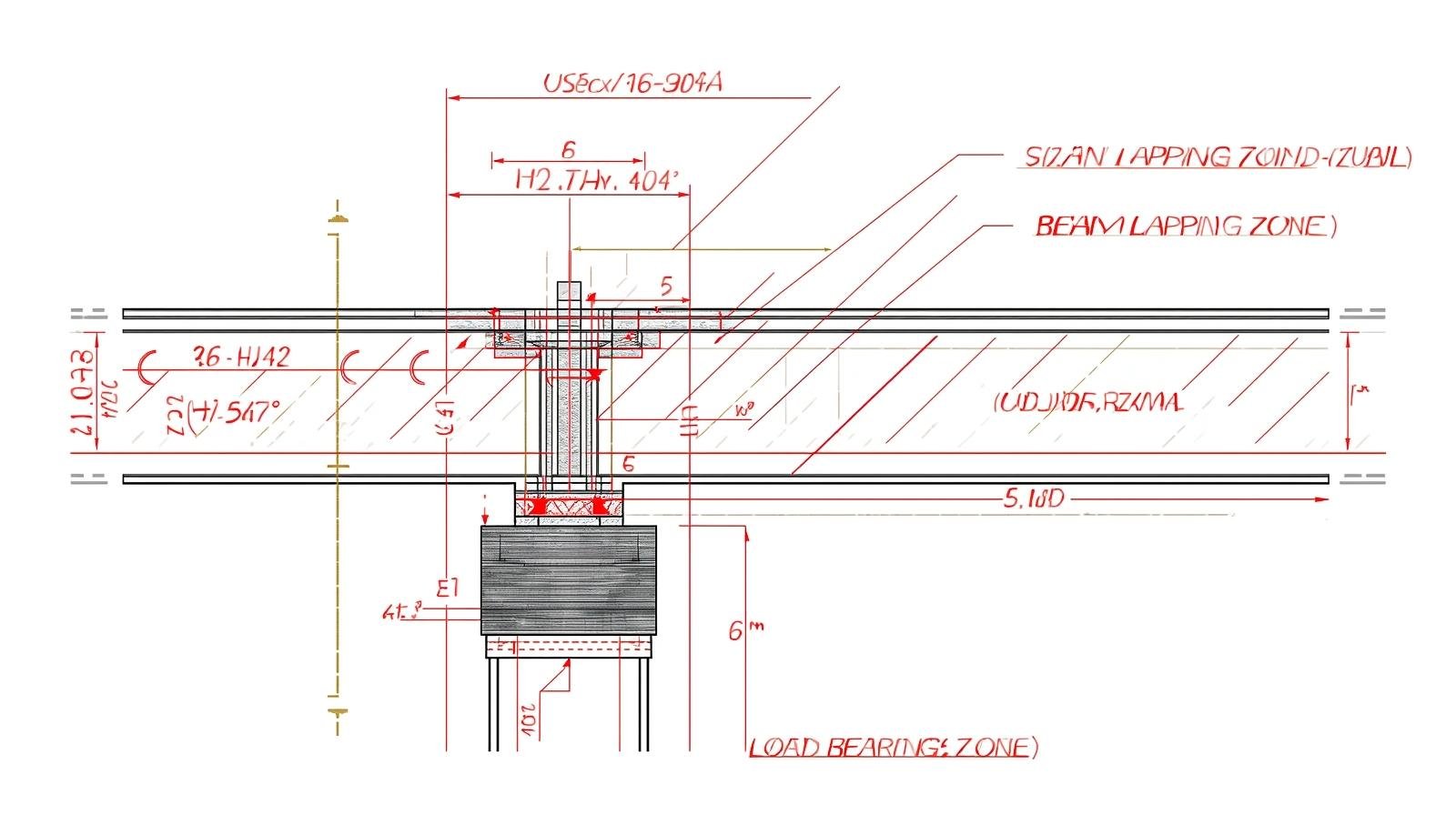
The beam lapping zone as per IS code is one of the most important detailing requirements in reinforced concrete construction. Correct placement of lap splices in beams ensures proper load transfer, structural continuity, crack control, and long-term safety of RCC structures. Improper lapping can severely weaken beams and may lead to serviceability issues or even structural failure.
This detailed guide explains beam lapping zone provisions strictly as per IS 456:2000, including location, lap length, tension and compression reinforcement rules, seismic considerations, and site best practices.
What Is Beam Lapping Zone
A beam lapping zone is the portion of an RCC beam where two reinforcement bars are overlapped to maintain continuity when a single bar length is insufficient. This overlap allows stress to transfer safely from one bar to another through bond with concrete.
In beams, lapping is highly sensitive because beams primarily resist bending, making bar location and stress condition extremely critical.
Why Beam Lapping Zone Is Important in RCC Beams
Correct beam lapping ensures:
- Structural continuity
- Safe stress transfer
- Crack control
- Ductile behavior
- Compliance with IS code safety standards
Wrong lapping location or length can result in bond failure, slippage of bars, and beam cracking.
IS Code Reference for Beam Lapping
Beam lapping zone is governed mainly by:
- IS 456:2000 – Clause 26.2 (Splices in Reinforcement)
- IS 13920:2016 (for seismic zones)
These codes specify where lapping is allowed, where it is prohibited, and how lap length is determined.
Beam Lapping Zone Location as per IS 456:2000
As per IS code:
1. Lapping Should Not Be Provided at Maximum Stress Zones
IS 456 clearly states:
Lap splices shall not be used at sections of maximum stress.
For beams:
- Maximum bending moment occurs at:
- Mid-span in simply supported beams
- Over supports in continuous beams
Therefore, lapping must be avoided in these zones.
2. Preferred Beam Lapping Zone Locations
For Simply Supported Beams
- Bottom (tension) bars
👉 Lapping should be done near the supports, where bending moment is minimum.
For Continuous Beams
- Bottom bars
👉 Lapped near the supports - Top bars
👉 Lapped near the mid-span
This ensures lapping is placed in zones of minimum stress.
3. Lapping Near Supports
IS code allows lapping near supports but not:
- Exactly at the face of the support
- Within the beam-column junction
A minimum clear distance from support face is required to avoid high shear and bond stress zones.
Lap Length in Beam as per IS Code
Lap length is based on development length (Ld).
Lap Length in Tension
As per IS 456:
Lap length in tension = Development length or 30d, whichever is greater
Practically used values:
- For Fe415 → 40d to 50d
- For Fe500 → 50d or more
Where d = diameter of bar
Lap Length in Compression
Lap length in compression = 24d or development length, whichever is greater
Compression lap length is shorter because bond stress is less critical than in tension.
IS Code Rules for Beam Lapping
1. Bars Larger Than 36 mm
As per IS 456:
Bars larger than 36 mm should not be lapped and should be welded or mechanically coupled.
2. Staggered Lapping
IS code recommends:
- Laps should be staggered
- Not more than 50% bars should be lapped at one section
This avoids formation of a weak plane in the beam.
3. Minimum Clear Spacing Between Lapped Bars
Adequate spacing must be maintained to allow:
- Proper concrete flow
- Proper compaction
- Effective bond
Beam Lapping in Seismic Zones (IS 13920)
In earthquake-prone zones, stricter rules apply.
As per IS 13920:
- Lapping shall not be done in plastic hinge zones
- Plastic hinge zones are:
- Near beam-column joints
- Near supports in beams
- Laps should be shifted to mid-span region only
- Closely spaced stirrups must be provided in lap zone
This ensures ductile behavior during earthquakes.
Beam Lapping Zone – Good Site Practices
For correct implementation on site:
- Always follow approved drawings
- Do not shift lapping zones arbitrarily
- Ensure full lap length is provided
- Tie lapped bars properly
- Maintain cover and spacing
- Provide extra stirrups in lap zones
Common Mistakes in Beam Lapping
Avoid these critical errors:
- Lapping at mid-span of simply supported beams
- Lapping near beam-column joints
- Insufficient lap length
- All bars lapped at one section
- Improper concrete compaction in lap zone
These mistakes seriously compromise beam safety.
Beam Lapping Zone vs Column Lapping Zone
| Beam Lapping | Column Lapping |
|---|---|
| Stress due to bending | Mainly axial compression |
| Lapped in low moment zones | Lapped in mid-height |
| Avoided near joints | Avoided near joints |
| Highly stress-sensitive | Less stress-sensitive |
Understanding this difference is vital for RCC detailing.
Frequently Asked Questions on Beam Lapping as per IS Code
Can beam lapping be done at mid-span
No, IS code prohibits lapping at maximum bending zones.
What is minimum lap length in beam
Generally 40d to 50d for tension bars.
Can all bars be lapped together
No, IS code allows maximum 50% bars at one section.
Is welding allowed instead of lapping
Yes, for bars above 36 mm or where lapping is impractical.
Is beam lapping mandatory
Yes, wherever bar length is insufficient, lapping or coupling is mandatory.
Conclusion
The beam lapping zone as per IS code is a critical detailing requirement that directly affects the strength, safety, and durability of RCC beams. As per IS 456:2000 and IS 13920, lapping must always be done in low-stress zones, with adequate lap length, staggered arrangement, and proper confinement.
Following IS code guidelines for beam lapping is not optional—it is essential for ensuring structural reliability and preventing costly failures in reinforced concrete construction.