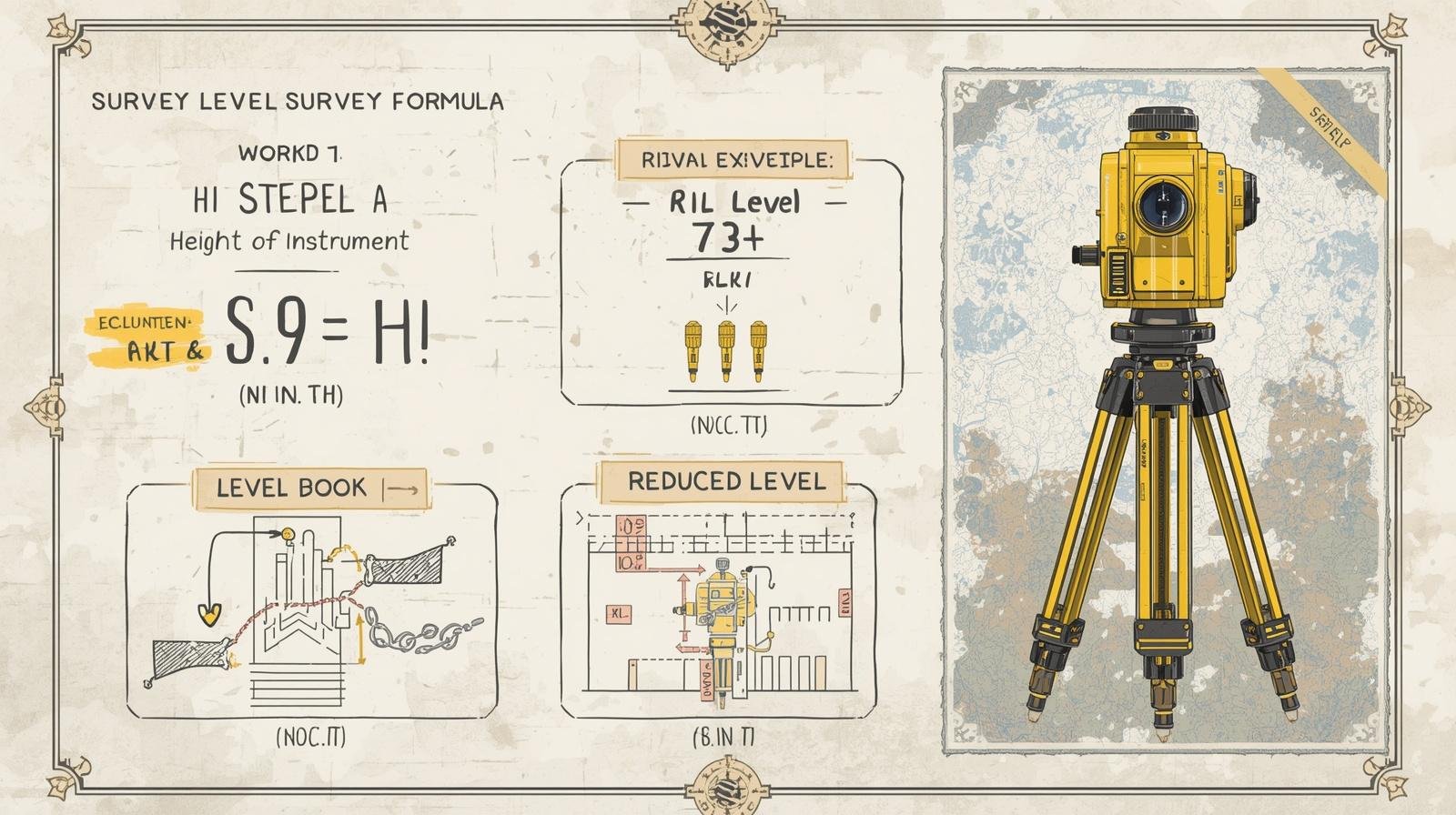
The auto level survey formula is used to calculate the Height of Instrument (HI) and Reduced Level (RL) of ground points from backsight (BS), intermediate sight (IS) and foresight (FS) readings. This article explains the HI method, a worked level-book example, the arithmetic check and the two-peg test used to check collimation error.
Understanding the Basics
What is an auto level?
An auto level is an optical instrument that automatically finds a horizontal line of sight. It removes small setup errors and speeds up leveling work on a construction site. Auto levels are ideal for setting out foundations, slabs, and grading work.
Key terms: HI and RL
HI stands for Height of Instrument. RL stands for Reduced Level (or simply level) of a point. The basic relation used in leveling is:
- HI = RL of benchmark + Backsight (BS)
- RL of any point = HI – Foresight (FS)
Auto Level Survey Formula Numerical Example
Here is a simple numerical example you can follow on site. Start from a benchmark (BM) with a known RL.
Setup and readings
Assume the benchmark RL is 100.000 m. From the first instrument setup, take a backsight (BS) on the benchmark, an intermediate sight (IS) on P1, and a foresight (FS) on P2, which is used as the change point (CP). After moving the instrument, take a new BS on the same CP, then an FS on P3.
| Station / Description | BS (m) | IS (m) | FS (m) | HI (m) | RL (m) |
|---|---|---|---|---|---|
| BM (known) | 1.250 | — | — | 101.250 | 100.000 |
| Point P1 | — | 0.750 | — | 101.250 | 100.500 |
| Change point P2 (FS) | — | — | 2.300 | 101.250 | 98.950 |
| Change point P2 (new BS) | 1.050 | — | — | 100.000 | 98.950 |
| Point P3 | — | — | 0.450 | 100.000 | 99.550 |
Notes:
- At first row HI = BM RL + BS = 100.000 + 1.250 = 101.250 m.
- For P1, RL = HI − IS = 101.250 − 0.750 = 100.500 m.
- When the instrument is moved, take a new BS on the same change point P2. New HI = CP RL + new BS = 98.950 + 1.050 = 100.000 m.
Level book format: how to record
Record each reading in the correct BS, IS or FS column. A change point normally has an FS from the old setup and a BS from the new setup; its RL remains unchanged. The table above includes separate rows for these two readings to make the calculation clear.
Arithmetic Check and Common Checks
Arithmetic check method
An arithmetic check catches data-entry errors quickly. The basic check is:
- Sum of all BS readings minus sum of all FS readings should equal change in RL between first and last recorded points.
Example from the table above:
- Sum(BS) = 1.250 + 1.050 = 2.300
- Sum(FS) = 2.300 + 0.450 = 2.750 (P1 is an IS reading, not an FS)
- Sum(BS) − Sum(FS) = 2.300 − 2.750 = −0.450
- Change in RL from first BM (100.000) to last point P3 (99.550) = -0.450
If the arithmetic check does not match expected change, re-check entries and recalculate HI values. Small sign conventions or a missed reading are common causes of mismatch.
Two-Peg Test: Collimation Error Check
Purpose and setup
The two-peg test checks whether the line of sight of an automatic level is horizontal. By comparing the height difference between two staff points from a midpoint setup and a second setup near one point, the test isolates the collimation error. Follow the instrument manufacturer’s procedure and the accuracy requirement specified for the survey.
Procedure (step-by-step)
- Set two stable pegs or staff points A and B on reasonably level ground, commonly about 50–60 m apart or as specified for the test.
- Set the instrument midway between A and B. Take staff readings S1 on A and S2 on B. Because the sight lengths are equal, the difference S1 − S2 gives the true difference in elevation, with collimation error effectively cancelling.
- Move the instrument close to A, keeping it on the same line. Take readings S3 on A and S4 on B.
- Compare the difference from the near setup (S3 − S4) with the midpoint difference (S1 − S2).
Error calculation and interpretation
Let L be the distance between the two pegs. The collimation error per unit distance is:
e = [(S1 − S2) − (S3 − S4)] ÷ L
Use the same reading order for A and B in both setups. The sign indicates the direction of the line-of-sight error; the magnitude is usually reported in millimetres per metre or per stated sight distance. Compare the result with the tolerance required by the survey specification or instrument manufacturer. There is no single 2–3 mm tolerance that applies to every class of levelling.
If the measured error exceeds the permitted value, do not alter the instrument casually in the field. Recheck the setup and readings, then arrange adjustment or calibration according to the manufacturer’s instructions.
Common Practical Tips for Construction Site Leveling
- Always begin from a reliable benchmark.
- Record BS, FS and HI immediately in your level book.
- Keep instrument roughly level and use the automatic compensator.
- Use arithmetic check after each setup to catch mistakes early.
- Carry out the two-peg collimation check at the interval required by the survey specification and manufacturer, and after the instrument has been jolted or suspected of damage.
Frequently Asked Questions
What is HI RL calculation in leveling?
HI is the Height of Instrument found by adding a backsight to a known RL. RL for other points is found by subtracting foresights from HI. This HI RL calculation is the backbone of leveling work.
How do I perform an arithmetic check quickly?
Sum all BS readings and all FS readings. Their difference should equal the change in RL between the first and final point. If it doesn’t, re-check your numbers and instrument setups.
How often should I perform a two-peg test?
Perform the two-peg test at the interval required by the survey specification and instrument manufacturer, and after any shock or suspected damage to the instrument. It helps detect collimation error before inaccurate readings accumulate.
Is the auto level suitable for construction site grading?
Yes. Auto levels are widely used on construction sites for setting out levels, verifying slab heights, and general grading. They are fast and reliable when properly checked.
Conclusion
Accurate leveling depends on correct BS, IS and FS booking, a reliable benchmark, arithmetic checks and an instrument whose line of sight has been checked. Use the HI method or rise-and-fall method consistently, retain the level book for verification and follow the approved survey tolerance. The worked example and two-peg test provide a practical check before accepting site levels.