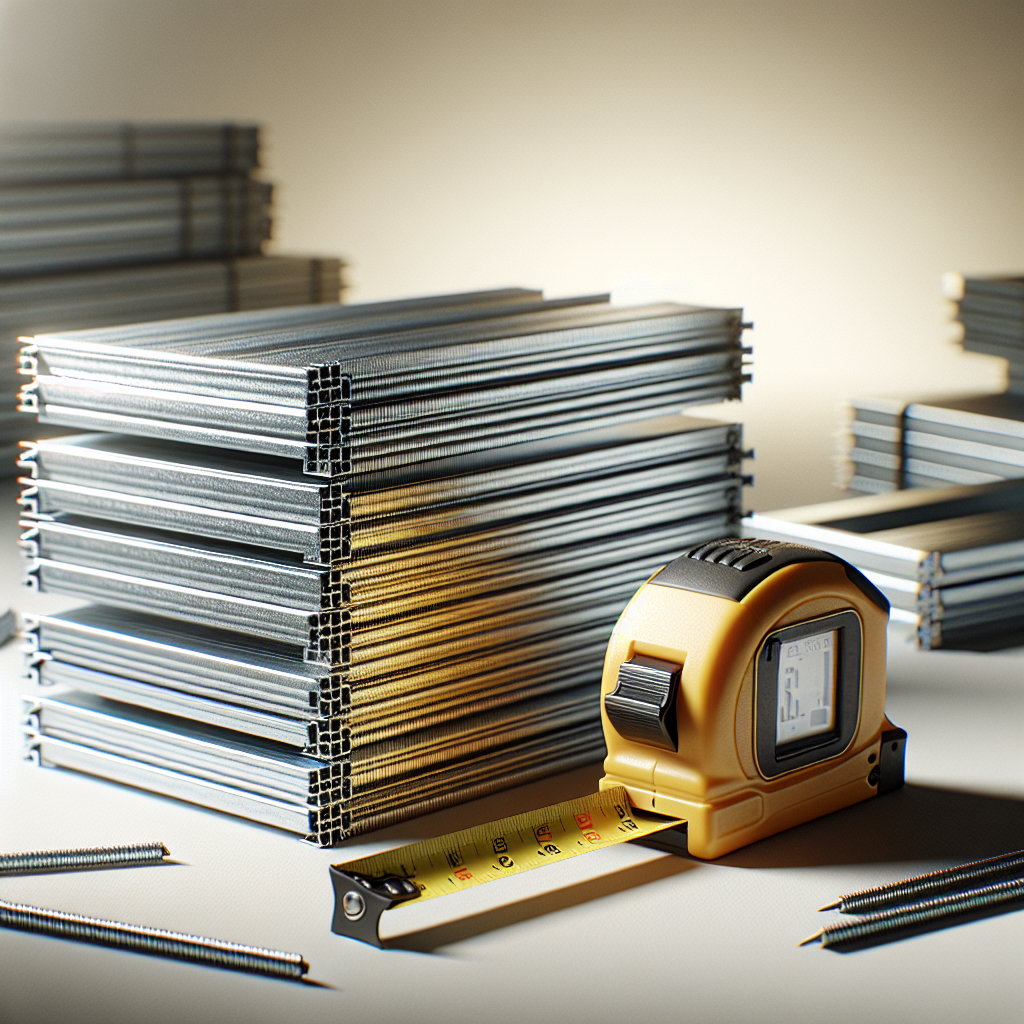
Metal studs are a mainstay in modern interior framing. They come in predictable sizes and weights that affect wall strength, sound performance, and how drywall is fastened.
This article lays out common metal stud profiles, how to read gauges and depths, spacing rules, and practical notes to help you understand how size choices change results.
Common sizes and profiles
Producers make metal studs in a few standard widths and depths to suit most partition and non-loadbearing wall needs. Choosing the right profile starts by matching the stud flange and depth to the wall finish and service runs.
Typical widths
Widths are measured across the face of the stud flange. Common widths include 1-5/8″, 2-1/2″, 3-5/8″, 4″, and 6″. Narrow widths suit thin partitions; wider widths allow more insulation or larger service cavities.
Typical depths
Depth refers to the distance from the web to the outer face of the flange, often listed as the stud’s leg length. Standard depths include 1-1/4″, 2-1/2″, 3-5/8″, 4″, and 6″. Greater depth increases stiffness and makes space for insulation or wiring.
C profiles and tracks
The most common stud shape is the C or U profile with flanges that accept drywall screws. Tracks are the top and bottom channels into which studs are inserted and secured. Tracks match stud widths and hold alignment during installation.
Understanding gauge, thickness and weight
Metal stud strength is closely tied to sheet thickness, commonly described by gauge. Gauge numbers run inversely: the smaller the gauge, the thicker the steel. Choosing the right gauge balances cost, weight and load capacity.
How gauge works
Common gauges for interior non-loadbearing studs are 25, 20, and 18. A 25-gauge stud is thinner and lighter than a 20-gauge stud. Use thicker gauges where added stiffness or higher screw pullout is needed.
Weight per foot and practical impacts
Manufacturers list weight per linear foot. Lighter studs are easier to handle but can bend under impact or with heavy finishes. Heavier studs increase wall mass and can improve structural performance and sound isolation.
Comparing gauges in practice
For single-layer drywall partitions, 25- or 20-gauge studs are often sufficient. For walls that will carry cabinets, tile or other loads, 18-gauge or heavier sections are safer. Check screw holding values and cantilever loads when in doubt.
Spacing, layout and fastening basics
Stud spacing and fastening pattern influence wall strength, drywall performance and sound control. Standard spacing options and attachment points are based on finish type and load expectations.
Common stud spacing
Studs are commonly spaced at 16″ on center (o.c.) or 24″ o.c. for typical drywall applications. Use 16″ o.c. where loads are higher or finer attachment support is required. For heavy tile or cabinetry, reduce spacing or use thicker studs.
Fastening to track and floor/ceiling
Tracks are fastened to the substrate with appropriate fasteners and then studs are locked or screwed into the track. Top track should be leveled to ensure plumb studs and tight joints at drywall seams.
Screw spacing and drywall attachment
Drywall screws are typically installed every 12″ along edges and every 16″ in the field when studs are at 16″ o.c. For 24″ o.c. studs, reduce spacing or add blocking to meet manufacturer and code requirements.
Practical size selection: matching stud to use
Picking a stud size depends on the wall’s function: simple partition, sound-rated assembly, or wall carrying localized loads such as cabinets. Balance depth, gauge and spacing to meet those needs.
Partitions and interior walls
For lightweight interior partitions with single-layer drywall, a 3-5/8″ or 3-5/8″ depth with 25- or 20-gauge studs at 24″ o.c. is common. If extra stiffness is needed, move to 16″ o.c. or a thicker gauge.
Sound or fire-rated walls
For assemblies that require sound control or rated performance, deeper studs with more layers of board and resilient channels are typical. A 3-5/8″ or 4″ cavity can accept mineral wool and multiple board layers to meet ratings.
Walls with heavy fixtures
Where cabinets, shelving or heavy finishes are mounted, use heavier gauge studs (18-gauge or thicker) and consider blocking or steel reinforcing clips to transfer loads to structure. Relying solely on drywall screws is not sufficient.
Corrosion, finish and durability
Steel stud finish matters in wet or exposed conditions. Most studs use galvanized coatings to slow corrosion. For harsher environments, look for enhanced coatings or stainless options.
Galvanized vs G60, G90
Galvanized coatings are specified by pound per square foot values such as G40, G60, or G90. Higher numbers indicate thicker zinc coating and better corrosion resistance. Choose G90 in coastal or high-moisture areas when possible.
Handling and cut edges
Cut edges expose bare steel and should be treated or covered when corrosion resistance is required. Some installers use touch-up coatings or tape to prevent rust at cuts and screw holes.
Estimating material and planning cuts
Doing a quick material takeoff saves time and helps avoid shortages. Count studs per bay, include extra for corners and openings, and add waste for cuts and mistakes.
Counting studs
For a straight wall, count bays by dividing wall length by stud spacing and add one end stud. Add studs for corner framing and studs beside openings like doors and windows.
Allowances and waste
Add 5–10% waste depending on the complexity of openings and the number of short cuts. Heavily detailed walls or multiple window openings require a higher waste factor.
Sample quick checklist
- Measure wall length and height.
- Divide length by spacing to get number of bays.
- Add end studs, corner studs and jack studs for openings.
- Include top and bottom tracks per run length.
- Add 5–10% for waste.
Conclusion
Choosing the right metal stud size means matching widths, depths and gauges to the wall’s purpose. Consider spacing and fastening, plus finish and corrosion protection, to ensure a durable, functional assembly.
Knowing typical sizes and how each factor affects performance makes it easier to specify and install walls that meet strength, fire, or acoustic needs without unnecessary cost.
Frequently Asked Questions
Below are common questions about metal stud sizes, spacing and suitability for different applications.
What stud depth is best for sound control?
Deeper cavities (3-5/8″ or more) allow for thicker insulation and multiple layers of board, which improves sound performance. Combine with resilient channels or staggered studs to further reduce sound transfer.
Can I use 24″ spacing for all drywall types?
While many drywall systems tolerate 24″ o.c., heavy finishes or tile may require closer spacing. Always check the drywall manufacturer’s recommendations and local codes when choosing spacing.
How do I choose the right gauge?
Use lighter gauges (25 or 20) for non-loadbearing partitions and heavier gauges (18 or thicker) where mounting loads or higher impact resistance are present. If unsure, prioritize higher gauge for long-term durability.
Are all metal studs galvanized the same?
No. Coating thickness varies by specification (G40, G60, G90). Higher coating values offer better corrosion resistance. Select the appropriate coating for exposure conditions, especially in humid or coastal areas.
How much extra should I order for waste?
Typical waste allowances range from 5% for simple straight runs to 10% or more for walls with many openings or complex layouts. Larger projects with repetitive cuts may reduce waste percent as installers become efficient.