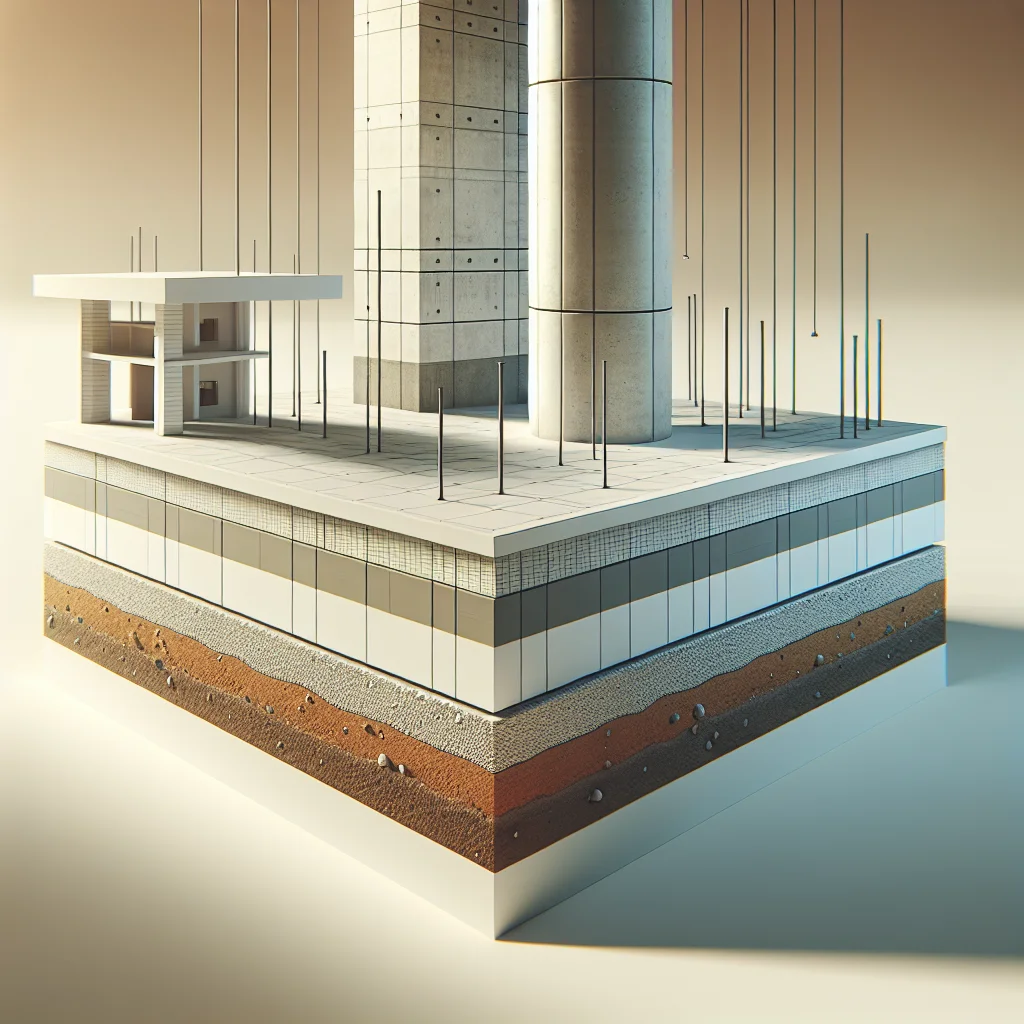
Sizing a foundation element well avoids costly repairs and uneven settlement. This article breaks down the main factors that set footing dimensions and shows clear math you can follow on a project.
The focus is on practical steps: how loads, soil capacity and simple math combine to give safe footing area and basic geometry. Examples use round numbers to make the process easy to replicate.
Load and soil essentials
Start by collecting two key numbers: the vertical load that the footing must carry and the allowable bearing pressure of the soil beneath. The load includes dead weight, live loads transferred from the structure, and any permanent equipment weight.
Soil data usually comes from a site investigation or local experience. If only rough information is available, conservative allowable pressures can be used, but expect larger required areas and greater cost.
Estimating column or wall load
List all contributing loads that sit above the footing. For a column, add beam reactions, slab tributary loads and self-weight of the column. Use working loads unless a factored design is required by local codes.
Using soil bearing capacity
Allowable bearing pressure depends on soil type, depth of footing and groundwater. Typical conservative values: dense sand or gravel 200–300 kN/m2, stiff clay 150–250 kN/m2, soft clay 50–100 kN/m2. Always adjust for local conditions.
Step-by-step area sizing
Once you have total vertical load and allowable soil pressure, the basic area that spreads that load safely is found by dividing load by soil capacity. That gives a starting area for the footing footprint.
From that area you choose a practical shape: square, rectangular or circular. Shape choice affects dimensions but not the required area in principle.
Basic area formula
Required area = Total vertical load / Allowable soil bearing pressure.
Example: a column carrying 200 kN on soil with allowable 100 kN/m2 needs 200 / 100 = 2.0 m2 of footing area.
Converting area into dimensions
For square footings, side length = sqrt(area). For rectangular footings, choose a length-to-width ratio that suits formwork and site conditions (commonly 1:1 to 3:1).
- Square footing example: area 2.0 m2 -> side = 1.414 m (round to 1.5 m practically).
- Rectangular choice: keep one side to a round number and compute the other: if width = 1.0 m then length = 2.0 m.
Adjust for eccentric loads and combined columns
If the resultant vertical load does not act near the centroid of the footing, bending and uneven pressure can occur. Simple checks ensure the pressure remains compressive across the soil contact area.
When eccentricity exists, use the concept of an equivalent area or enlarge the footing so the pressure distribution remains within allowable limits.
Common footing types and example calculations
Different conditions lead to different footing choices. Isolated footings suit individual columns, combined footings join columns with small spacing, and strip footings support walls. Selection affects dimensioning and reinforcement needs.
Below are brief examples showing how area calculations change with type and load layout.
Isolated square footing example
Scenario: single column load = 120 kN. Soil allowable = 120 kN/m2.
- Required area = 120 / 120 = 1.0 m2.
- Choose square: side = sqrt(1.0) = 1.0 m. Provide practical clearance and round up to 1.1 m or 1.2 m to allow for reinforcement cover.
Rectangular footing with eccentric load
Scenario: column load 300 kN with an eccentricity of 0.15 m in one direction. Soil allowable = 150 kN/m2.
- Initial area = 300 / 150 = 2.0 m2.
- Without eccentricity a 1.4 x 1.4 m square works (area 1.96 m2 close to 2.0 m2).
- With eccentricity, check the pressure distribution: maximum pressure increases and minimum reduces. Increase area or shift dimensions to keep pressures positive and within allowable limits.
Combined footing quick check
When two columns are close and loads are unequal, a combined footing can distribute load between them. Sum vertical loads and compute total required area, then check center of gravity to place the footing so pressures under each column portion are acceptable.
- Total area = (P1 + P2) / q_all.
- Length and width chosen to satisfy geometry and development length for reinforcement.
Practical checks, depth and reinforcement notes
Footing area is only part of design. Depth must resist punching shear and bending, and reinforcement must control cracking and distribute stresses. Simple rules of thumb are helpful early on but must be verified.
Shallow depth often suffices for light columns on firm soil; deeper sections or rafts are needed for heavy loads or weak soils.
Depth selection basics
Start with a minimum depth that gives durability and resistance to bending: common practice uses 150–300 mm for small footings and larger for heavier loads. Increase depth when soil is weak or when bending moments are high.
Shear and bending checks
Check one-way shear along critical sections at a distance d from the face of the column and check punching shear around the column area. If shear is too high, either increase depth or enlarge the footing area.
- Calculate bending moment from eccentricity or load transfer geometry.
- Select reinforcement to resist moment with acceptable steel area and spacing.
Settlement consideration
Even when the footing area meets bearing pressure limits, settlement must be acceptable. Total and differential settlement depend on soil compressibility and footing stiffness.
For moderate structures, maintain spread footings on uniform, compacted fill and shallow depths. For sensitive or heavy structures, obtain a geotechnical report and estimate settlements quantitatively.
Conclusion
Determining footing dimensions starts with reliable loads and soil capacity. Divide load by allowable pressure to find area, then choose practical geometry and verify depth and reinforcement requirements.
Simple math and a few safety checks often provide a robust starting point. When soil is weak or loads are large, involve more detailed geotechnical input and structural checks.
Frequently Asked Questions
How do I compute required footing area for a column?
Add all vertical loads transmitted by the column, then divide by the allowable soil pressure. The result is the minimum plan area the footing needs to spread that load.
What if soil information is not available?
Use conservative allowable pressures based on local experience and increase the footing area accordingly. Arrange for a site investigation as soon as possible to avoid oversizing or unexpected settlement.
How does an eccentric load affect footing size?
An eccentric load shifts pressure distribution, increasing pressure on one side and reducing it on the other. You may need to enlarge the footing or change its shape to keep all soil pressures compressive and within allowable limits.
When should a combined footing be used?
Use a combined footing when columns are close and individual footings would overlap or when unequal loads need to be supported on a single continuous footing to prevent differential settlement.
Are there quick rules for minimum footing depth?
Minimum depths often range from 150 mm for very small footings to 300 mm or more for typical residential footings. Larger loads and poor soils require increased depth and professional checks.