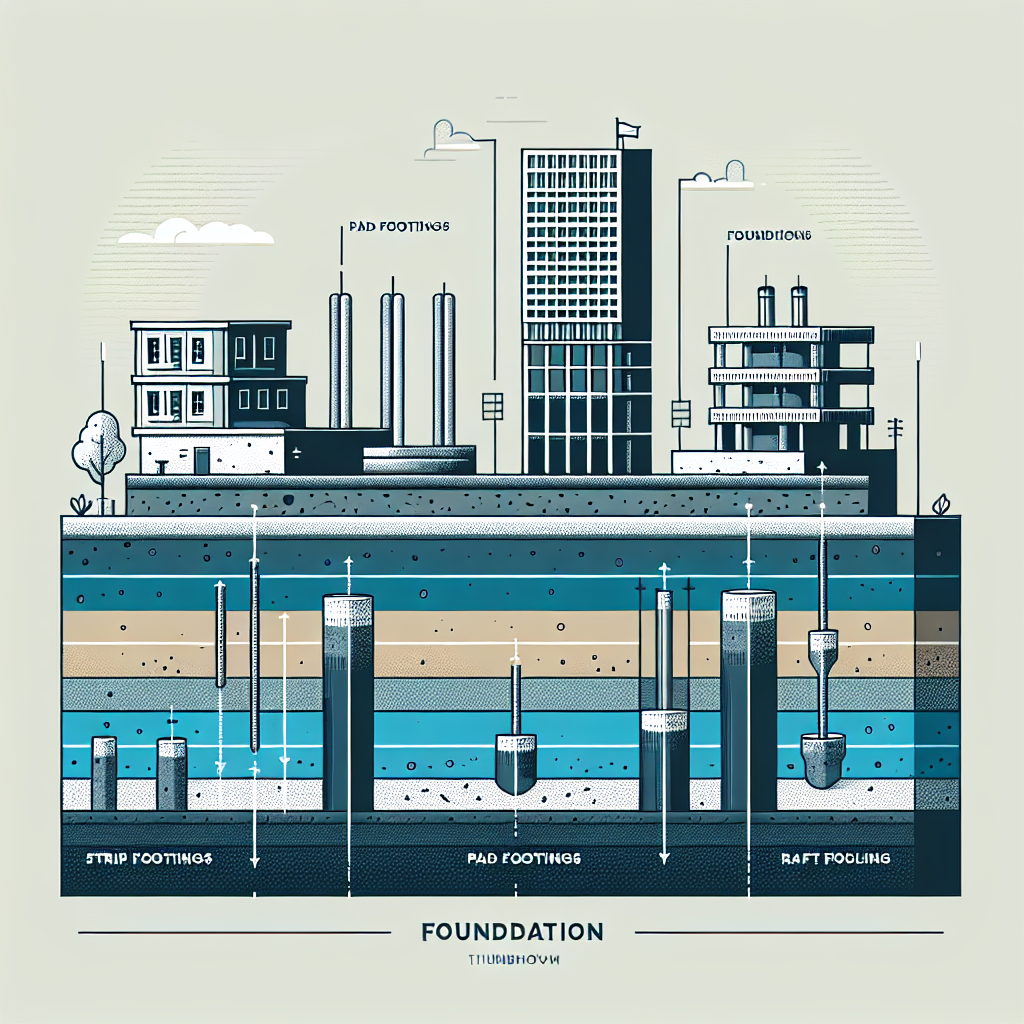
Foundations transfer building loads safely to the ground, and the right footing keeps a structure stable and long-lasting. Choosing the correct type depends on soil, load, site conditions, and budget.
This article explains common footing types, what they do, and the key factors that influence the choice. Each option has strengths and limits, so understanding them helps match the footing to the project.
Shallow footings: common options for low to moderate loads
Shallow footings sit near the surface and are often used when good bearing soil is available at shallow depth. They are simpler to build and usually more economical than deep foundations.
These footings are suited to houses, small commercial buildings, and light structures where loads are modest and subsurface conditions are stable.
Strip footing
Strip footings are continuous strips of concrete that support load-bearing walls. They spread the load over a wider area and are placed below the wall line.
They are straightforward to construct and work well when wall loads are uniform and soil has adequate bearing capacity.
Pad footing
Pad footings are isolated square or rectangular pads that support individual columns or piers. Each pad distributes the column load to the ground below.
They are useful on grid layouts where columns carry concentrated loads, and they are often reinforced to handle punching shear and bending.
Combined and eccentric footings
When two columns are close or a column lies near a property line, combined footings tie them into a single concrete element. Eccentric footings shift the pad to keep loads within the soil bearing area.
These solutions balance loads and prevent undue stress on the soil while maintaining space constraints at the site.
Raft (mat) footing
A raft footing is a large, continuous slab covering the whole building footprint. It spreads loads across a wide area and reduces differential settlement.
Rafts are common when soil is weak but fairly uniform, or when column spacing is dense and individual pads would overlap.
Deep footings: reaching stronger layers below
Deep foundations transfer loads through weak surface soils to stronger strata at depth. They are necessary when shallow soil cannot support the structure safely.
Deep types vary by installation method and load capacity. They are used for tall buildings, heavy industrial loads, or when nearby structures limit settlement.
Driven piles
Driven piles are prefabricated elements (concrete, steel, or timber) hammered into the ground. They work by bearing on strong layers or by skin friction along their length.
Installation is fast and reliable in many soils, but vibration and noise can be an issue in urban areas.
Bored piles (drilled shafts)
Bored piles are made by drilling a hole and casting concrete in place, often with reinforcing steel. They are ideal where vibrations must be minimized or where large diameter piles are needed.
These piles handle heavy axial and lateral loads, and can be extended to significant depths depending on site geology.
Micro-piles and screw piles
Micro-piles are small-diameter, high-strength elements grouted into place. Screw piles are helical steel shafts screwed into the ground. Both suit tight access sites or retrofit applications.
They offer flexibility and often reduce the need for heavy equipment, making them practical for constrained or sensitive locations.
Special footing types and niche solutions
Some sites call for specialized footing types to deal with particular soil behavior, water, or load patterns. These options tackle challenges that standard footings cannot.
Choosing a special footing often balances technical need with increased cost and construction complexity.
Under-reamed footings
Under-reamed footings have bulbs or enlargements at the base of drilled shafts to increase bearing area and resist uplift. They work well in expansive clays where seasonal movement occurs.
The enlarged base anchors the foundation and reduces the risk of heave-related damage.
Grillage foundation
Grillage foundations use layers of beams, usually steel, set in concrete to spread heavy loads over poor soil. They are common for heavy columns and machine foundations where point loads must be spread.
This type reduces excavation and can be faster than deep foundations in some cases.
Compensated or floating foundations
Floating foundations remove soil equal to the structure weight so net load on the ground is reduced. The idea is to balance the building weight with excavated soil to limit settlement.
This method is sometimes used near water bodies or where total removal of load is needed to protect compressible layers.
Key factors that influence footing selection
Several site and structural factors drive the choice of footing. Designers weigh these to find a safe, cost-effective solution that matches the project goals.
Understanding these factors helps predict performance and avoid surprise costs or delays during construction.
Soil type and bearing capacity
Soil tests reveal bearing capacity, compressibility, and drainage. Sandy soils drain well but may require piles if loose; clays can be strong but may swell or settle excessively.
Designers use test data to decide whether shallow spread footings suffice or if deep foundations are required.
Structural loads and layout
The magnitude and distribution of loads—point loads from columns, line loads from walls, and dynamic loads from equipment—affect footing size and type.
Closely spaced columns or heavy machinery often push the design toward raft slabs or pile groups rather than isolated pads.
Groundwater and drainage
High water tables reduce effective soil strength and can require dewatering, waterproofing, or specialized footings like piles or waterproof rafts.
Proper drainage design and site grading can protect shallow footings from saturation and long-term weakening.
Constructability, access, and site constraints
Access for heavy equipment, nearby structures, and local noise or vibration limits influence the method chosen. Bored piles avoid vibration; driven piles are faster where vibration is acceptable.
Urban sites may favor methods that reduce traffic disruption and minimize excavation depth.
Cost and schedule
Shallow footings usually cost less and are quicker to build. Deep foundations raise material and mobilization costs but can save money if they prevent long-term settlement issues.
Designers weigh immediate costs against lifecycle performance and potential remedial expenses.
Practical considerations during construction
Execution quality matters as much as design. Proper compaction, concrete placement, and curing are essential to achieve the expected performance.
Site supervision and testing during construction verify that footing dimensions, reinforcement, and soil preparations match design assumptions.
Excavation and subgrade preparation
Cleaning the subgrade, removing organic material, and achieving uniform bearing supports consistent load transfer. Poor preparation leads to uneven settlement and cracking.
Engineers often specify testing and compaction protocols to confirm subgrade readiness before concrete placement.
Reinforcement and concrete quality
Rebar placement and concrete strength must meet design specifications. Proper cover, spacing, and concrete consolidation prevent corrosion and ensure capacity.
Adverse weather during pouring—extreme cold or heat—requires special measures to protect concrete quality and curing.
Settlement monitoring
On critical projects, monitoring settlements during and after construction helps detect unexpected movement. Early detection allows corrective action before damage occurs.
Monitoring is especially important near sensitive structures or when using deep foundations that may interact with adjacent soils.
Conclusion
Footing selection is a balance of soil conditions, loads, cost, and construction constraints. Shallow footings offer simplicity and economy when the ground is suitable.
When surface soils are weak or loads are large, deep or specialized foundations provide reliability. Thoughtful site investigation and careful construction make the selected footing perform as intended.
Frequently Asked Questions
What is the difference between shallow and deep footings?
Shallow footings are placed near the ground surface and spread loads over a broad area. Deep footings transfer loads to deeper, stronger layers using piles or drilled shafts.
How does soil type affect the choice of footing?
Soil bearing capacity, compressibility, and drainage determine whether shallow footings are safe. Weak, compressible, or water-logged soils often require deep foundations.
When is a raft footing preferred?
A raft footing is chosen when loads are spread across many columns, or when soil has low bearing capacity but relatively uniform properties. It reduces differential settlement risk.
Can footings be modified if unwanted settlement occurs?
Minor settlement can be addressed with underpinning, grouting, or load redistribution. Major settlement may require more extensive remediation, including additional piles or strengthening measures.
Do water table levels change the footing design?
Yes. High water tables reduce soil strength and can cause buoyancy or uplift. Designers may use deeper footings, waterproofing, or drainage measures to protect foundations.