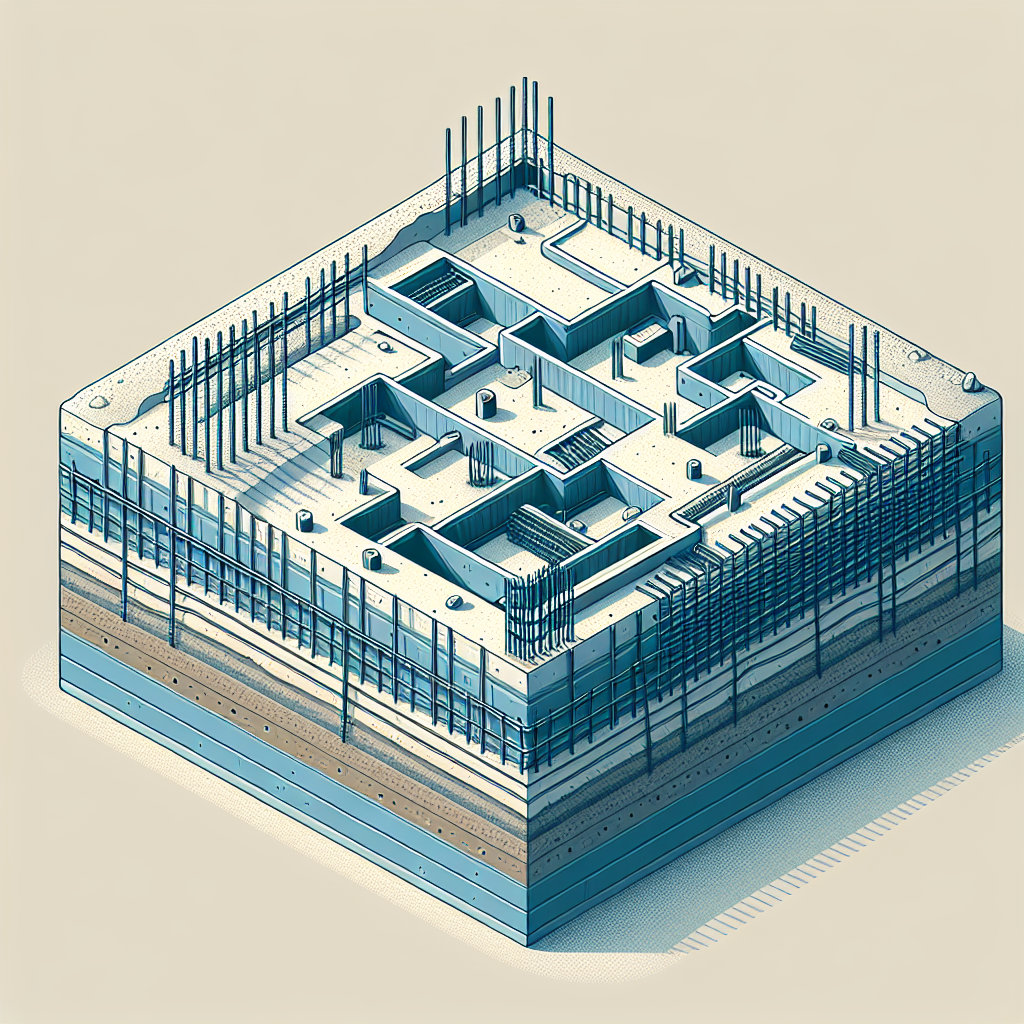
Strip footings are a common choice when loads are spread along walls or continuous beams. They offer a cost-effective way to transfer loads to reasonably strong soils without deep excavation.
This article explains how to assess site conditions, size and detail a strip footing, and avoid common mistakes during construction. Practical calculations and clear checks help keep decisions simple and reliable.
When to choose a strip foundation
Strip foundations work best where loads run along a line—such as load-bearing walls or rows of columns with close spacing. They suit sites with stable, moderate-strength soils and where deep piling is unnecessary.
They are not the first choice where soils are weak, highly compressible, or where heavy point loads require concentrated support. In those cases, different shallow or deep options may be safer and more economical.
Typical situations
Use strip footings under continuous masonry or concrete walls, ground beams supporting closely spaced columns, and perimeter walls carrying roof and floor loads.
They are also helpful for simple low-rise residential structures where the soil bearing capacity exceeds the applied loads by a comfortable margin.
Limitations to watch
Avoid strip footings on soft clay, peat, or very loose sands without soil improvement. Differential settlement can cause cracking in walls and finishes.
Also consider the water table. High groundwater increases buoyancy and can reduce effective bearing capacity unless drainage and waterproofing are provided.
Assessing soil and load conditions
A reliable assessment starts with understanding the soil profile, bearing capacity, and expected loads from the structure. These inputs determine footing width, depth, and reinforcement needs.
Simple site tests, combined with lab results when available, make the difference between conservative estimates and risky assumptions.
Soil checks and tests
Perform basic probing or penetrometer tests to identify strata and firmness. If possible, obtain a standard penetration test (SPT) or plate load test for better accuracy.
Look for layers of soft organic material, high water content, or fill. Any of these may require deeper foundations or soil improvement before footing work begins.
Calculating applied loads
Sum all vertical loads from walls, floors, roofs, and any live loads that the wall supports. Add self-weight of the footing if needed for detailed checks.
For continuous walls, use load per unit length. For rows of columns with strip footing between, convert column loads to equivalent line loads over the footing length.
Sizing and basic calculations
Footing width is primarily controlled by bearing capacity and the line load from the structure. Depth offers protection against frost, surface disturbances, and improves bearing by resting on firmer soil.
Keep designs simple: determine required bearing pressure, then size the width so that applied pressure does not exceed allowable bearing capacity with a suitable factor of safety.
Width and depth
Width (B) is found from B = line load / allowable bearing pressure. Always round up and consider constructability and reinforcement placement.
Depth below finished ground should meet local frost line requirements, typically 300–1000 mm depending on climate. Also include cover for reinforcement and any localized excavation tolerances.
Reinforcement basics
Provide continuous longitudinal bars near the bottom of the footing to resist bending from soil pressure and wall loads. Stirrups or transverse bars help control shear and maintain bar spacing.
Spacing and bar sizes depend on bending moments and shear forces. Where calculations are not complex, a minimum reinforcement grid helps crack control: two continuous bars at the bottom and two near the top in critical zones.
Concrete strength and workmanship
Concrete must be strong enough to resist bending and shear and durable in the given environment. Choose a mix that meets compressive strength requirements and workability for site placement.
Good workmanship in forming, placing, and curing concrete is as important as the design numbers. Small defects can lead to large durability issues over time.
Specifying mix and cover
Typical residential footings use concrete with compressive strength of 20–25 MPa. Increase strength where required by structural checks or aggressive soil conditions.
Ensure adequate cover to reinforcement (usually 50–75 mm for footings). This protects steel from corrosion and provides proper embedment for bond strength.
Quality control on site
Consolidate concrete to remove voids and ensure uniform bearing against the soil. Avoid cold joints along the footing length when possible.
Keep forms rigid and aligned. Check level and fall along the footing, and cure the concrete sufficiently to develop strength before loading.
Construction steps and practical checks
A clear sequence reduces errors: strip topsoil, set levels and trenches, place reinforcement, pour concrete, cure, and backfill with care.
Working methodically makes it easier to check dimensions and keep the footing on plan, reducing the risk of costly corrections later.
Excavation and bedding
Remove organic topsoil and soft material. Create a stable subgrade by compacting or adding a thin lean concrete or leveling sand layer where needed.
Ensure the bottom is level and retains the planned depth. Any pockets of weak soil should be excavated and repaired with compacted fill or lean concrete.
Reinforcement placement and checks
Place bars on chairs to maintain cover; avoid resting bars directly on the soil. Tie splices with sufficient overlap according to bar size and concrete strength.
Check longitudinal alignment and continuity. Random gaps or unsupported laps increase the chance of cracking or reduced capacity.
Pouring and curing
Pour concrete evenly, avoid segregation, and vibrate or tamp as needed for consolidation. Use a continuous pour for long lengths to prevent cold joints.
Cure the concrete for at least 7 days in moderate climates; extend curing time in hot or dry conditions to reduce shrinkage cracking.
Common problems and simple fixes
Many issues arise from poor soil preparation, inadequate cover, or insufficient reinforcement. Spotting these early saves time and money.
Practical corrective measures often include underpinning localized weak spots, adding more reinforcement where bending is higher than expected, or improving drainage around the footing.
Settlement and cracking
Minor uniform settlement is normal, but differential settlement causes cracks. Check adjacent fill heights, water flow, and load distribution when cracks appear.
If settlement is ongoing, consider grouting or underpinning. For small cracks without movement, repair with suitable sealants and monitor.
Water and drainage issues
Poor drainage increases the risk of footing failure. Direct surface water away from foundations and provide perimeter drainage if the water table or runoff is high.
Install damp-proofing or waterproof membranes where needed. Keep backfill granular and free-draining to reduce water retention near the footing.
Conclusion
Strip foundations are a straightforward and economical choice when soil conditions and loads suit a continuous support system. Success depends on correct sizing, reliable soil checks, and sound construction practice.
Stay practical: verify the bearing capacity, size the footing with appropriate safety margins, ensure proper reinforcement and concrete quality, and watch drainage around the structure.
Frequently Asked Questions
What is the main factor in sizing a strip footing?
The primary factor is the soil’s allowable bearing pressure relative to the applied line load. Width is chosen so the pressure under the footing stays below the allowable value with a safety margin.
How deep should a strip footing be placed?
Depth depends on frost depth, surface disturbances, and the need to reach firmer soil. Typical depths range from 300 mm to 1000 mm below finished ground, but local conditions dictate exact values.
When is reinforcement necessary?
Reinforcement is needed to control bending and cracking, especially where footings span slightly between stronger zones or where loads are higher. Even simple footings benefit from a minimal reinforcement layout to handle temperature and shrinkage stresses.
Can strip footings be used on sloping sites?
Yes, but slopes require careful checking. Terracing the footing, providing stepped footings, or improving the subgrade can prevent sliding and unequal settlement on sloped ground.
How to deal with weak layer beneath the planned footing?
If a weak layer is found, options include removing and replacing it with compacted fill, using a blinding layer or raft, or switching to deeper or piled foundations depending on depth and extent of weakness.