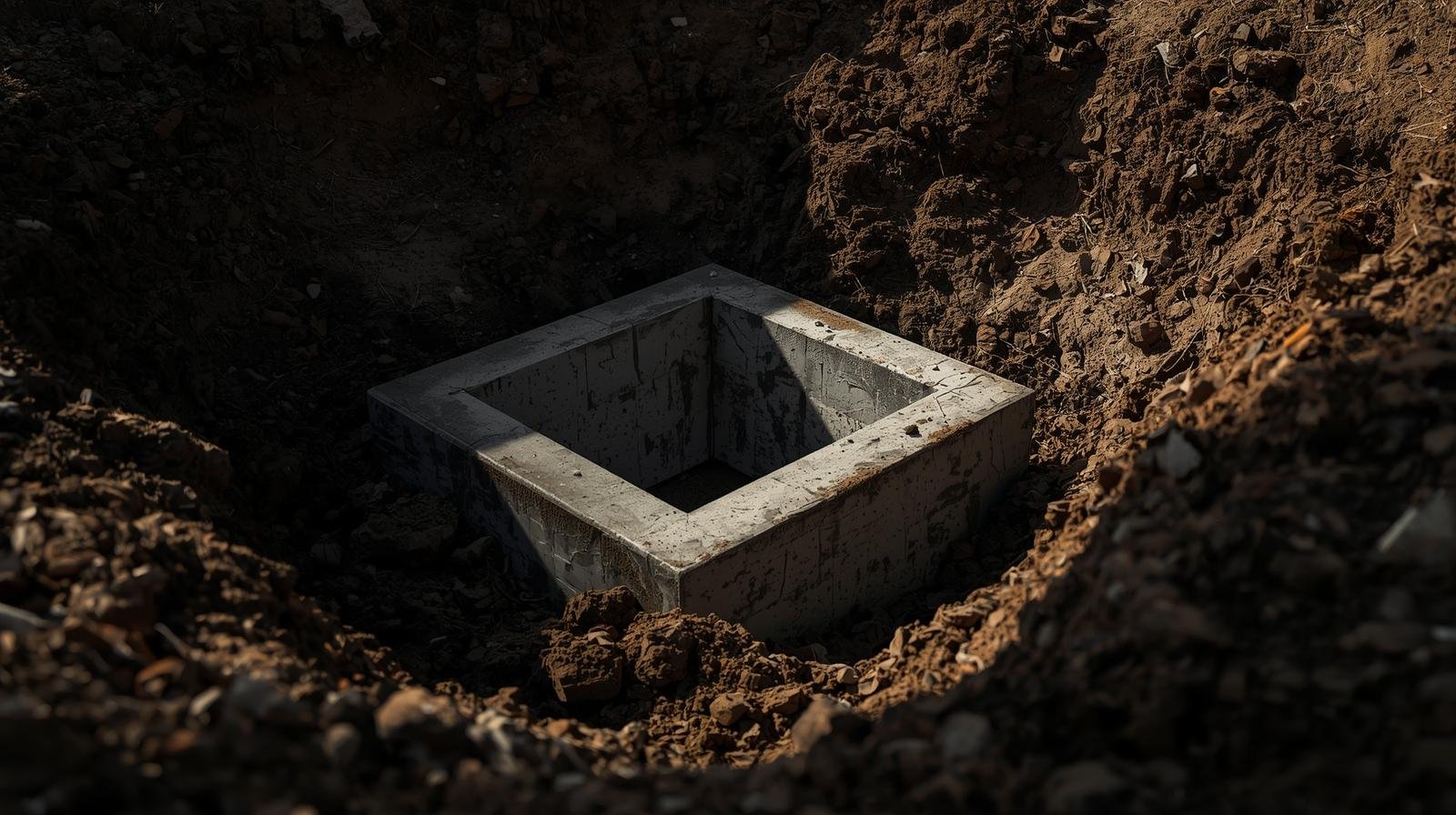
A deep foundation is a type of foundation that transfers structural loads to deeper soil layers or bedrock when the upper soil strata are too weak to support the structure safely. Deep foundations are commonly used in high-rise buildings, bridges, marine structures, industrial plants, and heavy construction projects where surface soil has low bearing capacity. Unlike shallow foundations, deep foundations extend significantly below ground level to reach stable soil or rock capable of carrying heavy loads without excessive settlement. Proper design and execution of a deep foundation system ensure structural stability, safety, and long-term durability.
What Is a Deep Foundation?
A deep foundation is constructed at a depth greater than its width and is typically used when suitable bearing soil is not available near the surface. These foundations transfer load either through end bearing, skin friction, or a combination of both mechanisms. End bearing occurs when the foundation rests on hard rock or strong soil, while skin friction develops along the surface area of the embedded structural element. Deep foundations are essential in areas with soft clay, loose sand, filled soil, or high groundwater levels.
When Is Deep Foundation Required?
Deep foundations are necessary when the soil near the ground surface is weak or highly compressible. They are also required when the building loads are extremely heavy, such as in skyscrapers or bridge piers. Construction in waterlogged areas, coastal regions, and riverbeds often demands deep foundation systems. Additionally, structures subjected to uplift forces, lateral loads, or seismic activity benefit from deep foundation support.
Types of Deep Foundation
Pile Foundation
Pile foundation is the most widely used deep foundation system. It consists of long, slender columns made of reinforced concrete, steel, or timber that are driven or bored deep into the ground. Piles transfer structural loads through end bearing on hard strata or through friction along their surface. There are two main types of piles: driven piles and bored piles. Driven piles are hammered into the ground using heavy equipment, while bored piles are constructed by drilling holes and filling them with reinforced concrete. Pile foundations are commonly used in high-rise buildings, bridges, offshore platforms, and large industrial structures.
Pier Foundation
Pier foundation is constructed by drilling large-diameter cylindrical holes into the ground and filling them with reinforced concrete. Unlike piles, piers have a larger cross-sectional area and are suitable when stable soil exists at moderate depth. Pier foundations are commonly used in residential construction and medium-load commercial buildings. They are economical compared to pile foundations when soil conditions allow moderate-depth support.
Caisson Foundation (Well Foundation)
Caisson foundation, also known as well foundation, is a watertight structure used primarily in bridge construction and underwater projects. It is sunk into the ground or riverbed and filled with concrete to form a solid base. Caissons can be open, box, or pneumatic types depending on construction conditions. This type of deep foundation is suitable for heavy structures and locations with flowing water.
Load Transfer Mechanism in Deep Foundation
Deep foundations transfer structural loads through two primary mechanisms. End-bearing piles transfer load directly to a strong soil layer or rock at the bottom. Friction piles transfer load through skin friction between the pile surface and surrounding soil. In many cases, both mechanisms work together to ensure structural stability.
Advantages of Deep Foundation
Deep foundations provide high load-carrying capacity and are suitable for weak surface soils. They minimize settlement and improve resistance against lateral forces such as wind and earthquakes. Deep foundation systems are highly durable and suitable for challenging environmental conditions. They allow construction of tall and heavy structures even on soft or unstable ground.
Limitations of Deep Foundation
Deep foundations are generally more expensive than shallow foundations due to specialized equipment and labor requirements. Construction time is longer, and quality control is critical. Proper soil investigation and structural design are necessary to avoid potential failure.
Construction Process of Deep Foundation
The process begins with detailed geotechnical investigation to determine soil properties and depth of stable strata. Layout marking and positioning of foundation elements follow. Depending on the type, piles the type, piles are driven or bored into the ground. Reinforcement cages are placed, and concrete is poured. In the case of caisson foundations, sinking and filling operations are carefully controlled. Proper curing and testing ensure structural integrity.
Applications of Deep Foundation
Deep foundations are widely used in skyscrapers, bridges, transmission towers, marine structures, dams, and heavy industrial plants. They are ideal for locations with soft clay, loose sand, reclaimed land, and high groundwater levels.
Difference Between Shallow and Deep Foundation
Shallow foundations transfer loads near the ground surface and are suitable when soil has adequate bearing capacity. Deep foundations extend to greater depths to reach stronger soil layers. While shallow foundations are economical and simple to construct, deep foundations are necessary for heavy loads and weak surface soils.
Conclusion
A deep foundation is essential for structures built on weak soil or subjected to heavy loads. By transferring loads to deeper stable strata, deep foundations ensure structural safety, minimize settlement, and enhance durability. Proper design, soil investigation, and construction practices are critical for achieving long-term performance. Selecting the appropriate deep foundation system guarantees that even the most demanding construction projects remain stable and secure for decades.