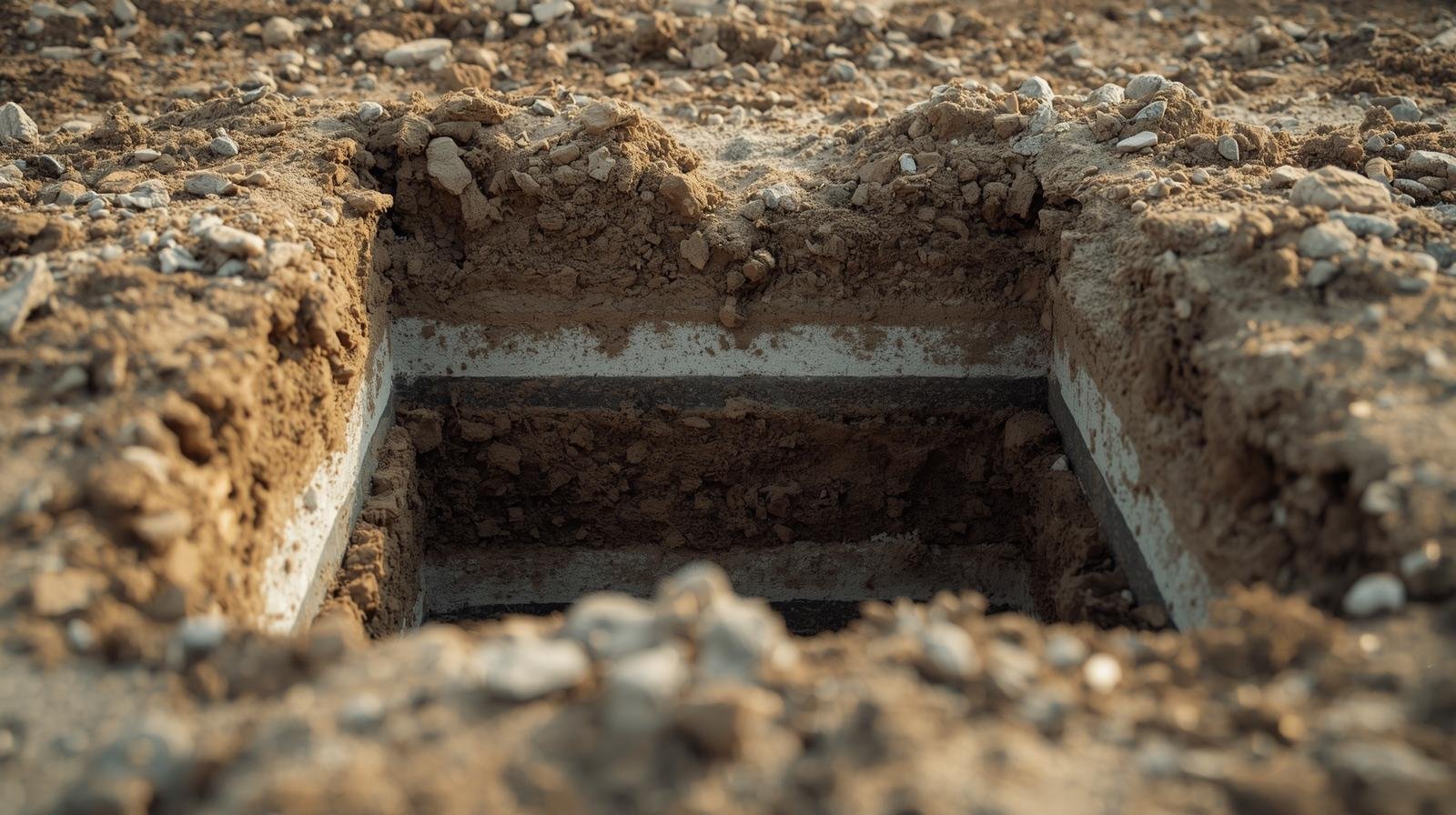
A shallow foundation is a type of foundation that transfers structural loads to the soil at a relatively small depth, usually less than three meters below ground level. It is one of the most commonly used foundation systems in residential and low-rise commercial construction because of its simplicity, cost-effectiveness, and ease of construction. Shallow foundations are suitable where the soil near the surface has adequate bearing capacity to support building loads safely without excessive settlement. Proper design of a shallow foundation ensures uniform load distribution, structural stability, and long-term durability.
What Is a Shallow Foundation?
A shallow foundation is constructed close to the ground surface and spreads the load of the building over a large area. It reduces the pressure on the soil by increasing the contact area between the structure and the ground. This type of foundation is preferred when the upper soil layers are strong enough to carry structural loads without requiring deep excavation. It is widely used in houses, small offices, schools, and low-rise buildings.
Depth Criteria of Shallow Foundation
A foundation is considered shallow when its depth is less than or equal to its width. In most cases, the depth ranges between 0.8 meters and 3 meters depending on soil condition and structural load. If suitable bearing soil is available at a shallow depth, this foundation type becomes the most economical choice.
Types of Shallow Foundation
Isolated Footing
An isolated footing supports a single column and is one of the simplest forms of shallow foundation. It is generally square, rectangular, or circular in shape and constructed using reinforced concrete. This footing is suitable when columns are spaced apart and soil has good bearing capacity. It is commonly used in residential construction.
Combined Footing
Combined footing supports two or more columns when they are close together or near property boundaries. It distributes loads evenly and prevents uneven settlement. It may be rectangular or trapezoidal depending on load conditions. This shallow foundation type is common in commercial buildings.
Strip Footing (Wall Footing)
Strip footing runs continuously under load-bearing walls. It spreads the wall load evenly across the soil. This type of shallow foundation is widely used in masonry buildings and low-rise structures where walls carry structural loads.
Raft Foundation (Mat Foundation)
A raft foundation consists of a large reinforced concrete slab covering the entire building footprint. It supports multiple columns and walls simultaneously. It is used when soil bearing capacity is low and individual footings would overlap. Raft foundations reduce differential settlement and improve structural stability.
Advantages of Shallow Foundation
Shallow foundations offer several benefits in suitable soil conditions. They are economical compared to deep foundations because they require less excavation and material. Construction is faster and simpler. Inspection and quality control are easier due to shallow depth. Maintenance and repair are also more convenient.
Limitations of Shallow Foundation
Shallow foundations are not suitable for weak or highly compressible soils. They cannot support extremely heavy loads such as those from high-rise buildings. In areas with high groundwater levels, additional waterproofing measures may be required.
Factors Affecting Selection of Shallow Foundation
The selection depends on soil bearing capacity, structural load, groundwater level, climate conditions, and budget constraints. Soil testing and proper structural analysis are essential before finalizing the foundation type.
Construction Process of Shallow Foundation
The construction begins with site clearance and layout marking. Excavation is carried out to the required depth. The base is compacted and a lean concrete layer may be placed. Reinforcement is fixed according to structural design, followed by concrete pouring. Proper curing is done to achieve required strength.
Applications of Shallow Foundation
Shallow foundations are widely used in residential buildings, small commercial structures, warehouses, schools, and light industrial units. They are ideal where soil conditions are stable and loads are moderate.
Conclusion
A shallow foundation is a practical and economical solution for many construction projects where surface soil has sufficient bearing capacity. With proper design and construction, shallow foundations provide stability, durability, and long-term performance. Understanding its types, advantages, and limitations ensures safe and efficient building construction.