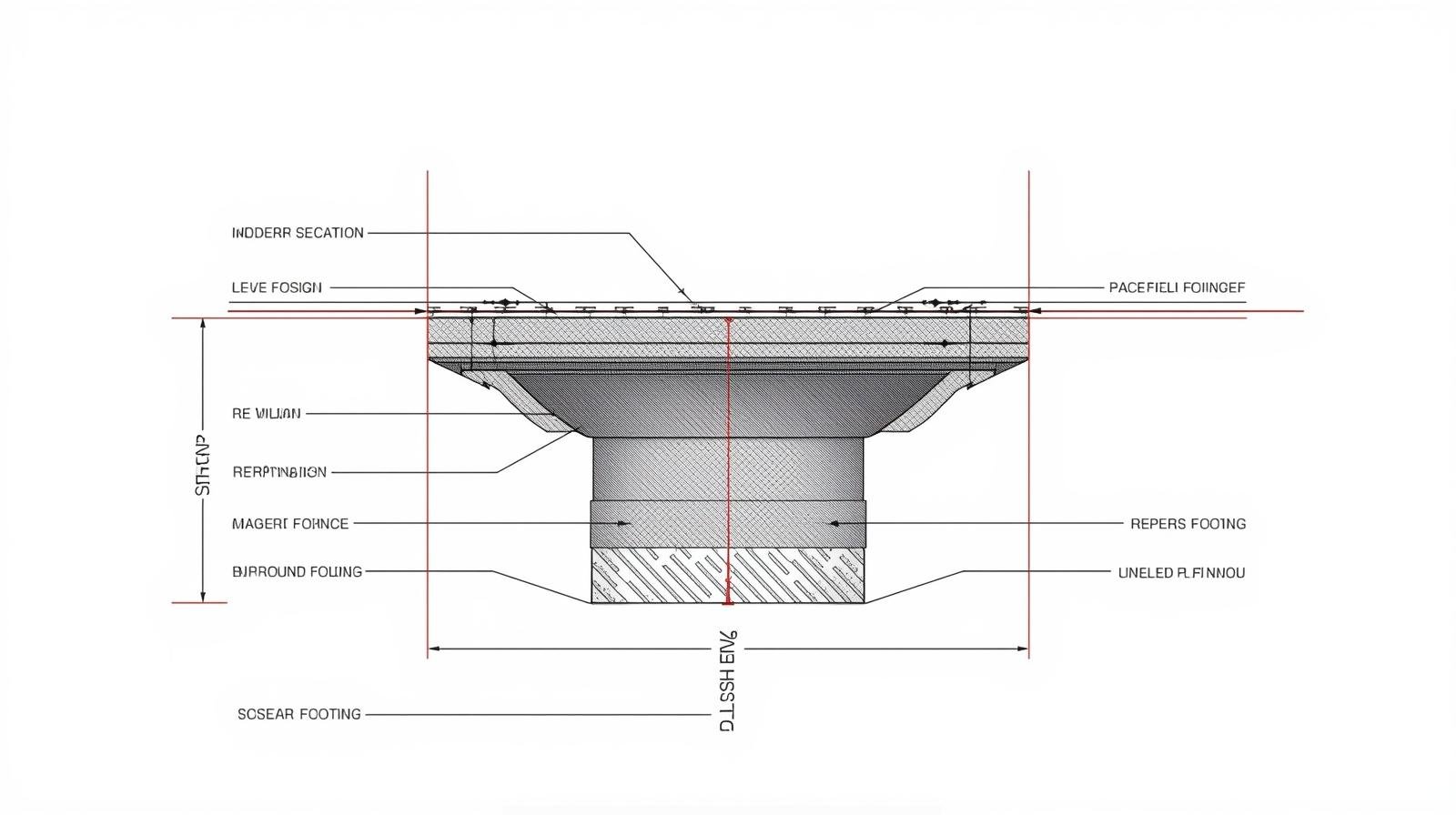
Pedestal footing is a commonly used foundation type in building construction where a short vertical concrete member, called a pedestal, is provided between the footing base and the column. The main purpose of a pedestal footing is to safely transfer the load of the column to the soil while reducing stress concentration. This type of footing is simple in design, economical, and widely used in low-rise and medium-load structures.
What Is Pedestal Footing
A pedestal footing consists of a plain or reinforced concrete footing at the bottom and a pedestal above it that supports the column. The pedestal acts as a load-distributing element and helps in raising the column above ground level. Pedestal footing is generally adopted when the column load is moderate and soil bearing capacity is adequate.
Why Pedestal Footing Is Used
Pedestal footing is used to improve load transfer efficiency and construction convenience. It helps align columns properly, reduces direct stress on the footing slab, and provides better control over column positioning. This footing type is especially useful where columns are small in size but loads are relatively concentrated.
Key Reasons for Using Pedestal Footing
- Better distribution of column load to footing
- Reduced bending stress in footing slab
- Easy construction and alignment of columns
- Economical solution for moderate loads
Types of Pedestal Footing
Pedestal footings are classified based on reinforcement and load requirements.
Plain Cement Concrete Pedestal Footing
This type is used for very light loads where soil bearing capacity is high. No reinforcement is provided, and the footing relies mainly on compressive strength.
Reinforced Cement Concrete Pedestal Footing
This is the most commonly used type where moderate column loads are present. Reinforcement is provided in the footing slab and sometimes in the pedestal for added safety.
Design Considerations for Pedestal Footing
Design of pedestal footing depends on column load, soil bearing capacity, and structural requirements. The footing area is calculated based on safe bearing capacity of soil. Pedestal height and width are designed to safely transmit loads without crushing or excessive stress. Reinforcement is provided when tensile stresses exceed permissible limits.
Important Design Factors
- Column load and size
- Safe bearing capacity of soil
- Footing thickness and size
- Pedestal height and cross-section
- Minimum reinforcement requirements
Construction Procedure of Pedestal Footing
The construction process of pedestal footing is straightforward and follows standard foundation practices. Excavation is done up to the required depth, followed by leveling and PCC bedding. Footing concrete is then placed with proper compaction. After footing gains initial strength, the pedestal is cast, and finally the column is constructed.
Basic Construction Steps
- Site excavation and leveling
- PCC bed preparation
- Casting of footing slab
- Casting of pedestal
- Column construction
Advantages of Pedestal Footing
Pedestal footing offers several structural and economic advantages in suitable conditions.
Main Advantages
- Simple design and construction
- Cost-effective for low to moderate loads
- Reduces stress concentration under columns
- Requires less reinforcement compared to other footings
- Suitable for normal soil conditions
Limitations of Pedestal Footing
Despite its benefits, pedestal footing has some limitations. It is not suitable for very heavy loads or weak soils. In such cases, combined footing, raft foundation, or pile foundation may be required. Proper soil investigation is essential before adopting pedestal footing.
Applications of Pedestal Footing
Pedestal footing is commonly used in residential buildings, small commercial structures, sheds, and industrial buildings with moderate column loads. It is also used in structures where columns need to be raised above ground level to avoid moisture or flooding issues.
Pedestal Footing vs Isolated Footing
Pedestal footing is similar to isolated footing but includes an additional pedestal member. While isolated footing directly supports the column, pedestal footing provides an intermediate load-transfer element. This makes pedestal footing more suitable when column dimensions are small but loads are relatively high.
FAQs on Pedestal Footing
What is the purpose of a pedestal in footing
The pedestal helps distribute column load evenly to the footing and provides proper alignment and elevation for the column.
Is pedestal footing reinforced
Pedestal footing can be plain or reinforced depending on load and design requirements. RCC pedestal footing is more common in practice.
Where is pedestal footing commonly used
Pedestal footing is used in residential buildings, low-rise commercial structures, and industrial sheds with moderate loads.
Is pedestal footing suitable for weak soil
No, pedestal footing is not suitable for weak or highly compressible soil. Alternative foundations are preferred in such cases.
Conclusion
Pedestal footing is a simple, efficient, and economical foundation solution for structures with moderate loads and good soil conditions. By providing a pedestal between the footing and the column, it improves load transfer and construction accuracy. When properly designed and constructed, pedestal footing ensures stability, safety, and long-term performance of the structure.