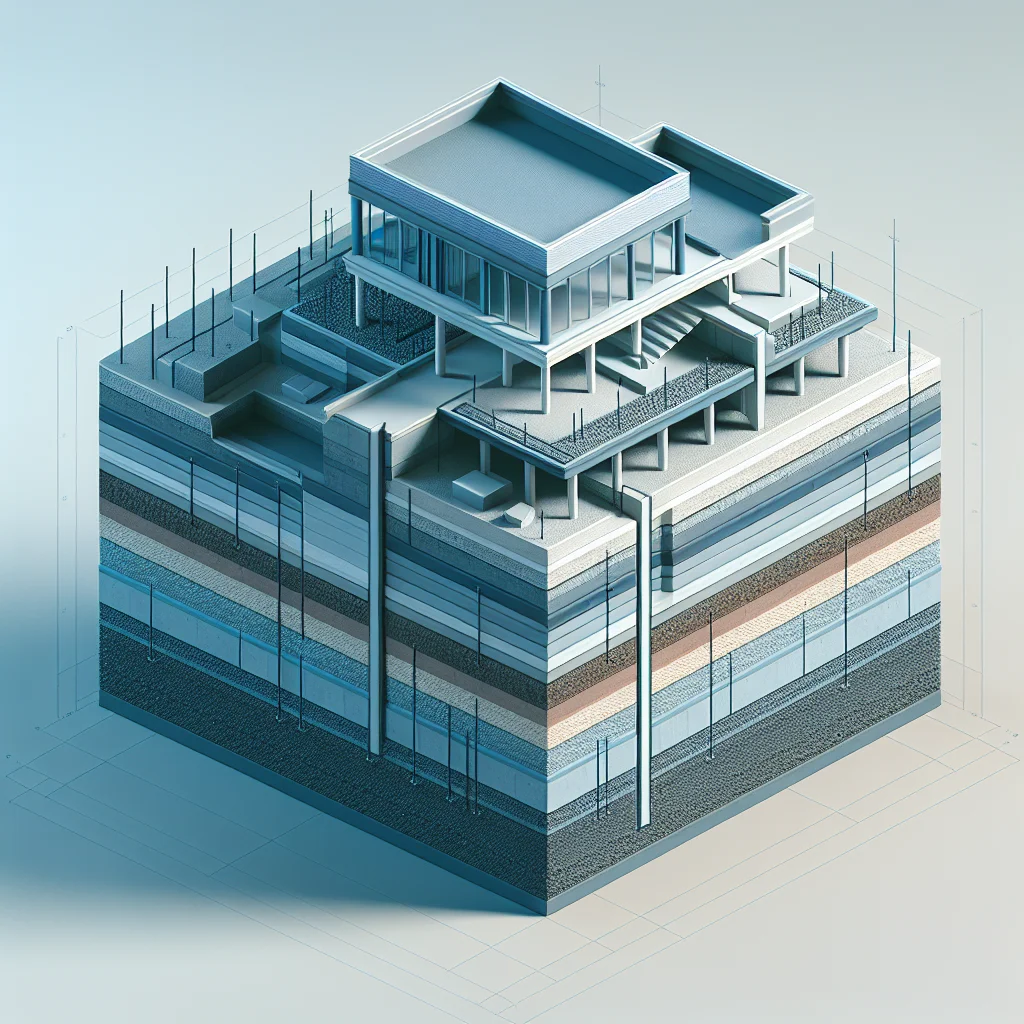
Strong supports start with clear thinking about loads, soil behavior and the link between design and construction. This article explains practical approaches to designing foundations that perform well under realistic site conditions.
It focuses on core concepts, common foundation systems, site investigation essentials, material considerations and quality practices that reduce risk and cost while improving long-term performance.
Key principles that shape foundation design
Design begins with understanding what the structure transfers to the ground and how the ground reacts. Loads, settlement tolerance and the acceptable level of risk guide all decisions.
Design choices balance safety, durability and economy. That means selecting systems that match site soils, construction access and expected service life.
Load characterization
Identify dead, live and environmental loads, and translate them into vertical and lateral demands at the foundation level. Dynamic or concentrated loads need special attention to avoid unexpected settlements or rotation.
Settlement limits and tolerances
Different structures tolerate different amounts of settlement. Residential buildings accept smaller absolute movement but can tolerate differential settlement differently than industrial structures. Design must quantify allowable movement and check predicted settlement against it.
Factor of safety and design philosophy
Use appropriate safety factors and consider serviceability as well as ultimate strength. Local codes set minimums, but prudent practice often calls for checks beyond basic requirements, particularly where soils vary widely.
Subsurface investigation and analysis
A solid subsurface study reduces surprises during construction. It reveals soil stratigraphy, groundwater, and potential hazards such as compressible layers or collapsible soils.
Testing and careful interpretation allow realistic estimates of bearing capacity, compressibility and lateral resistance, all critical inputs to foundation sizing and detailing.
Field exploration techniques
Boreholes, standard penetration tests, cone penetration tests and trial pits each bring different strengths. Combine methods to map variability across the site, not just a single spot.
Laboratory tests and what they tell you
Grain-size analysis, Atterberg limits, consolidation and shear tests help predict settlement and strength. Proper sampling and testing practices are essential to get reliable design parameters.
Groundwater and seasonal changes
Record groundwater levels and their seasonal fluctuation. Rising or fluctuating water tables influence effective stress and can reduce bearing capacity or cause heave in sensitive soils.
Common foundation systems and selection criteria
Choosing a foundation system depends on loads, soil conditions, project budget and construction constraints. Understanding the trade-offs helps find the most efficient option.
Below are common systems with notes on typical use cases and limitations to help match site needs with structural demands.
Shallow spread footings
Used where competent soils are near the surface. Footings transmit loads directly to the soil and are economical for low- to mid-rise buildings.
- Advantages: simple, low cost, easy to construct.
- Limitations: not suitable over soft or highly variable soils or where large column loads cause excessive settlement.
Raft or mat foundations
Mats spread loads over the entire building footprint, reducing differential settlement and providing a stiff base under weak soils. They are useful where many columns are closely spaced or when soil improvement is costly.
- Advantages: reduces differential movement, efficient for heavy slabs.
- Limitations: can be expensive in terms of concrete and reinforcement; needs careful control of slab bending and cracking.
Deep foundations: piles and drilled shafts
Deep elements transfer loads to stronger soil or rock at depth. Piles can be driven or cast in place; drilled shafts (caissons) provide larger diameter capacity where high loads or obstructions exist.
- Advantages: supports heavy loads, bypasses weak surface layers.
- Limitations: higher cost, requires specialized equipment and quality control of installation.
Ground improvement options
Soil replacement, compaction, grouting, and stone columns can improve weak layers to permit shallow foundations or reduce settlement. Selection depends on depth of weakness and access.
- Advantages: can be more economical than deep foundations in some sites.
- Limitations: effectiveness varies with soil type and treatment quality.
Design process and calculations
Design is iterative: start with soil data and loads, propose a system, run calculations, and adjust until performance targets are met. Modern software helps but sound engineering judgment remains essential.
Key checks include bearing capacity, settlement, lateral stability and constructability. Each requires different inputs and has different sensitivity to soil variability.
Bearing capacity checks
Compute ultimate and allowable capacities using recognized methods, then apply safety factors. Account for eccentricity, overlapped loads and potential scour or erosion near the foundation.
Settlement analysis
Estimate immediate and consolidation settlement separately. Immediate settlement follows elastic response of soils; consolidation reflects time-dependent volume change in saturated fine-grained layers.
Lateral and uplift resistance
Calculate lateral load capacity using p-y curves or equivalent methods. For uplift, consider shaft friction, base resistance and anchorage systems when tension loads are present.
Materials selection, construction and quality control
Material choices and construction practices influence long-term performance. Durable materials, proper reinforcement detailing and vigilant inspection reduce maintenance and repair costs.
Quality control during construction ensures the design intent is realized and avoids costly post-construction fixes.
Concrete and reinforcement considerations
Specify concrete strength, cover and reinforcement detailing to resist expected loadings and environmental exposure. Proper curing and placement practices are crucial for strength and durability.
Pile and shaft installation controls
Monitor installation parameters like driving resistance or torque, and test load capacity where required. Misplaced or damaged elements reduce capacity and cause uneven settlements.
Site supervision and documentation
Maintain clear records of soil conditions, material tests and as-built dimensions. These records help resolve disputes and provide useful data for future work at the site.
Conclusion
Sound foundation work ties thoughtful analysis to practical construction. A clear assessment of soil behavior, careful system selection and strict quality controls produce supports that resist settlement and maintain structural integrity.
Investing effort in the early stages—accurate subsurface data, realistic calculations and robust construction oversight—lowers lifecycle costs and reduces risk.
Frequently Asked Questions
How deep should investigations extend beneath the planned foundations?
Investigations should reach layers that influence bearing and settlement. As a rule of thumb, explore to depths several times the foundation width or until reaching a competent stratum, but adjust depth for site history and geologies.
When is a mat slab better than individual footings?
A mat works well when soil is weak but relatively uniform, or when many columns are closely spaced. It spreads loads and reduces differential settlement compared to isolated footings.
What are signs of unacceptable settlement during construction?
Monitor tilting, misaligned openings, sudden cracks, and uneven floors. Small movements can be acceptable, but rapid or uneven changes indicate a need to reassess the support system promptly.
Can ground improvement replace deep foundations in all cases?
Not always. Ground improvement is effective for certain soils and depths but may be impractical where deep weak layers exist or loads are exceptionally high. A comparative cost and performance analysis will help decide.
How important is testing of installed piles or shafts?
Testing validates that elements meet capacity expectations and reveals installation issues. Static load tests, dynamic monitoring and integrity tests are valuable tools to confirm performance and reduce uncertainty.